
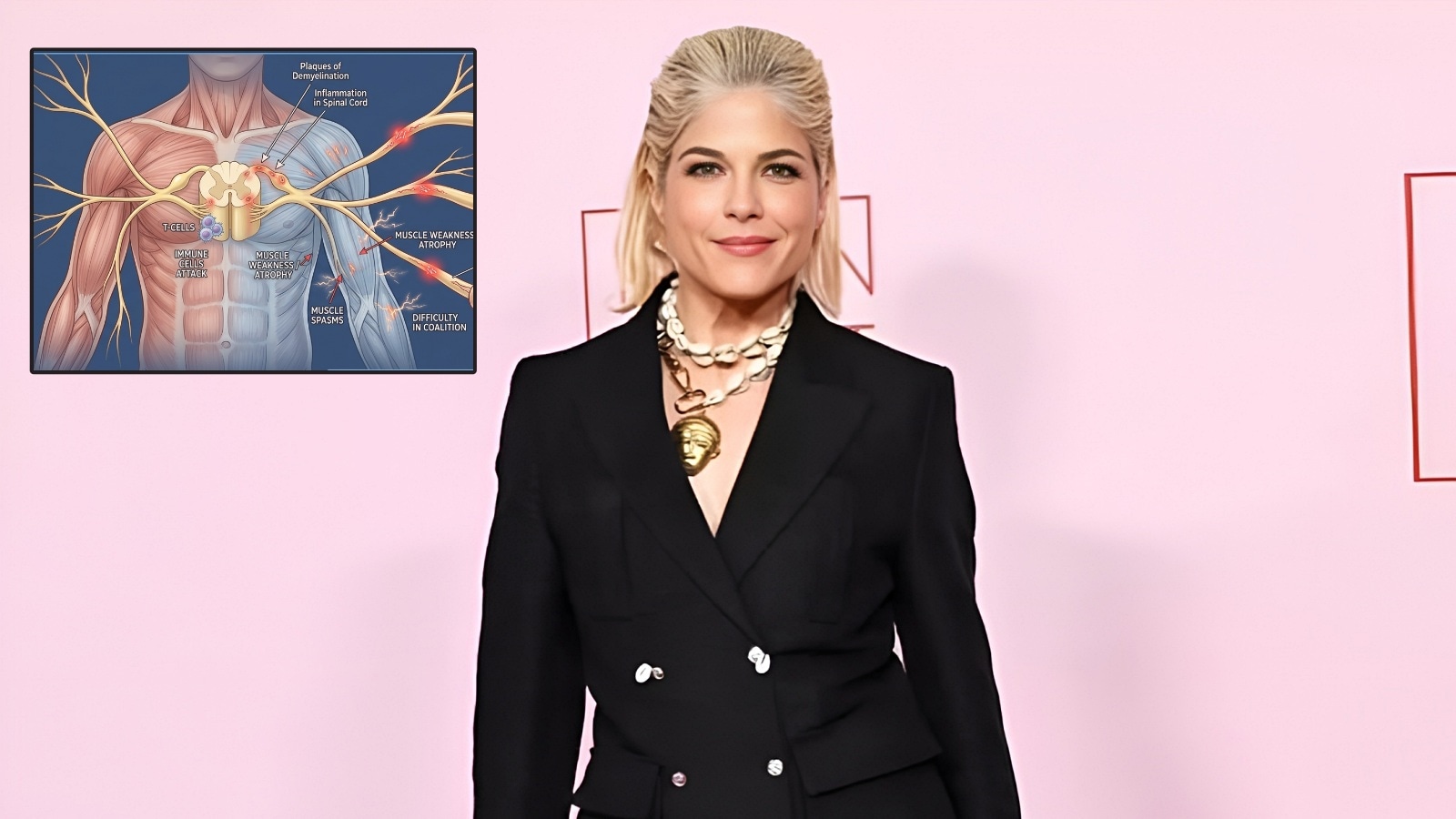
For years, actor Selma Blair spoke openly about the exhaustion, uncertainty and quiet resilience that came with living with Multiple Sclerosis (MS). In this autoimmune disease, the body attacks the nerves, causing symptoms like fatigue, weakness, and difficulty with movement or thinking.
Blair shared how much of her time after diagnosis was spent simply trying to get through each day. Now, she finally has space to think beyond survival.
Blair has revealed that she is “truly relapse-free” — a moment that marks not just medical progress, but an emotional shift towards reclaiming energy, ambition and the ability to dream again.
DISCLAIMER: This article is based on information from the public domain and/or the experts we spoke to. Always consult your health practitioner before starting any routine.
Speaking to People at The Daily Front Row’s 9th Annual Fashion Los Angeles Awards in April 2025, Blair said her health has improved significantly over the past year. “I am doing amazingly well. I’ve been feeling great for about a year,” she said.
The Legally Blonde actress explained that having more energy has changed how she experiences everyday life: “But I am finally well enough to really, genuinely … I always try and feel my best, but now that I actually have stamina and energy and getting out and going out isn’t so scary.”
 . “You’re just tired all the time. I spent so much of my life so tired from being unwell that I think I just was trying to get through the day.”: Blair recalls earlier days of MS (Image: IG)
Blair, who was diagnosed in 2018, said living with the condition for years meant she was often just trying to get through the day. “I think maybe since the diagnosis,” she said. “You’re just tired all the time.”
Story continues below this ad
“I spent so much of my life so tired from being unwell that I think I just was trying to get through the day.” Now, as her health stabilises, her focus is shifting.
“I haven’t spent enough time having dreams. And now it’s like, what are my dreams?” “And now it’s like, wait, I realize I don’t know what my goals are.” The actress revealed that she is now more hopeful of the future, which she believes is going to be “much more career-oriented” going forward.
What does “relapse-free” actually mean?
According to Dr Atampreet Singh, Senior Director & Head – Neurosciences, ShardaCare-Healthcity, the term has a specific medical meaning.
“Being relapse-free means a person has not experienced any new or worsening neurological symptoms for a defined period — typically twelve months or more.”
Story continues below this ad
He adds that while this is encouraging, it does not mean the disease is gone. MS can still cause internal changes without obvious symptoms — something known as subclinical activity.
“It is an encouraging sign, but it does not mean the disease has stopped, the actress said while adding that the relapse-free status tells us is that the “current treatment is working well — suppressing the visible attacks.”
Because of this, patients still need regular monitoring through scans and clinical evaluations.
Why fatigue still affects patients
Even when someone appears healthy, MS fatigue can continue to impact daily life. “It is not common fatigue,” notes Dr Singh while explaining that it is a result of the disease itself, since “the damaged nerve pathways demand much more energy to conduct signals. Tis means a person may look fine externally but feel completely drained.
Story continues below this ad
Living with MS today
The long-term outlook for MS has improved significantly with modern treatment. “A lot of people with MS live full, active, productive lives,” says Dr Singh.
Treatment focuses on reducing relapses, slowing disability, and maintaining quality of life — through medication, physiotherapy, lifestyle changes, and regular monitoring. “MS is a life-long, but not a life-limiting condition… patients can create their own normal,” he further assures.
Blair’s update highlights something many people with chronic illness understand deeply — when your health stabilises, it’s not just your body that heals, but your ability to imagine a future again.
DISCLAIMER: This article is based on information from the public domain and/or the experts we spoke to. Always consult your health practitioner before starting any routine.

Leave a Reply