
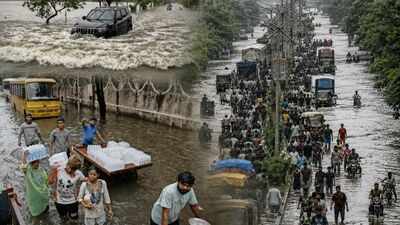
MUMBAI: Monsoons have been a part of Mumbai’s life always. However, what the city has witnessed in the past week is beyond the definition of a “normal” Mumbai monsoon.Between June 30 and July 6, two key observatories of the India Meteorological Department (IMD) recorded massive amounts of rainfall. Colaba recorded almost 883 mm during the seven-day period while Santacruz got nearly 989 mm. Updated numbers for the first week of July pushed Santacruz’s total over 1,000 mm, beating what the station received in the entire month of July last year.
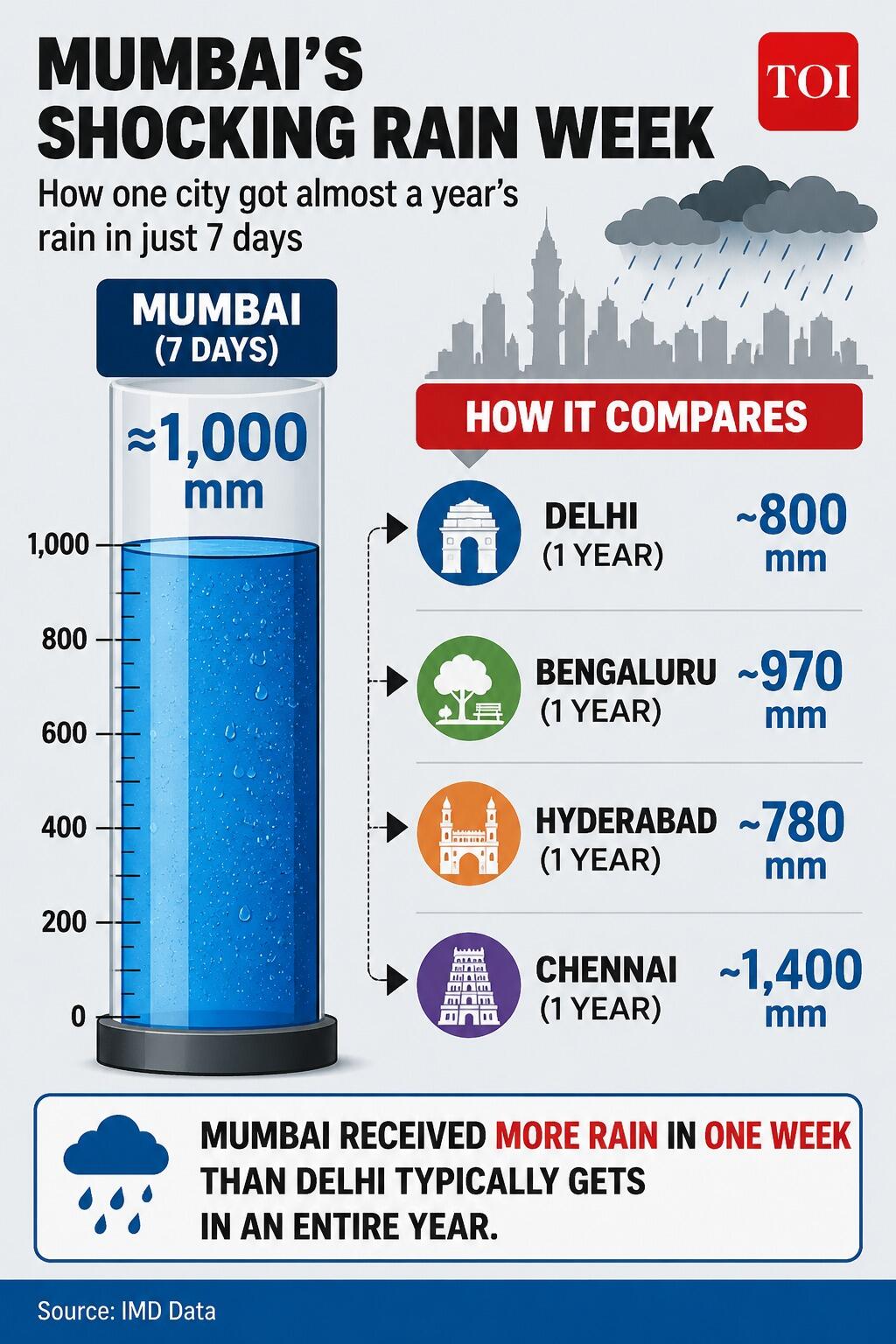
Mumbai’s shocking rain week
When compared to annual rainfall elsewhere in India, the figures are even more striking. In a week, Mumbai received more rain than Delhi typically gets in a year, nearly matched Bengaluru’s annual rainfall and surpassed the annual averages of some of India’s biggest cities.The comparison points to a larger story than just flooded roads and delayed trains. It is a reflection of how climate change is increasingly altering rainfall patterns across India – not necessarily by dramatically increasing seasonal rainfall, but concentrating huge amounts of rain into much shorter periods.Days of rain packed into a yearThe city has an average annual rainfall of 2,200-2,500 mm, with July being the wettest month. In the old days, rain would fall over a period of weeks with a mixture of moderate and heavy showers. The heavy spells were not uncommon, but were interspersed with relatively lighter days, allowing drainage systems and rivers to recover gradually. But, that trend is changing more and more.Mumbai is not having a steady rain over the season but a series of “cloudburst-like” rain episodes one after another when several hundred millimetres fall in 24 to 48 hours. This year shows that shift in stark terms.In fact, the city received over 60% of its average seasonal rainfall in just six days. Before the month was a week old, rainfall also exceeded the city’s normal July average in many places. Climate scientists care about more than just how much rain falls in total.It’s the ferocityClimate change is altering the way it rains. Warmer air can hold more water vapor. For every one degree Celsius increase in temperature, the atmosphere can hold about 7 % more water vapor. That added moisture is rapidly released as extremely intense rainfall when weather systems are favorable. In addition, the Arabian Sea has been warming steadily over the past decades.
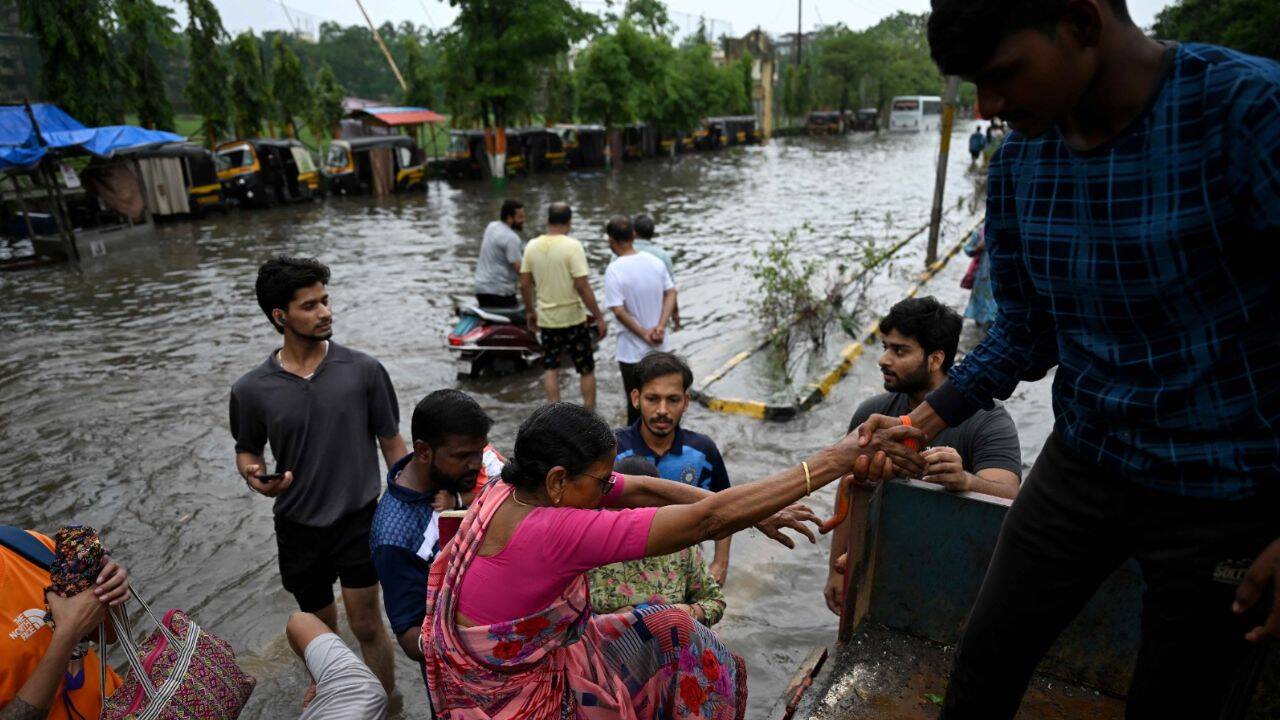
Flood-hit Nalasopara residents rely on tractors.
Monsoon systems carry more moisture towards India’s west coast because warmer sea surface temperatures cause more evaporation. These moisture-laden winds hit the Western Ghats and rise rapidly, cool and shed huge amounts of rain over Mumbai and neighbouring districts.Scientists say that not every heavy rainfall event is caused by climate change. It makes already favorable weather systems much more intense.And this is why rainfall records are being broken more and more. Not because monsoons are getting uniformly wetter, but because the rainfall is coming in shorter, more concentrated bursts.Why Mumbai still can’t get flood planning right – even after decadesWhat every great flood asks: Why does a little rain still bring Mumbai to a standstill? Thousands of crores have been spent by the city since the devastating floods of 2005. Storm water drains have been widened. Built pumping stations. Floodgates have been enhanced.Several desilting and widening projects have been carried out on the Mithi River. But many of the same neighbourhoods still suffer from water-logging. Part of the answer is infrastructure limits.Most urban drainage systems are designed using rainfall assumptions based on historical weather records. And when the intensity of the rainfall regularly exceeds these design standards, even upgraded systems can’t handle it.
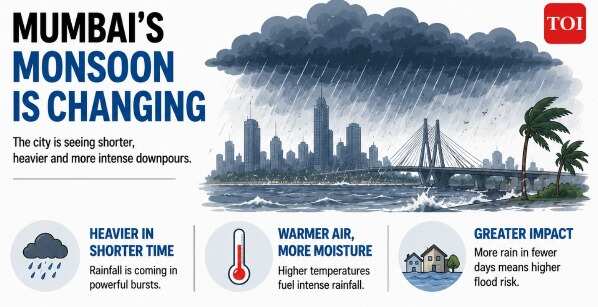
Mumbai’s monsoon is changing.
For example, when 200-300 mm falls in a matter of hours, drains cannot drain the water away fast enough.This is compounded by the high tide which simultaneously stops storm water from draining into the sea, a perpetual issue specific to Mumbai’s coastal geography. IMD has issued warning for high tides during the recent heavy rains coinciding with intense rainfall, which further increases the flood risks.Urbanisation is exacerbating the problemIt’s not just climate change that’s making Mumbai flood. The capacity of the city to absorb rainfall has been diminished by urban development. Huge areas of wetlands, mangroves, marsh and open ground have been gradually replaced by roads, buildings and concrete surfaces. Rainwater that used to soak into the ground now almost immediately runs off onto streets.Encroachment on natural drainage channels further retards the movement of water. Construction waste, silt and plastic waste often choke drainage capacity in the monsoon. This results in a city where heavy rainfall leads to immediate runoff, even with upgraded drainage infrastructure.Growing public frustrationApart from the weather, the monsoon rain this year has added to the woes of many Mumbaikars. Social media is flooded with videos of flooded roads, stranded vehicles, overflowing drains and commuters trapped for hours.A large number of citizens argue that flood is no longer an exceptional event but is expected to be happening in each monsoon.

Floodwaters turn streets into waterways.
Concerns are growing over: If drainage projects are keeping up with changing rainfall patterns. If flood mitigation planning is still using old rainfall benchmarks. Whether adequate wetlands and natural flood buffers continue to be protected.Has climate adaptation become a core concern of urban planning? The discussion has moved from “Why did it flood?” to “Why are we still unprepared when we know that rainfall extremes are becoming more frequent?”Lessons learned from a changing climateMumbai has always had spectacular extremes in rainfall history. The benchmark remains July 26, 2005 when the Santacruz observatory logged 944 mm in just 24 hours, one of the city’s worst disasters. But as the climate warms, experts warn, what was once considered “once-in-a-generation” events could start happening more often.That doesn’t mean all years will be record breakers. Rather, the variability of the rainfall is increasing.Cities could experience longer periods of dry weather followed by extremely heavy rains in a few days. This makes for a tough planning problem. Infrastructure built for average rainfall may not be sufficient when extreme rainfall becomes the norm.More than rain totalsSo Mumbai’s extraordinary week of rain is not just another monsoon statistic. It’s evidence of a changing climate hitting one of the world’s most densely populated coastal megacities.Many will recall the almost 1,000 mm of rain that fell in seven days, with flooded roads and transport disruption. But there is a bigger story behind those headlines. It asks tough questions about whether Indian cities are preparing for yesterday’s climate or tomorrow’s.
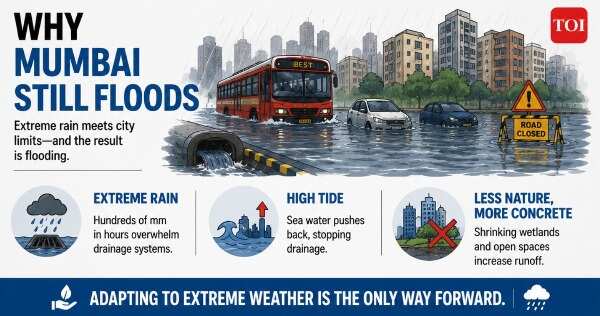
Why Mumbai still floods.
Less predictable, heavier and more frequent rain will mean resilience will require not only bigger drains and pumping stations but smarter urban planning, protection of natural flood buffers, climate-informed infrastructure design and better early-warning systems.The latest deluge in Mumbai is a reminder that the challenge is no longer just about handling the monsoon. It is adapting to a changing monsoon.

Leave a Reply