
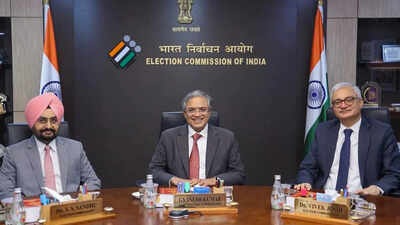
NEW DELHI: Two of three election commissioners, Sukhbir Singh Sandhu and Vivek Joshi, formally objected at least 14 times in 10 months to decisions taken in the full Commission’s name, according to an Indian Express report.On Wednesday, the Supreme Court split on the challenge to the law used to appoint them and asked the CJI to set up a five-judge bench.
Why it matters
The row lays bare three unsettled questions about election referee: who decides, who controls the voter database, and who picks the people at the top.Here are 10 questions at the centre of the controversy.
1. What exactly are the 2 EC reported to have objected to?
The objections concern some of the most basic functions of election administration.According to the Express investigation, Sandhu and Joshi raised issues involving changes to Form 6, used by new voters seeking registration; deletion and restoration of names during SIR; appeals against decisions restoring voters; and access to and control over the electoral-roll database. Some notes also questioned communications allegedly issued in the Election Commission’s name without approval of the Commission.The EC’s response is that these were inputs during decision-making, that differing opinions are natural within a multi-member body, and that final decisions ultimately had the approval of all three commissioners.
2. Can ECs disagree with one another?
Absolutely. The law explicitly expects that they sometimes will.Section 18 of the Chief Election Commissioner and Other Election Commissioners Act, 2023 says Commission business should, “as far as possible”, be conducted unanimously.“As far as possible” is the key phrase here.But it immediately provides for what happens when unanimity fails: if the CEC and Election Commissioners differ on an issue, the matter is decided according to the majority opinion.With three commissioners, the mathematics is straightforward: 2-1 decides the matter.The more intriguing issue in the current controversy is different: What happens if two commissioners say an action should not have been taken without the approval of the full Commission?
3. Is the CEC the boss of the other two?
The CEC unquestionably has an important institutional position, but the other two commissioners are not deputies who simply report to the chief.This question was fought over dramatically during T N Seshan’s tenure. The Supreme Court upheld the creation of a multi-member Election Commission and rejected the idea that the other commissioners were merely ornamental additions. Decisions could legally be taken by majority.The 2023 law reinforces the collegial structure. It says the Commission’s procedure and allocation of business may be regulated through a unanimous decision, while disagreements on substantive matters can be resolved by majority.So “Chief” does not mean the CEC has an automatic casting vote over two colleagues.In some respects, the arrangement resembles a three-judge bench more than a conventional government department headed by a secretary.
4. If disagreements are routine, why has this become such a controversy?
Because the reported disagreement is not simply over what the Commission should decide.Some of the notes reported by the Express raise an important question: Who authorised actions to be taken in the Commission’s name in the first place?In April, for example, Sandhu and Joshi separately flagged communications they said had been issued without the requisite approval of the Commission, according to the investigation.The factual question is therefore not merely whether commissioners had different views, but whether the disputed actions fell within areas requiring approval by the Commission and, if so, what approval existed.The EC says its final decisions were collectively and unanimously taken.
5. Have not Election Commissioners dissented before?
Yes.Election Commissioner Ashok Lavasa disagreed with the majority in five Model Code of Conduct cases involving complaints against PM Modi and then BJP president Amit Shah. In some cases the Commission’s final position was reached 2-1.But the current episode is not identical.The reported notes by Sandhu and Joshi relate heavily to administration of the electoral-roll system and the process by which actions were authorised, rather than commissioners being formally outvoted 2-1.And this time, the two commissioners raising concerns constitute two of the three members.
6. Should EC dissent be made public?
That question remains unresolved politically and institutionally.The case for confidentiality is that collegial bodies need room for frank internal discussion. Officials may become more guarded if every disagreement is immediately made public, particularly while elections are underway.The opposite argument is that disclosure can demonstrate that controversial decisions were debated rather than simply rubber-stamped.This is a practice followed by RBI and SC.At the RBI’s Monetary Policy Committee, the law requires publication not only of the final resolution but also how every member voted and each member’s written explanation.The Supreme Court routinely publishes majority and dissenting judgments.The Election Commission has traditionally taken a different approach. The present row has therefore revived an old question: Should an institution whose law explicitly provides for majority decisions also have a formal mechanism for publishing minority reasoning?
7. Why has electoral roll software become part of the controversy?
Because election administration is increasingly also software administration.The law places responsibility for constituency electoral rolls with statutory officials such as Electoral Registration Officers. But modern voter rolls are maintained through interconnected digital platforms.The Express investigation reports that Sandhu and Joshi questioned growing centralisation of access to the electoral database and the extent to which local statutory officials retained control. One episode cited involved 97 Goa voters who had been found eligible by electoral officials but could not immediately be restored because the software lacked the required facility at that stage, according to the report.The EC says its digital systems operate with appropriate security safeguards and that statutory election officials retain their legal powers.
8. Why SIR makes all this more consequential?
The simple answer is: Scale.The Election Commission’s Special Intensive Revision has involved electoral rolls across multiple states and Union Territories. More than 13 crore names were excluded from draft rolls during the exercise across 30 states and UTs.Exclusion from a draft roll is not necessarily permanent: Voters may make claims, submit documents and pursue appeals.But depriving any electorate from casting vote for any election, howsoever local, should be treated as a serious issue in any democracy. The system needs to find a quick way to rectify it.
Join conversation
Share your thoughts in the comments
Be respectful · TOI community guidelines
Delhi SIR exercise has created a peculiar scenario. More than 33 lakh voters have received notices over matters including “logical discrepancies”, prompting the Supreme Court to question whether some notices appeared to have been issued “mechanically” and ask whether additional filters were needed.
9. What’s the row about appointing election commissioners?
On September 23, Justices Dipankar Datta and Satish Chandra Sharma differed on selection mechanism of election commissioners. Justice Sharma favoured reference to a five-judge Constitution Bench; Justice Datta took a different view and emphasised that the EC must not only be independent but also appear independent. The matter is now to go before the Chief Justice for constitution of an appropriate bench.
10. So, what is the larger question raised by the EC row?
It is less about whether disagreement inside the Election Commission is healthy or unhealthy. A three-member constitutional body is designed to accommodate disagreement.The bigger issue is whether there are clear rules for what happens around that disagreement.It’s also about the sanctity of electoral rolls. No eligible voter should be deprived of their right to cast vote in any kind of polls.

Leave a Reply