
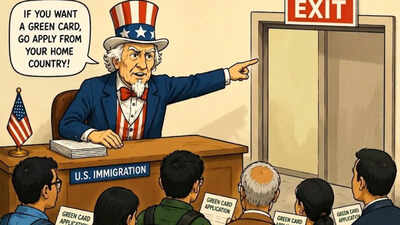
“An alien who is in the US temporarily and wants a Green Card” must return to their home country to apply, except in extraordinary circumstances, the US Citizenship and Immigration Services (USCIS) announced last week.Though the word “alien” in the announcement may have sounded routine in immigration law, but for hundreds of thousands of immigrants waiting for permanent residency, the message triggered immediate panic.For decades, one of the biggest attractions of the US immigration system was a relatively simple promise that many foreign nationals already living legally in the country could apply for permanent residency without having to leave. That long-standing understanding was suddenly thrown into question.The announcement sparked immediate panic among immigrants, creating uncertainty around the long-standing Adjustment of Status (AOS) process that allows eligible immigrants to apply for a Green Card without leaving the country. Phones at immigration law firms across the country began ringing almost instantly.“It has a chilling effect because we have some cases that we were going to proceed and I can tell already, we should wait and see what’s going on,” immigration attorney Flavia Santos Lloyd said. The announcement appeared to signal a major departure from a system that has existed for more than half a century.Under that system, many immigrants living legally in the United States, including spouses of US citizens, employment visa holders, students, refugees and asylum seekers could complete the Green Card process through a mechanism known as “adjustment of status” without leaving the country.The confusion has since deepened. A week after the announcement triggered widespread concern, the adminstration sought to clarify that there had been no blanket policy change and that immigration officers would continue exercising case-by-case discretion.However, the episode has exposed a growing uncertainty surrounding legal immigration pathways under President Donald Trump’s administration.
What exactly changed?
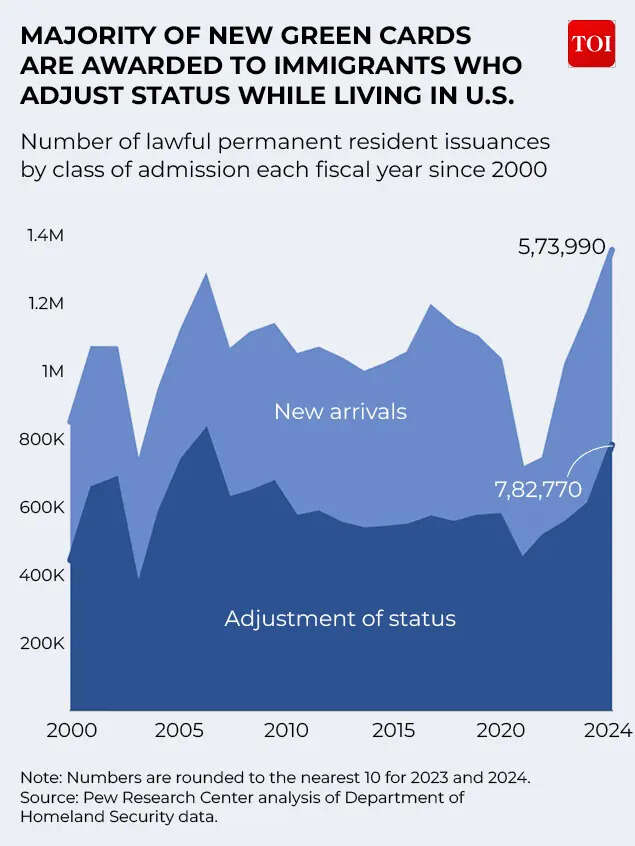
The original USCIS announcement suggested that Green Card applicants already inside the United States would need to leave and complete the process through American embassies or consulates abroad unless they qualified for unspecified “extraordinary circumstances.”That immediately raised alarms because adjustment of status has become one of the most commonly used pathways to permanent residency.According to US government data, about 1.36 million people received Green Cards during fiscal year 2024. A majority of them were already living in the United States when they obtained permanent residency.Data analysed by the Pew Research Center showed that 58 per cent of all Green Cards issued between October 2023 and September 2024 went to immigrants who adjusted their status from within the US, while 42 per cent were granted to applicants who completed the process through US consulates abroad.Of the 1,356,760 Green Cards issued during the fiscal year, 782,770 were approved through the Adjustment of Status (AOS) process, highlighting how crucial the pathway has become for immigrants already residing in the country.“The majority of people who have received Green Cards are already living in the US,” said Sahana Mukherjee, Associate Director of Race and Ethnicity Research at Pew Research Center.“The May 22 USCIS memo reinforces how adjustment of status has long been discretionary. If more applicants are directed to consular processing in their home countries, rather than adjusting status here, that could affect a large share of cases,” it added.The implications were potentially enormous. Immigration attorneys warned that forcing applicants to leave the country could create long delays, increase uncertainty and, in some cases, prevent individuals from returning to the United States altogether.
Administration walks back the announcement
As criticism mounted, a department spokesperson later said the announcement was not intended as a broad policy shift but rather a reminder that immigration officers have always possessed discretionary authority to decide whether applicants should complete the process inside the United States or abroad.“This was just a reminder to officers of their discretionary authority, which has always existed on a case-by-case basis,” a DHS spokesperson said.The department maintained that people who “legitimately and properly” qualify for Green Cards would still be able to obtain them.Officials indicated that some individuals may still be required to pursue consular processing overseas, particularly those who overstayed visas or belonged to categories that immigration officers considered higher risk.But critics argue the clarification has not eliminated uncertainty.“The public backlash has clearly sent the administration scrambling to clean up its own mess,” Sarah Pierce, a former USCIS official who now leads social policy research at Third Way said according to the New York Times. She argued that the administration’s immigration agenda has increasingly relied on creating uncertainty.
Officers begin questioning applicants?
Despite the clarification, immigration attorneys say the policy’s practical impact remains unclear because officers appear to be interpreting the guidance differently.The American Immigration Lawyers Association reported that some applicants attending Green Card interviews were asked unusual questions that had not traditionally been part of the process.Some officers have started asking green card applicants why they chose to apply for permanent residency from within the United States instead of completing the process through US consulates abroad, according to immigration attorneys.Immigration lawyers told TOI that responses from officers have varied widely. While some USCIS officers have been questioning applicants on their choice of Adjustment of Status route, others have continued approving applications without reference to the memo. A third group is reportedly delaying decisions while awaiting clearer guidance on implementation.
Although the US administration has clarified that the memo did not eliminate Adjustment of Status for holders of dual-intent visas such as H-1B and L visas, it introduced a more discretionary framework under which applicants may need to justify why they should be allowed to complete the Green Card process from within the US.Immigration attorney Rajiv S Khanna said officers may now expect applicants to present stronger justification for approval. This may include evidence of tax compliance, economic contribution, family ties, professional achievements and long-term residence in the United States.“My concern is that applicants’ experience will depend on what type of application they filed (employment or family-based), where it’s being handled, and who the officer is,” Elissa Taub, a partner at Siskind and Susser immigration law firm in Tennessee, previously told Newsweek.“Because USCIS officers are anonymous, unless there is an interview, we often do not know where our clients’ cases are being handled or who is handling them,” she added.Immigration experts say applicants should now prepare more detailed documentation for interviews or Requests for Evidence (RFEs), as scrutiny is expected to increase under the new approach.Xiao Wang, CEO of Boundless, said applicants must go beyond standard paperwork. “For employees who are cleared to proceed with an AOS application, a well-prepared filing that affirmatively documents positive factors is more important than ever,” he said.He added that this should include employer support letters highlighting specialised skills and economic contributions, proof of long-term lawful employment, tax history, and other documentation showing the applicant’s value to the US.According to immigration lawyer Mitch Wexler of Fragomen, Adjustment of Status has always been discretionary under US law, but the new memo changes the emphasis in decision-making.“What has changed is the emphasis. USCIS is now directing officers to more explicitly evaluate whether an applicant merits a favourable exercise of discretion, including whether it is appropriate for the applicant to complete the process in the US rather than abroad,” he said.Wexler said officers are now expected to consider the “totality of the circumstances” before approving applications.He noted that negative factors could include immigration violations, unlawful presence or visa misuse, while positive factors include stable employment, long-term residence, community ties, and good moral character.For EB-5 investors, strong documentation is often inherent due to job creation and capital investment requirements. Similarly, H-1B workers with established careers and long-term residence may be able to demonstrate strong ties to the US.
Family-sponsored immigrants may face biggest impact?
Although much of the public discussion initially focused on employment-based immigration, experts believe family-sponsored Green Card applicants could face the greatest disruption.Many immigrants arrive in the United States on temporary visas and later marry American citizens. Historically, they have often been permitted to remain in the country while adjusting their status.If these applicants are required to leave and apply abroad, the consequences could be severe. Individuals who have overstayed visas may trigger re-entry bans once they depart. “It’s very clear they’re trying to go after that,” Doug Rand, a former senior USCIS official during the Biden administration told NYT.“Because if now suddenly you can’t adjust status, and you have to go home to your home country, joke’s on you, now you’re barred from coming back for 10 years,” he added. That possibility has become one of the biggest sources of concern among immigration lawyers.
What about H-1B workers?
The initial announcement also triggered alarm among employers who rely heavily on highly skilled foreign workers.Technology companies, healthcare providers and engineering firms depend significantly on workers holding H-1B visas. Many of these workers spend years navigating America’s lengthy employment-based Green Card system.The possibility that they might have to leave the United States and complete the process abroad raised fears of disruptions to businesses and labour markets.However, many immigration experts believe H-1B holders may ultimately be less affected.Kevin Miner, a partner at immigration law firm Fragomen, noted that H-1B visas are considered “dual intent” visas, meaning holders are explicitly allowed to pursue permanent residency while remaining in the country.“Those probably are cases that will continue to proceed business as usual and that we won’t see a significant impact,” Miner told the Associated Press.
Indians could be among the most affected?
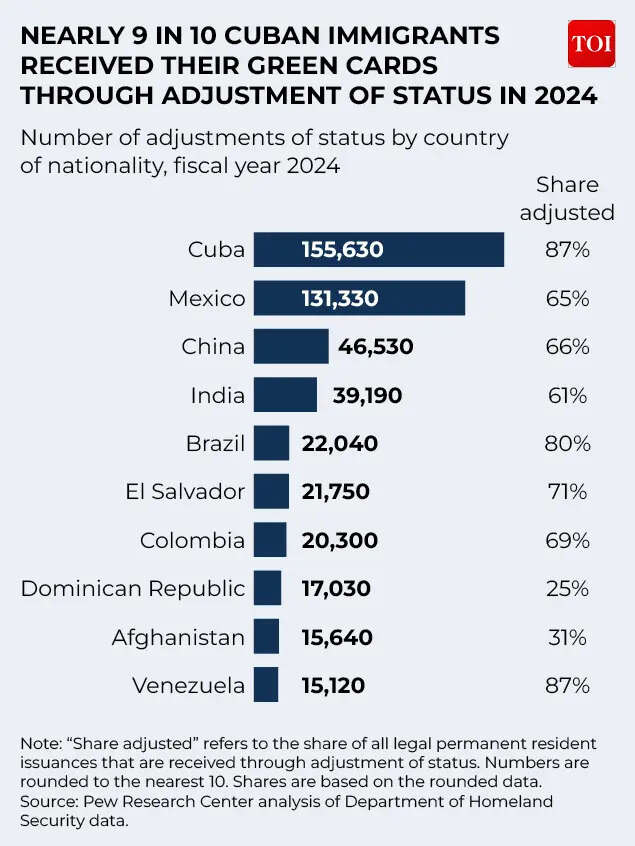
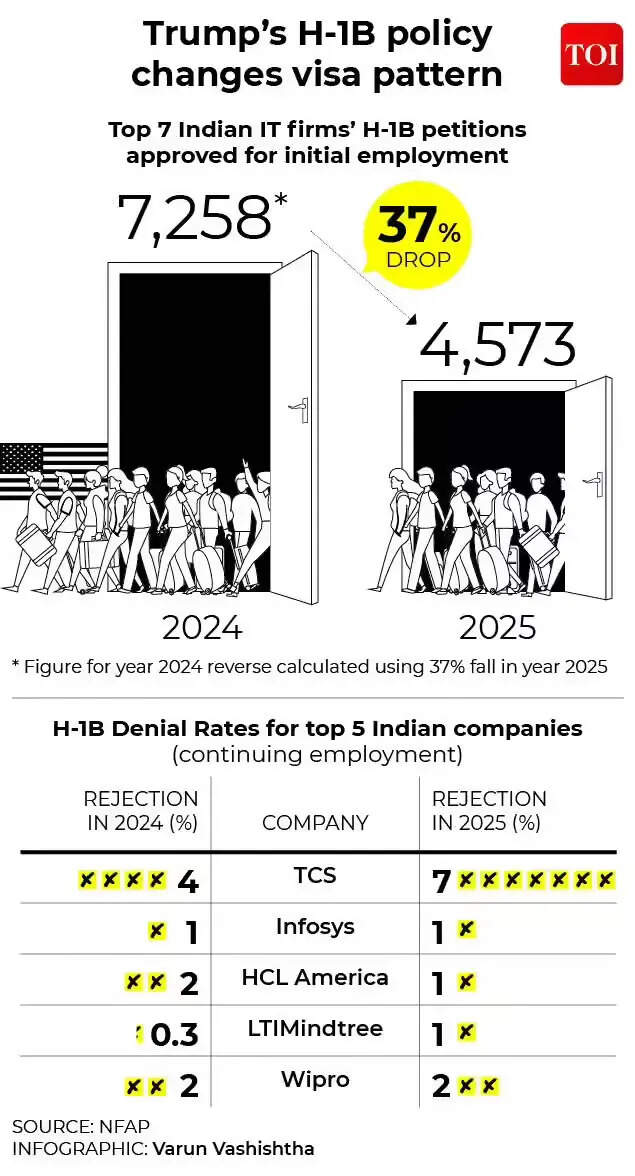
The issue carries particular significance for Indian nationals. India remains one of the largest sources of employment-based immigrants in the United States. Most Indian Green Card recipients obtain permanent residency through adjustment of status rather than consular processing.According to Pew data, approximately 61 per cent of Indians receiving Green Cards in 2024 did so while already living in the United States.At the same time, Indians dominate the H-1B visa programme and often face some of the longest Green Card backlogs due to country-specific caps.Any policy creating additional uncertainty around adjustment of status could therefore disproportionately affect Indian professionals and their families. As, India remains one of the largest sources of new lawful permanent residents in the United States. In fiscal year 2024, a total of 64,660 Indians were granted green cards, marking a significant year for Indian immigration to the U.S. Out of 1,356,760 total green cards issued that year, Indians accounted for nearly 5% of all recipients.Of the Indian recipients in FY 2024, 39,190 obtained permanent residency through adjustment of status—converting from temporary visas such as H-1B or F-1 while already living in the U.S. The remaining 25,470 became permanent residents by entering the country as new arrivals.In the first quarter of fiscal year 2025, latest Department of Homeland Security (DHS) data shows 15,460 Indians received green card status, a 9.33% increase year-on-year. Of these, 9,440 were adjustment-of-status approvals and 6,010 were new arrivals.
Student visa changes
The concerns extend beyond Green Cards. The Trump administration is also considering broader immigration changes that could affect international students and future skilled workers.Another proposal under consideration would replace the current “Duration of Status” framework for F-1 student visas with fixed periods of stay. Under existing rules, international students can generally remain in the United States as long as they maintain valid student status.The proposed changes would require many students to seek additional approvals if they need more time to complete studies or participate in post-graduation work programmes.Danielle Goldman, CEO and co-founder of Build, warned that the proposal could close off important pathways that international graduates currently use to build careers in America and could worsen labour shortages in sectors such as artificial intelligence, technology and engineering, according to The American Bazaar.“Indian students are one of the largest student populations in the United States,” Goldman said. “They’re getting the jobs, they’re working through school, they’re getting companies to say, ‘Yes, we will sponsor you,’ and they’re entering the H-1B lottery at a very high rate.”Many international graduates rely on the Optional Practical Training (OPT) programme to gain work experience after university while employers sponsor them for the H-1B visa lottery. However, not all applicants are selected.Goldman noted that companies have often relied on alternative pathways to retain skilled workers who miss out on H-1B visas. One common option has been Day 1 CPT programmes, which allow some students to continue working legally while pursuing another academic course.
For anyone who already has a master’s degree, they’re not going to be able to go back and say, ‘I need another master’s degree because I need work authorization to continue working.
Goldman
According to Goldman, the proposed rules could significantly restrict that route. Under the new framework, students who have already completed a degree at a particular academic level may no longer be able to enrol in another programme at the same level simply to maintain work authorisation.“For anyone who already has a master’s degree, they’re not going to be able to go back and say, ‘I need another master’s degree because I need work authorization to continue working,'” Goldman said. Instead, some workers may be forced to pursue higher qualifications, such as doctoral degrees, to remain eligible to stay in the country.Goldman warned that thousands of highly skilled workers, including many Indian professionals who have repeatedly missed out in the H-1B lottery, could be left searching for alternative immigration options. She also said major technology firms may need to rethink how they retain international talent if the proposal moves forward.
Scars on biggest buyers
The uncertainty surrounding H-1B visas and Green Card pathways is already leaving visible scars on some of America’s fastest-growing housing markets.Nowhere is that more evident than in the suburbs north of Dallas, where Indian professionals helped fuel one of the country’s biggest real-estate booms during and after the pandemic.According to a Bloomberg report, builders in the Dallas-Fort Worth region spent years tailoring luxury homes to Indian buyers. In one model home, builder Zach Schneider points to a room designed to function as a traditional Hindu prayer space. For years, such features helped drive sales.South Asian buyers once accounted for nearly 70 per cent of sales at Schneider’s family-owned Tradition Homes. Today, that figure has fallen below 30 per cent, leaving the company with a backlog of 125 luxury homes waiting for buyers.The Dallas-Fort Worth region emerged as a major destination for Indian technology professionals over the past decade. Since 2018, the metro area has attracted more corporate headquarters relocations than any other US region, drawing thousands of skilled workers through the H-1B visa programme.For the four-year period ending September 2024, nearly 32,000 new H-1B approvals were granted in the Dallas area, more than Silicon Valley, Seattle, San Francisco and Washington, DC, according to federal data.Many of those workers settled in rapidly expanding suburbs such as Frisco, Prosper and Celina. The population of Celina more than tripled within five years, while Collin and Denton counties became the fastest-growing large counties in the United States. Collin County also recorded one of the sharpest increases in Indian residents during that period.But that growth story is now losing momentum. As immigration rules tighten and technology companies increasingly replace workers with artificial intelligence-driven systems, many Indian professionals are postponing home purchases or considering leaving the United States altogether.Real-estate agent Neeraj Gupta, who arrived in the US on an H-1B visa in 2000 and later became a citizen, says the nature of calls he receives has changed dramatically. During the housing boom, Indian tech workers frequently contacted him looking to buy homes. Now many are calling to sell.“Some of them said, ‘I have seen enough: Just sell it, I don’t care,'” Gupta says.
Refugees and humanitarian applicants face questions
The guidance also created confusion among refugee and humanitarian groups. Refugees are generally required to apply for permanent residency one year after arriving in the United States.Many cannot safely return to their home countries. Matthew Soerens of World Relief said language in the policy memo appeared to leave room for exceptions, giving advocates some hope that refugees would not be affected.Still, questions remain about people admitted under humanitarian parole programmes and other special immigration categories.Many such individuals have established lives in America and may have family-based pathways to permanent residency. Advocates fear uncertainty surrounding these programmes could deter eligible applicants from pursuing lawful status.
Businesses warn of economic consequences
Business groups have also expressed concern. Neil Bradley, Executive Vice President of the US Chamber of Commerce, praised efforts to address illegal immigration but warned that disruptions to legal immigration pathways could harm employers.Many industries already face labour shortages and depend on foreign-born workers. A system perceived as unpredictable could make it harder for American companies to recruit and retain global talent.The concerns come as data already shows declining interest among foreign job seekers considering opportunities in the United States.Immigration experts warn that uncertainty itself can become a deterrent. “It’s crazy how much panic this has caused,” said immigration attorney Victoria Slatton. “If the memo wanted to scare people into not applying, it’s doing a pretty good job.”
The broader shift in US immigration policy
During the first months of the Trump administration, attention focused largely on illegal immigration and border enforcement. Now, critics say, the administration is increasingly targeting legal immigration channels as well.While DHS insists that adjustment of status remains available and that no sweeping change has occurred, the episode demonstrates how even administrative guidance can reshape behaviour.Immigration attorneys say some clients are already postponing applications. Companies are reassessing sponsorship plans and families are reconsidering long-term decisions. For many immigrants, the uncertainty itself has become the biggest challenge.The United States issued more than 1.36 million Green Cards in fiscal year 2024 and another 350,100 during the first quarter of fiscal year 2025. Millions continue to view permanent residency as the key stepping stone toward American citizenship and long-term stability.Ultimately, whether this guidance amounts to a routine reminder of long-standing discretion or the beginning of a tougher, more unpredictable phase in US legal immigration will only become clear over time.For now, it has already achieved what matters most in immigration policy, by changing perception. For millions waiting in the Green Card queue, especially Indians caught in decades-long backlogs, the promise of stability in the US system feels, at least for the moment, a little less certain.

Leave a Reply