
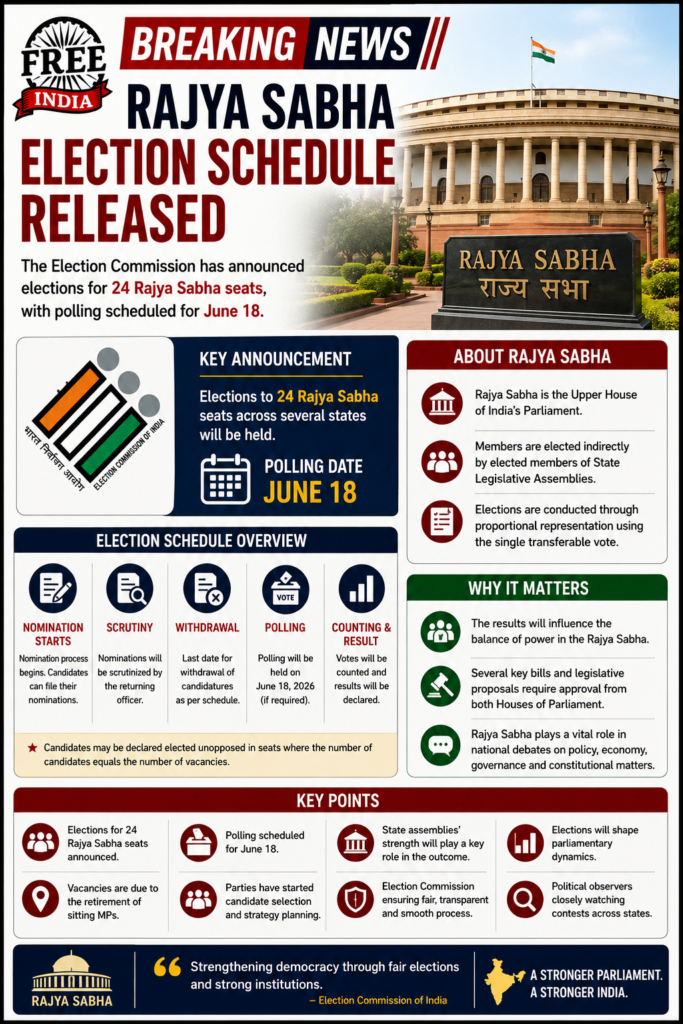
The Election Commission of India (ECI) has officially announced the schedule for elections to 24 Rajya Sabha seats across several states, with polling set to take place on June 18. The elections are being conducted to fill vacancies arising from the retirement of sitting Members of Parliament whose terms are set to expire in the coming months.
The Rajya Sabha, also known as the Council of States, is the upper house of India’s Parliament and plays a crucial role in the legislative process. Unlike Lok Sabha members, Rajya Sabha MPs are elected indirectly by elected members of state legislative assemblies through a system of proportional representation using the single transferable vote.
According to the Election Commission’s notification, the nomination process will begin immediately, allowing eligible candidates from various political parties and independent groups to file their nominations. Following scrutiny and withdrawal procedures, polling will be conducted on June 18 wherever contests arise. In seats where the number of candidates equals the number of vacancies, candidates may be declared elected unopposed.
The upcoming elections are expected to attract significant political attention, as the results could influence the strength of various political parties in the Rajya Sabha. The composition of the upper house is important because several key bills and legislative proposals require approval from both houses of Parliament before becoming law.
Political parties have already begun internal discussions regarding candidate selection, with many expected to nominate senior leaders, experienced legislators, and prominent public figures. Regional parties are also likely to play a significant role in states where assembly arithmetic could determine the outcome of closely contested seats.
The Rajya Sabha currently serves as an important platform for national debate on policy, governance, economic reforms, foreign affairs, social welfare initiatives, and constitutional matters. Changes in the composition of the house can influence parliamentary discussions and the passage of legislation in the coming years.
Election experts note that Rajya Sabha elections often reflect the political balance within state assemblies rather than direct public voting patterns. As a result, parties with strong representation in state legislatures generally enjoy an advantage in securing seats.
The Election Commission has assured that all necessary arrangements are being made to ensure a smooth, transparent, and fair electoral process. State election authorities have also been instructed to follow established procedures and guidelines during the conduct of polling and counting.
With polling scheduled for June 18, political activity is expected to intensify across multiple states as parties finalize candidates and prepare their electoral strategies. The outcome of these elections will be closely watched for its potential impact on the national political landscape and parliamentary dynamics.
Key Highlights
- Election Commission announces elections for 24 Rajya Sabha seats.
- Polling scheduled to be held on June 18.
- Elections are being conducted to fill vacancies caused by retiring members.
- Rajya Sabha members are elected by state legislators through proportional representation.
- Political parties have begun discussions on candidate selection.
- Results could influence the balance of power in the upper house of Parliament.
- State election authorities directed to ensure a smooth and transparent process.
- Political observers are closely monitoring the upcoming contests across states.

Leave a Reply