
A blood pressure reading of 90/60, regular exercise, and a healthy diet might seem like a reassuring combination for heart health. So what happens when someone with all three is still told they have a blocked artery?
This was the concern behind a question posted on Quora by a 61-year-old woman who said she exercises, avoids greasy foods and maintains a normal weight, but was told she had a blocked artery in the apex of her heart.
The query reads: How can I have a clogged artery? I have low blood pressure. 90/60, I exercise, I eat healthy, avoid greasy foods, I am a normal-weight 61 y/o woman. I was told I have a blocked artery in the apex. How is this possible with my lifestyle?
We reached out to Dr Punya Pratap Kujur, Consultant Cardiologist, Gleneagles Hospital, Parel, Mumbai, to understand how this can happen and what the diagnosis actually means.
Can a healthy lifestyle completely prevent artery blockage?
Not necessarily. While healthy habits lower cardiovascular risk, they cannot eliminate every factor that contributes to plaque formation.
Dr Kujur explains, “A healthy lifestyle lowers cardiovascular risk but does not eliminate it completely. Ageing, genetics, family history, diabetes, cholesterol levels, smoking exposure and other medical factors can contribute to plaque formation.”
This means that maintaining a healthy weight and exercising regularly does not necessarily mean the coronary arteries are free of plaque.
Story continues below this ad
“Low blood pressure and normal weight do not necessarily mean that the coronary arteries are free of plaque,” Dr Kujur adds.
Does low blood pressure protect against coronary artery disease?
A reading of 90/60 does not automatically protect someone from coronary artery disease.
“Low blood pressure does not completely protect against coronary artery disease. Blood pressure and artery blockage are different issues, and a person can have low blood pressure while also having plaque in the coronary arteries,” says Dr Kujur.
He adds, “The overall cardiovascular risk depends on several factors, not blood pressure alone.”
Story continues below this ad
So, a low BP reading and a coronary blockage can exist in the same person.
What other factors can contribute to a blockage?
Some of the risk factors may have little to do with body weight or how much fried food someone eats.
“Genetics and family history can play an important role, particularly when heart disease occurs despite a healthy lifestyle. High LDL cholesterol, diabetes, chronic inflammation, smoking, kidney disease and age-related changes can also contribute,” Dr Kujur says.
Another factor is particularly relevant to women.
“In women, hormonal changes after menopause may further influence cardiovascular risk.”
Story continues below this ad
So even when someone follows a healthy routine, factors such as genetics, cholesterol, diabetes, kidney disease and age-related changes can still influence their cardiovascular risk.
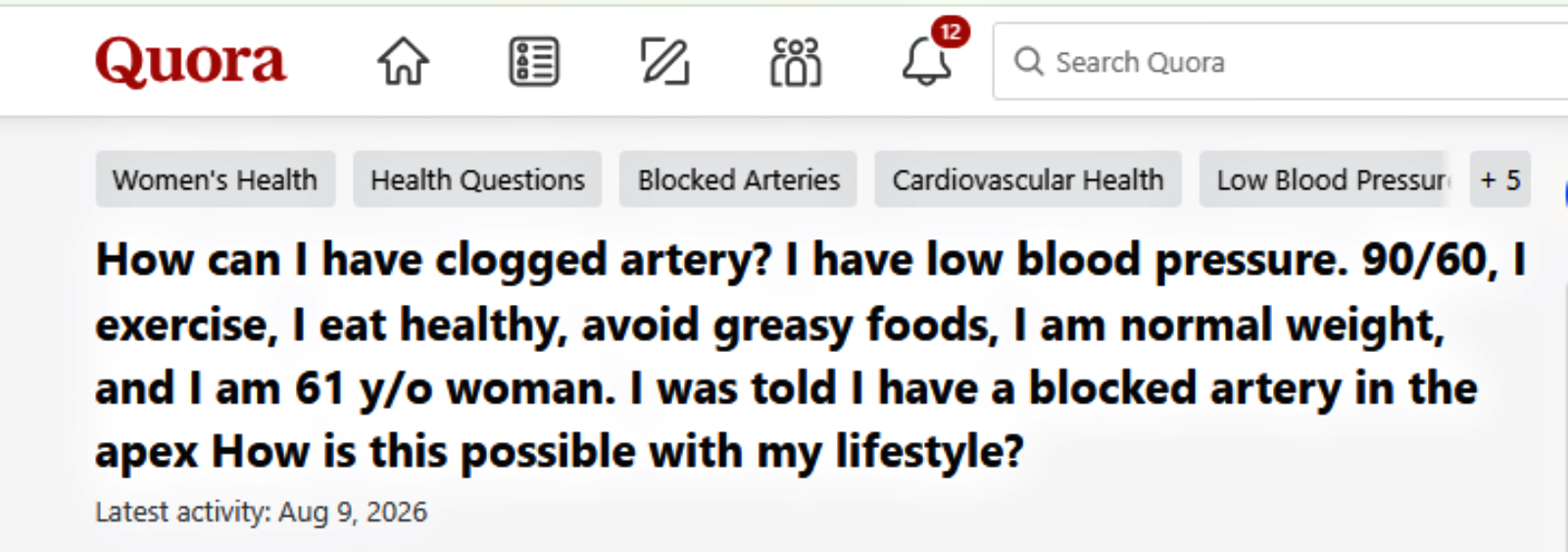 Screenshot of the query posted on Quora
What does ‘blocked artery in the apex’ mean?
The wording of the diagnosis matters because “blocked artery in the apex” does not, by itself, identify exactly what is happening.
“‘Blocked artery in the apex’ is not, by itself, a precise description of a coronary blockage and may refer to reduced blood supply to the apex of the heart or a blockage in an artery supplying that region,” Dr Kujur explains.
To understand the significance, doctors need to establish which artery is involved and how much it has narrowed.
Story continues below this ad
“The exact artery, percentage of narrowing and its significance are determined using the relevant test, such as CT coronary angiography or conventional coronary angiography, along with other findings,” he says.
What should you do after being told you have a blockage?
The first step is to clarify the actual finding rather than assuming the blockage is necessarily severe.
Dr Kujur advises, “The first step is to understand exactly which artery is affected, how severe the narrowing is and whether it is actually causing reduced blood flow.”
A cardiologist can then assess the imaging alongside the person’s other risk factors.
Story continues below this ad
“A cardiologist can review the imaging, cholesterol, blood sugar, blood pressure and family history and decide whether lifestyle measures, medication or further testing is appropriate,” he says.
Most importantly, “Treatment should be based on the actual findings rather than blood pressure or body weight alone.”
And being diagnosed with coronary disease despite following healthy habits does not necessarily mean the person did something wrong. Dr Kujur says, “Do not assume that the blockage is caused by something you did wrong; coronary disease can occur even in people who follow a healthy lifestyle.”
At 61, regular cardiovascular assessment becomes particularly important. Do not start or stop medications without medical advice. New chest pressure, breathlessness, sweating, fainting or pain spreading to the arm, jaw or back warrants urgent medical evaluation.
Story continues below this ad
DISCLAIMER: This article is based on information from the public domain and/or the experts we spoke to. Always consult your health practitioner before starting any routine.

Leave a Reply