

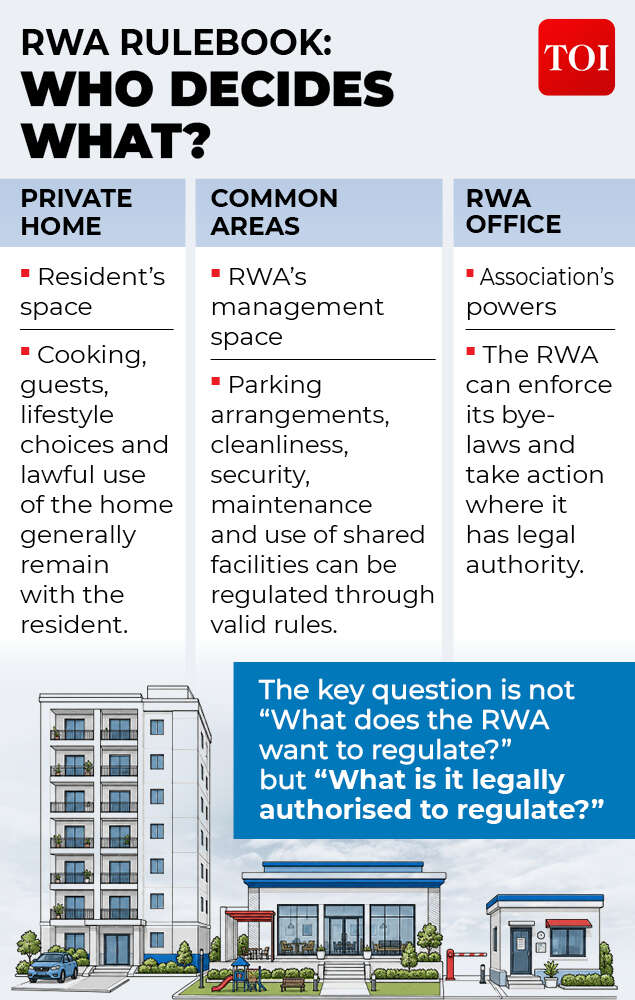
NEW DELHI: Parking, maintenance charges, pets, tenants and the use of common areas are among the issues that can trigger disputes between resident welfare associations (RWAs) and residents. But many residents are unclear about how far an RWA can go in making and enforcing rules, particularly when those rules affect their homes, tenants or personal choices.RWAs deal with matters such as common areas, security, maintenance, parking, cleanliness and nuisance. But lawyers and RWA representatives say an association cannot simply create powers for itself through a committee decision or majority vote. Its rules must have a legal basis and cannot override the lawful rights of residents.So, where should the line be drawn between community rules and individual rights?What can an RWA actually regulate?Manmeet Kaur, partner at Karanjawala & Co, said RWAs generally deal with maintenance, common areas, security and the enforcement of valid bye-laws. Their powers, however, derive from the law under which they are registered and their governing documents.“An RWA cannot legislate or override any legal rights of a resident,” Kaur said.Heena Chheda, partner at Economic Laws Practice, said the exact powers of an association can differ depending on whether it is a condominium, co-operative housing society or another form of residents’ association. An association can make rules for the orderly management of a property, but a general-body resolution cannot, by itself, take away a legal or proprietary right.A general-body resolution cannot override a statutory provision or take away a legal or proprietary right beyond the association’s lawful authority. Rules should have a proper basis, be applied fairly and relate to matters such as maintenance, safety, security, sanitation or the management of common facilities.Can an RWA stop you from renting your flat to a bachelor or student?Restrictions relating to tenants can become a source of disputes between residents and RWAs. Lawyers said an association cannot ordinarily impose a blanket ban on bachelors, students or people from a particular religion, caste or community merely because of their identity or status.An RWA can ask for tenant details and take reasonable security measures, including requirements relating to identification and verification. It can also act against genuine nuisance, safety problems or unauthorised commercial or short-term use of a flat.But this is different from having the power to decide whom an owner can rent a privately owned home to. Kaur said an association does not acquire an unrestricted right to prevent an owner from lawfully letting out an apartment merely through a bye-law or general-body resolution.Manoj Arya, president of Vasant Kunj Enclave, said his RWA does not generally have a rule barring bachelors. Instead, it focuses on conduct such as noise, late-night parties, nuisance and disturbance. The association also circulates notices about tenant verification and works with Delhi Police to organise verification camps.The distinction, therefore, is between regulating conduct within a community and deciding who is entitled to live in a privately owned home.Can an RWA tell residents what they can cook or eat at home?Food is another area where community rules can run into questions about individual choice.Kaur said an RWA does not ordinarily have a general power to dictate what an owner or lawful occupant can cook or consume inside their apartment. Rules dealing with fire safety, sanitation, waste disposal, nuisance or unlawful activity stand on a different footing.“An RWA’s mandate is maintenance and common-area management, and not policing private habits,” Kaur said.Chheda said a restriction based only on dietary preference, religion, caste or community, without a valid legal basis, would be particularly vulnerable to challenge.
=
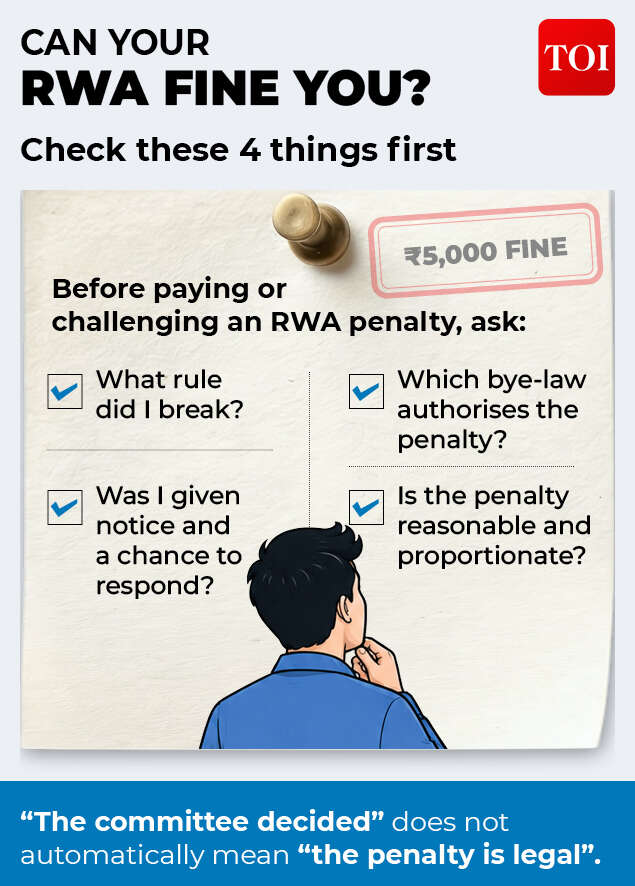
One resident said people should generally be free to make choices inside their homes, but excessive noise, strong food odours or disruptive pets may need to be addressed when they cause a genuine problem.The focus, the resident said, should be on preventing actual annoyance or harm rather than unnecessarily restricting individual choice.What about pets and parking?RWAs may regulate common areas and introduce reasonable rules on matters such as cleanliness, safety, leashing pets and the use of shared spaces, subject to their governing law and bye-laws. They can also manage common parking areas and introduce traffic and safety arrangements.But the rules cannot be applied selectively. Chheda said a blanket ban on keeping pets, or a special charge simply because a resident has a pet, would require a clear legal basis and could be challenged.Similarly, an RWA cannot use a resolution to extinguish an independently established proprietary or contractual right relating to parking, she said. The position can depend on the property’s governing documents, sanctioned plans and the nature of the parking space.For Arya, parking is one of the practical problems his RWA deals with. He said parking on roads can create traffic jams, while disputes also arise when residents attempt construction that affects common or sanctioned areas, including attempts to construct additional floors or flats in stilt parking areas.These are the kinds of issues where an RWA’s role in managing a community can overlap with individual property rights, making the legal basis and manner of enforcement important.Can an RWA impose fines or cut off facilities?An RWA cannot impose a fine simply because its committee believes a resident has broken a rule. The penalty must have a lawful basis.For societies covered by the Societies Registration Act, 1860, Section 9 deals with the recovery of a pecuniary penalty imposed under a bye-law. The provision refers to a penalty for breach of a bye-law duly made in accordance with the society’s rules and regulations.Chheda said the association should identify the particular bye-law or other provision that has been breached and check whether it actually authorises the proposed penalty. The resident should ordinarily be given reasonable notice of the alleged violation and an opportunity to respond before adverse action is taken.“Any penalty or additional charge imposed as a consequence of a breach must have a lawful basis; it cannot be created ad hoc by the managing committee,” Chheda said.
=
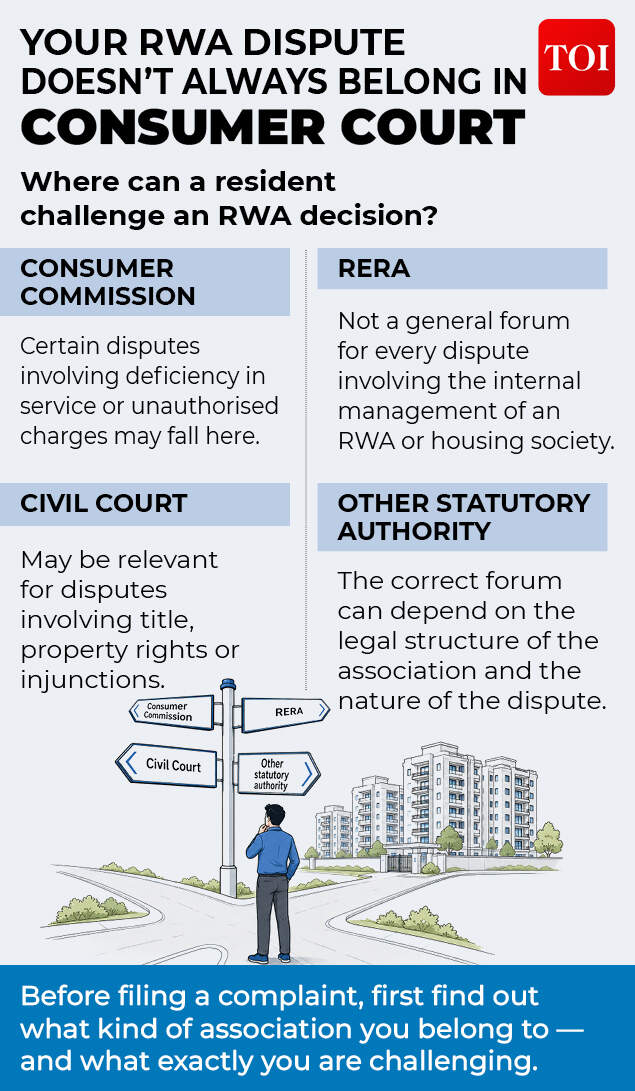
B S Vohra, president of East Delhi RWAs Joint Front, said an RWA should also ensure that penalties are proportionate and that residents have an opportunity to challenge them.“The RWA must have clear authority under its bye-laws, follow due process, give the resident notice and an opportunity to be heard, and ensure the penalty is proportionate, transparent and challengeable,” Vohra said.Arya said RWAs face a practical difficulty because they are resident associations and not government enforcement agencies. Their ability to impose penalties or take coercive action can be limited, depending on the association’s legal structure, registered bye-laws and the nature of the issue.Chheda also cautioned against using denial of access to an apartment or essential services to force a resident to pay or comply. A restriction on an optional common facility may be different, but it too would need to be properly authorised and reasonable.What happens when residents think an RWA rule is unfair?For residents, the problem is often not just the rule itself but how it is introduced.One resident said many people do not have a clear understanding of what an RWA can legally regulate, particularly when rules begin affecting individual homes and personal choices. The resident said people should be told why a new rule is being introduced, which bye-law or law supports it and how it will be enforced.\Tulika Chowdhury, a Delhi resident, said maintenance, parking, cleanliness and communication between residents and the RWA are among the biggest issues. She said rules can feel restrictive when they are implemented without sufficient discussion, but residents can raise their concerns with the RWA and seek clarification.“I feel resident participation can always be improved because ultimately, rules work best when the people affected by them are also heard before they are implemented,” Chowdhury said.Arya said his RWA tries to hear residents’ objections and resolve complaints by explaining the reason for a rule rather than simply arguing that the rule has already been made.Who can challenge an RWA decision?There is no single forum for every dispute between a resident and an RWA. The appropriate remedy depends on the association’s legal structure, the nature of the dispute and the relief a resident is seeking.Kaur said a consumer commission may be appropriate in cases falling within the Consumer Protection Act, including certain disputes involving deficiency in services or unauthorised charges. But not every dispute between a resident and an RWA is a consumer dispute.
=
RERA is also not a general forum for disputes over the internal management of an RWA or housing society. Depending on the issue, a dispute may instead have to go before a specialised statutory authority or a civil court, particularly where it involves title, proprietary rights or an injunction.Kaur said residents should first establish what kind of association they belong to and what exactly they are challenging before deciding where to take the dispute.Do Delhi’s RWAs need clearer rules?RWA representatives and residents said greater clarity and transparency could help reduce disputes over rules and their enforcement.Vohra said Delhi needs a more uniform framework setting out the powers and limits of RWAs, residents’ rights, permissible restrictions and penalties, due process and an independent grievance mechanism. He said this would allow RWAs to manage communities effectively without giving them arbitrary powers.Arya said RWAs should also be more transparent about elections, office-bearers, accounts and major rule changes. He suggested making audited accounts accessible to residents, giving prior notice before important changes and providing written reasons when enforcement action is taken.The residents also called for greater transparency and more opportunities to participate in decisions affecting them.The balance is ultimately a practical one. RWAs need enough authority to collect maintenance, manage common spaces and address genuine problems involving safety, security, nuisance and cleanliness. But residents should also know that an association’s internal rules do not automatically give it control over every aspect of their private lives.Residents should first look at the bye-laws and the law governing their association to understand whether the RWA has the authority to impose a particular rule. For RWAs, clear rules, consistent enforcement and an opportunity for residents to be heard can help keep community disagreements from turning into legal disputes.

Leave a Reply