
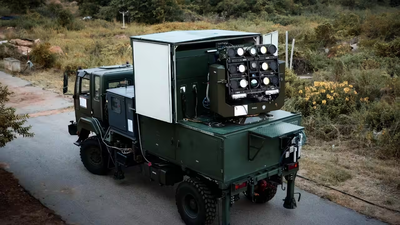
Drones have turned air defence into a question of arithmetic, upending traditional calculations of the cost of warfare. Drones costing a few thousand dollars each can be launched in large numbers to scout, locate air-defence positions and attack installations. This could lead to a situation in which a defender who responds to each one with a missile runs out of interceptors long before the attacker runs out of drones. That is why high-energy lasers, which promise to engage targets at the speed of light and at a fraction of the cost per shot, have attracted so much interest from militaries across the world.India is now moving its indigenous Directed-Energy Weapon (DEW) programme from technology demonstrations towards industrial production. The harder question is whether a successful trial can translate into a dependable battlefield capability.
How does a laser weapon work?
A laser weapon works by directing a concentrated beam at a vulnerable part of a target, such as its airframe, engine, battery or control system. The sustained energy generates heat that weakens the structure or disables critical components. At lower power, the beam can dazzle or damage a drone’s optical sensors.
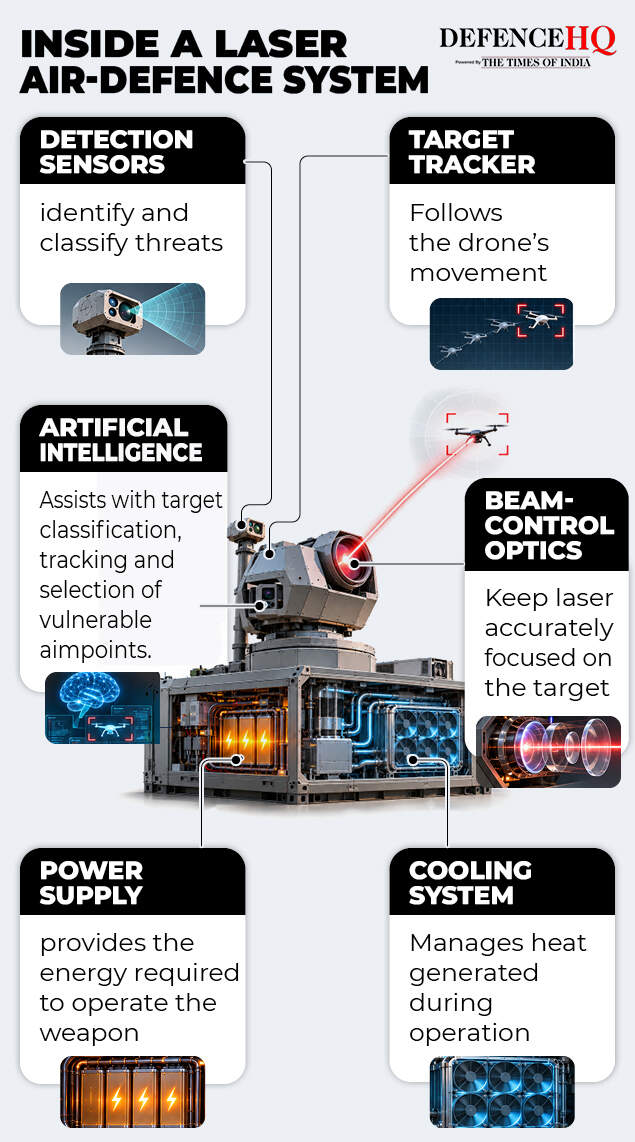
Many components need to come together to make a laser weaoncome together as an effective combat tool.
The beam is only one part of the system. It also needs sensors to detect and classify the target, a tracker to follow it, beam-control optics to hold the aimpoint on a small moving object, as well as power and cooling equipment. Artificial intelligence can help with classification, tracking and selecting a vulnerable section to target.
The attraction of lasers
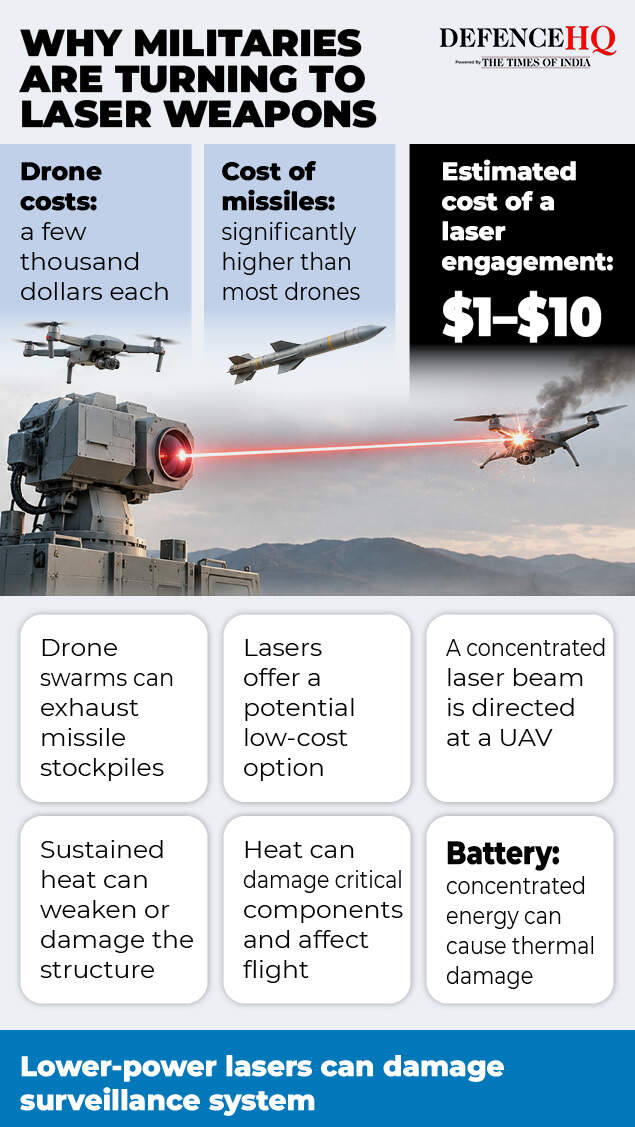
The cost-effectiveness and unlimited magazine depth of directed energy weapons are key to the rising interest in these systems.
The main attraction of these weapons is the cost per engagement, as a laser weapon does not consume missiles, shells or bullets to bring down a single drone. Its marginal cost is mainly the electricity or fuel needed to power it. US defence estimates have put the energy cost of some engagements at around $1 to $10. This, however, excludes the cost of buying, maintaining and operating the complete system.Lasers also offer greater magazine depth. A missile launcher has a fixed number of interceptors, while a laser can keep firing as long as power and cooling allow. That does not mean it can destroy every target instantly. Each engagement requires target acquisition, tracking and sufficient dwell time on the target. Overheating can also limit the duration of an engagement.
Directed-energy weapons belong to the next generation of weapon systems. They hold considerable promise but also have serious limitations in their employment. Their effectiveness in conclusively destroying targets has not yet been established, while their cost-effectiveness remains low. As a result, despite considerable discussion about their battlefield utility, their adoption remains limited. Directed-energy weapon technologies are still around five to 10 years away from maturing into practical battlefield capabilities.
Lt Gen PR Shankar (retired), Professor, Aerospace Dept IIT Madras and former DG Artillery
Where India stands
India’s most important progress has come from the Defence Research and Development Organisation (DRDO). In April 2025, it demonstrated its vehicle-mounted MK-II(A) laser DEW at the National Open Air Range in Kurnool, Andhra Pradesh. Developed by the Centre for High Energy Systems and Sciences (CHESS), the system engaged fixed-wing unmanned aerial vehicles (UAVs), countered a multiple-drone attack and damaged surveillance sensors and antennae.
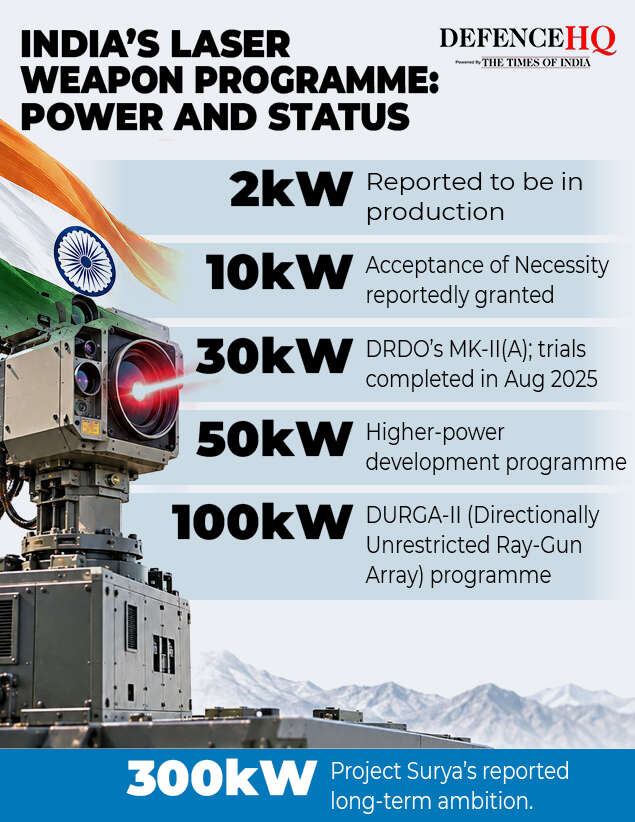
The DRDO and its establishment, CHESS, are developing lasers of different classes for the country.
The 30-kilowatt system is designed to counter drone swarms, fixed-wing UAVs and surveillance sensors at ranges of up to 5 km, and its final trials were completed in August 2025. In September, DRDO said it would issue an expression of interest within six months to select an industry partner for a first-of-production model. That marks a move from technology demonstrator towards production, but does not mean the weapon has been inducted or is available in significant numbers.Various systems in this family of weapons are at different stages of development. The 2-kilowatt weapon is reported to be in production, with Adani Defence and Aerospace, Astra Microwave Products and Bharat Electronics Limited (BEL) as industry participants. Earlier systems are reported to have been used by all three armed services. Numbers delivered and deployment details are not public.The 10-kilowatt system, meant to engage drones at around 1.5 to 2 km, has reportedly received Acceptance of Necessity, with BEL and Larsen & Toubro as development-cum-production partners. However, the first production models were still awaited as of September 2025. Claims that a 10-kilowatt system was used during Operation Sindoor are conflicting and need independent confirmation.Higher-power systems, including the 50- and 100-kilowatt classes under DURGA-II (Directionally Unrestricted Ray-Gun Array) and a reported 300-kilowatt ambition called Surya, remain development goals.In August 2025, DRDO also carried out the maiden trial of its Integrated Air Defence Weapon System (IADWS) off the Odisha coast. It combines the Quick Reaction Surface-to-Air Missile, the Very Short Range Air Defence System and a high-power laser DEW under a unified command network. During the trial, the three components collectively engaged and destroyed three targets: two high-speed fixed-wing UAVs and a multicopter drone.DRDO has also begun work on a laser pod for helicopters such as the Dhruv and its armed variant, Rudra, with development reportedly targeted for completion by the end of 2029. For now, it remains under development. Mounting a laser on an aircraft brings challenges involving weight, power, cooling, vibration and aerodynamics.
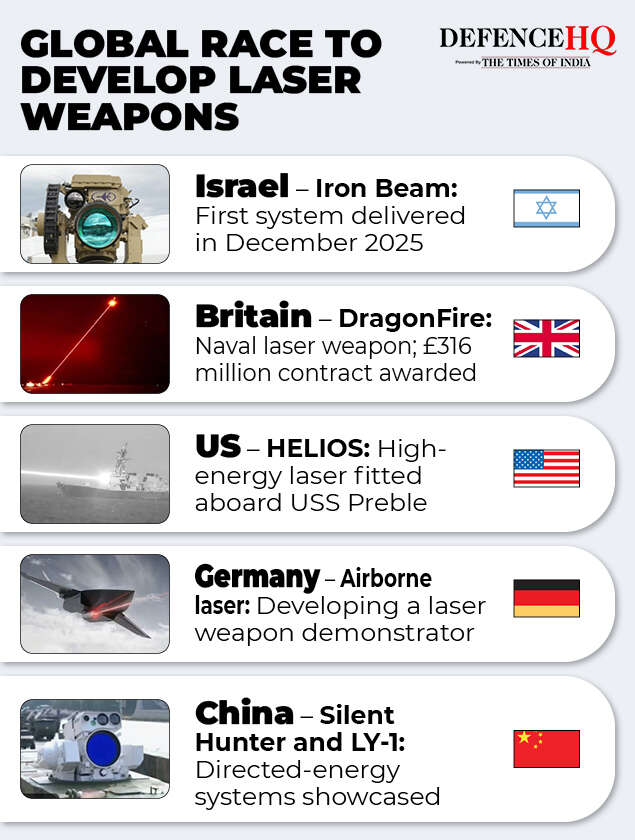
Apart from India, many other countries are also working on similar weapons for their own armed forces.
India is not alone in developing this class of directed-energy weapons. Israel delivered its first Iron Beam system to its armed forces in December 2025. Britain awarded a £316 million contract in November 2025 for the DragonFire naval laser. The US Navy has fitted the HELIOS system on the destroyer USS Preble, Germany is developing an airborne laser demonstrator, and China has showcased systems such as Silent Hunter and LY-1.
The limits of a laser
Several constraints can limit the effectiveness of this type of weapon in actual combat. Fog, rain, dust, smoke and clouds can absorb or scatter the beam. A system that performs well in clear-weather trials may have a shorter effective range in poor conditions, a problem that can be particularly severe in dusty deserts, maritime environments and high-altitude areas with cloud cover.A beam also needs a clear line of sight, so low-flying drones behind hills or buildings are difficult to engage. Dwell time is another issue. Against a swarm, the seconds spent on one drone are seconds not spent on the next. An adversary could also use heat-resistant materials or manoeuvres to buy time.Power and cooling add further limits on size, weight and mobility, especially when these systems are mounted on helicopters.For the armed forces, the first uses are likely to involve protecting airfields, bases, radars, ammunition depots and forward formations against drones and loitering munitions. Along the Line of Control and the Line of Actual Control, much will depend on whether the systems work reliably in difficult weather and terrain, remain mobile and integrate with existing radar and air-defence networks.Lasers are unlikely to replace guns and missiles, especially against ballistic missiles and high-speed cruise missiles.India has demonstrated its ability to develop and use high-energy lasers against aerial targets, but its systems are at very different levels of maturity. The next test is whether DRDO and industry can manufacture reliable systems in sufficient numbers and demonstrate that they can perform during prolonged operations, bad weather and saturation attacks.Readiness can only be proven under operational conditions.

Leave a Reply