
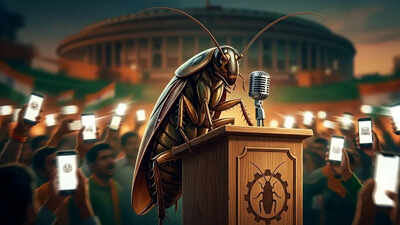
A new, or a 325 million-year-old, creature has just taken the subcontinent by storm. It was a “misinterpreted” comparison of cockroaches to humans that gave birth to a satirical online outfit – the Cockroach Janata Party (CJP) . But what perhaps started as a simple joke or at best a political satire meant for a few thousand eyes ended up catching the imagination and backing of millions.The party’s manifesto had demands for a ban on post-retirement Rajya Sabha seats for chief justices, media neutrality, 50 per cent reservation for women in Parliament, and a 20-year election ban for defecting MLAs and MPs. Its eligibility criteria for membership was: ‘unemployed, lazy, chronically online, ability to rant professionally.’While critics raised questions on the objective of CJP, the fact is that this “party” now technically enjoys a higher following than what both the mainstream political parties – BJP and INC – have combined. Allegations are thrown from both sides of the coin, people are in two minds and engagement for even a singular mention of this “party” is sky-rocketing. Why?Why is it resonating with millions of people? Or is it actually resonating?To understand this impact, one must situate memes within the contemporary attention economy, where the scarcity of human attention has superseded the scarcity of information (Lanham, 2006). The 21st century has seen a fundamental shift in how young people consume politics. They no longer wake up to newspapers. The TV no longer has news channels playing as ambient noise in the evening. The medium is now in your hands — you scroll for knowledge. You scroll, you don’t look. What you want to know has to find you, it has to make enough noise over the other 1.5 billion posts made per day.
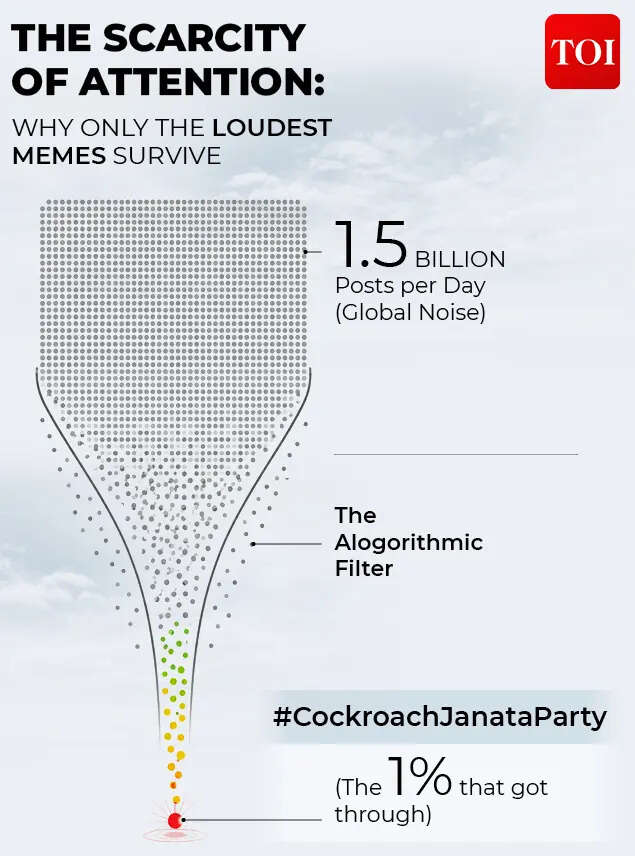
This is what Gil de Zúñiga, Strauss, and Huber called the “News Finds Me” perception. It explains why the initial remark on cockroach comparison made during a court hearing did not spread through court transcripts — it was interpreted through memes, which multiplied the agitation to the remark many times over. When news is supposed to find you through an algorithm, only the most volatile pieces break through. The CJP at its core is a meme that found you and then became news. Its virality forced its transformation and coverage. It is currently within this cycle that maintains its popularity. The moment it breaks from the cycle — what is its future?An outfit like the CJP is almost a textbook case of what comes under Bakhtin’s carnivalesque. The carnival, in Bakhtin’s telling, is a licensed space where hierarchy is suspended, where the king can be mocked by the jester. The term cockroaches was reportedly used for the unemployed youth. But then the remarks got co-opted within the carnival, with the people who are the brunt of this statement creating a party against him and what they believe is wrong within Indian politics. Dissent within the political space in social media is prevalent, expected, and encouraged but the popularity of this movement shifts it into the definition of a carnival. Yet the tents do come down eventually, is the CJP actually looking to become an institution of its own or just a viral carnival.Poe’s Law complicates any easy answer. Online, sincere extremism and satirical extremism wear the same clothes. Is the CJP a real political movement? A joke? A performance? The answer is all three at once. Its ambiguity shields it from proper persecution. Threats can be sent, allegations of it being a Pakistani front can be thrown, and accounts can be deleted. But at its core they are protected and political. You cannot jail a punchline. You cannot file an FIR against a meme. The CJP exists in the fog between satire and sincerity, and that fog is its best defence and the reason its numbers can grow.The very moves made by certain people in power to curb the popularity of CJP, like the allegations and platform disablements, are helping them stay popular. Each act of censorship has brought fresh sign-ups, fresh attention, and fresh memes. This could be equated to the Streisand effect. Named after Barbra Streisand, who in 2003 sued a photographer to remove an aerial photo of her Malibu mansion from a public shoreline erosion archive. The photo had been downloaded only six times before the lawsuit. After she filed it, over 400,000 people viewed the image. The attempt to hide something made it impossible to ignore. The same logic applies here.Social identity theory (Tajfel & Turner, 1979) explains the rest. People derive their sense of self from the groups they belong to, and the homo sapien is a social creature. We have an inherent need to belong. By calling themselves cockroaches, millions of young Indians are not just sharing a joke, they are signalling membership. This membership was also inspired by those around them, there was a level of groupthink to the decisions made as a lot of CJP’s membership did no background research on what and who they were supporting in their attempt to be a part of something huge, they created something extremely viral but also extremely empty. What does one truly know about the CJP? Does even the founder understand what CJP is?Memes have become the language of the internet. Which means they have become the language of online politics. Accessible. Simple. No dichotomy. A meme asks nothing of you except a split second of recognition. You do not think about it. You see it, it amuses you, you share it and you move on. This is why the form works. It is also why it fails. A shared language is fine for basic conversation. But it struggles with depth. It also allows you to not project any depth and still be viral but not truly important. A party legitimised through AI and memes does not carry with it a depth for it to be retained or taken seriously.
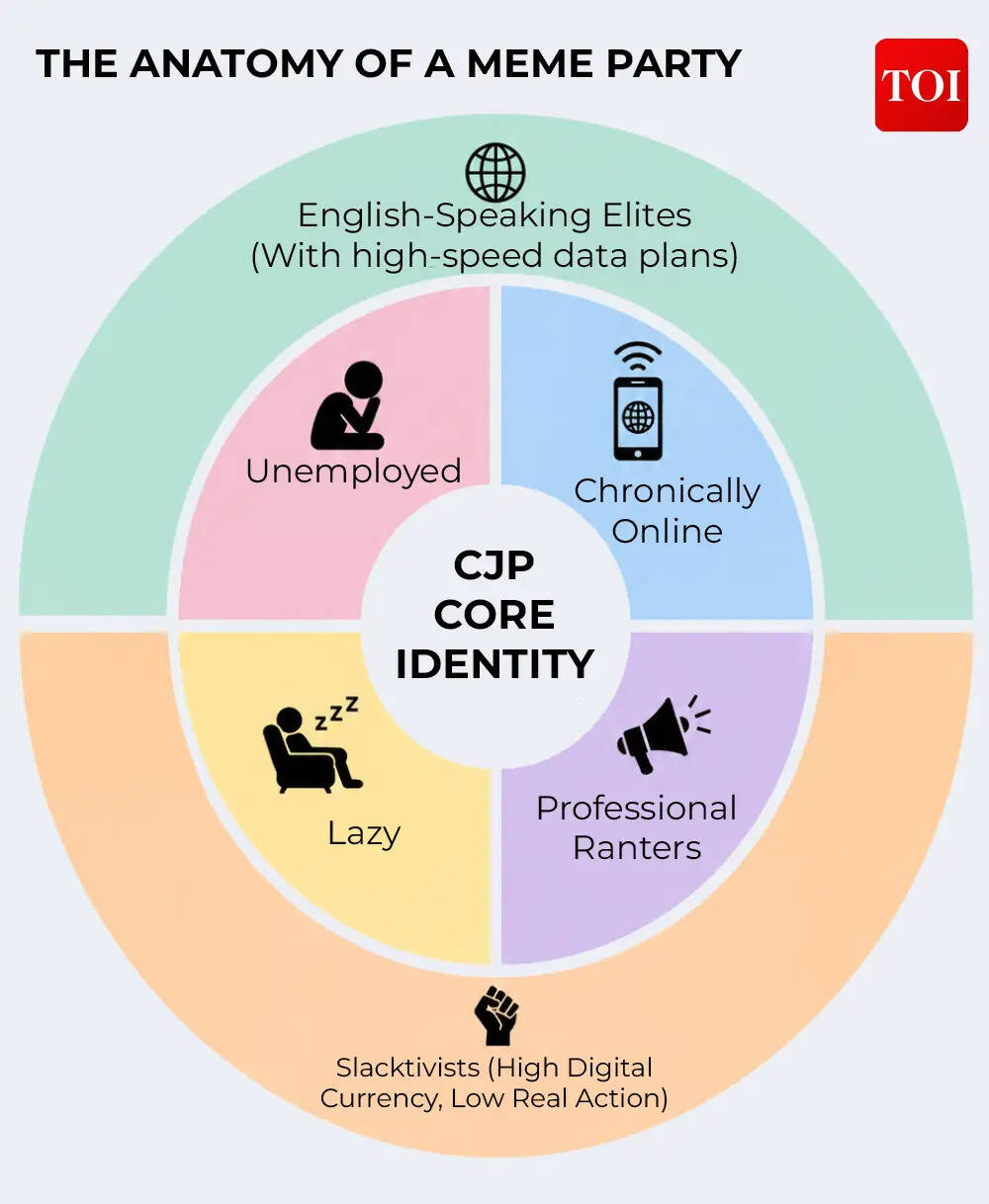
Which brings us to slacktivism.The internet has made it incredibly easy to align yourself with a cause. A follow button. A Google Form. A story repost. The CJP has mastered this low-barrier engagement. You want to join? Fill out this form. You want to show support? Repost this meme. You want to feel like you are part of something? Here is a hashtag. #MainBhiCockroach. Done. Our cause, something we are not entirely clear on ourselves, is something you stand with? Put a cockroach emoji in your username. You are now a member. You have contributed. You can scroll on.But what does that actually mean?The CJP’s eligibility criteria — unemployed, lazy, chronically online — is a joke. But it is also a mirror. If all it takes to join is a click, what does membership mean? If the movement’s primary activity is sharing memes, what has actually been achieved?This is the slacktivism problem. The ease of online participation creates an illusion of impact. You hit follow. You sign a Google Form. You repost a meme. You feel good. You feel like you have done something. But have you? The carnival needs an audience. The meme needs to spread. But when the carnival ends, when the meme cycle moves on, what remains?We laud the CJP for its impact. But let’s not forget that membership is a form of social currency. And membership here also needs currency.The CJP performs inclusive but is exclusive. The people talking about it. The members. Those who are “in” on the joke. They are the elites of our country. Upper class. Upper middle class. English-speaking. Chronically online by choice, not by circumstance. They have the data plans, the devices, the hours to scroll, the cultural capital to understand the references. They are the ones who can afford to be lazy.This is not a true people’s party. It can have a voting symbol. It can have social media leverage. But apart from that, what does it actually have?
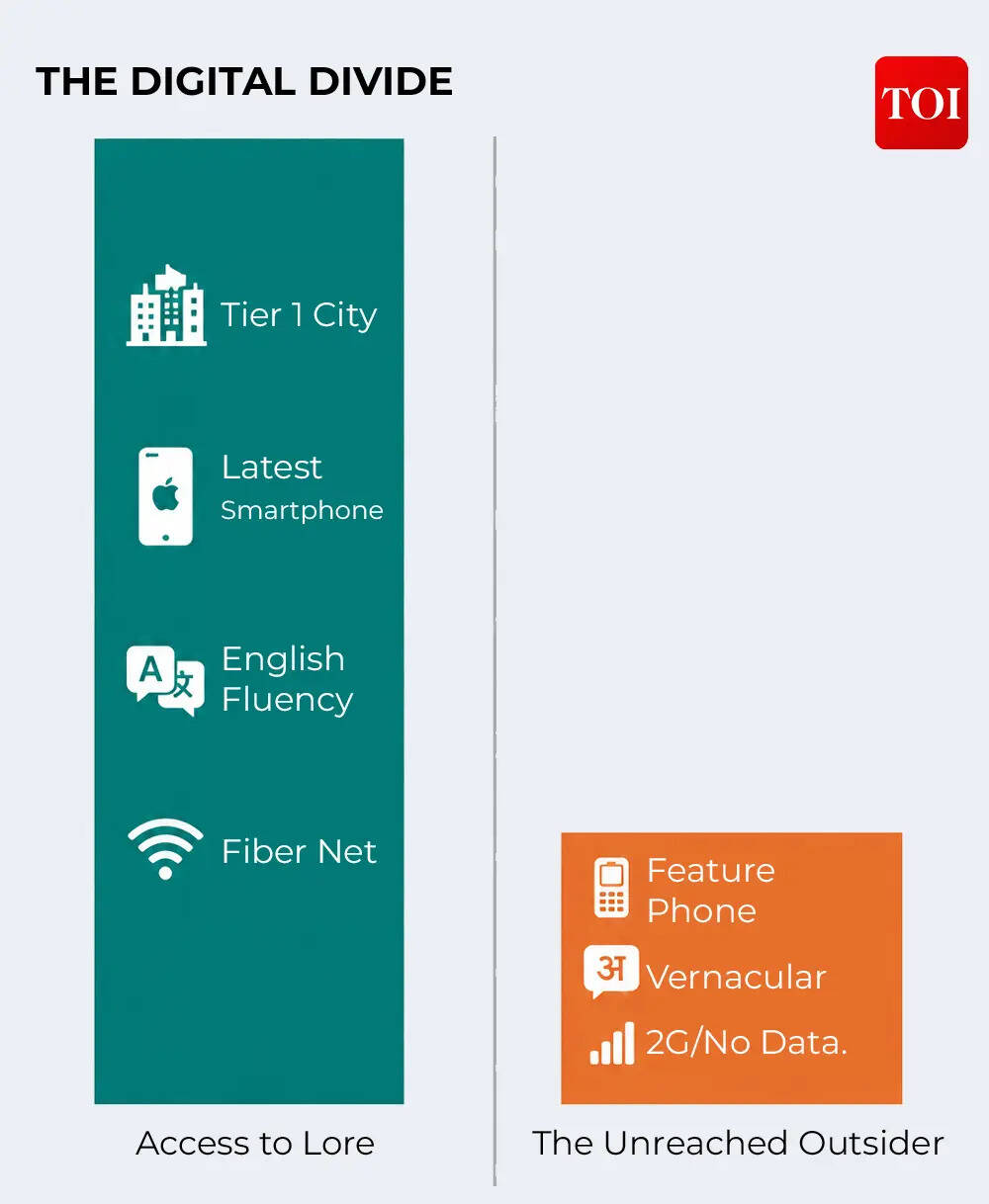
The digital divide is not just about access to technology. It is about access to culture. Memes require lore. Lore requires time. Time requires privilege. The CJP’s humour is insider humour. If you do not get the joke, you are an outsider. And if you are an outsider, you do not matter to this movement.So who is the CJP actually for? The answer is uncomfortable. It is for people like us. The educated. The connected. The ones who already have a voice.Its virality might be the only mark it potentially leaves.

Leave a Reply