
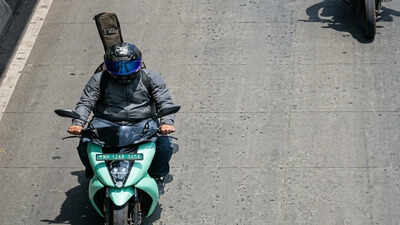
BENGALURU: Imagine being fined because a guitar strapped to your back is mistaken for a helmetless pillion rider. Or receiving a challan for not wearing a helmet when you are wearing a turban. For some motorists, these are not hypothetical situations but real encounters with automated traffic enforcement.As AI-powered cameras become increasingly common on Indian roads, can technology designed to minimise human error avoid making mistakes of its own?But, the bigger question remains: who takes responsibility when technology gets it wrong?Souvik Dutta was riding his wife’s scooter through Bengaluru with a guitar strapped to his back. An AI camera on Outer Ring Road saw something else: a pillion rider without a helmet.The camera captured him at noon on September 15. A Rs 500 challan for “pillion not wearing protective headgear” was generated, with photographic evidence attached.Bengaluru traffic police adopted an AI-based system in December 2022 and initially operated it without human validation. After complaints about incorrect number-plate readings, the report said, they began manually validating every violation flagged by the AI. It does not establish whether Dutta’s challan went through this check.A guitar mistaken for a person is easy to laugh at. The harder question is what it says about the evidence a motorist is expected to answer: if a system cannot always distinguish an object from a person, how much weight should its photograph carry?
Different errors, different causes
The documented cases do not all involve the same kind of failure.In Udham Singh Nagar, AI cameras issued 10 helmet challans to turban-wearing Sikh motorists over two months. The cameras appeared to interpret turbans as the absence of helmets.Assistant regional transport officer (administration) Mohan Kothari acknowledged complaints. “The department has addressed several such complaints from time to time,” he said.Dharmendra Singh Dang, a Sikh resident, said the community supports traffic rules, but “if an AI camera cannot recognise it correctly, that is a technical problem that must be resolved.”In another bizarre incident in Bengaluru, a system issued fines to drivers who were wearing seat belts, attributing the error to the belt’s colour blending with the driver’s shirt.
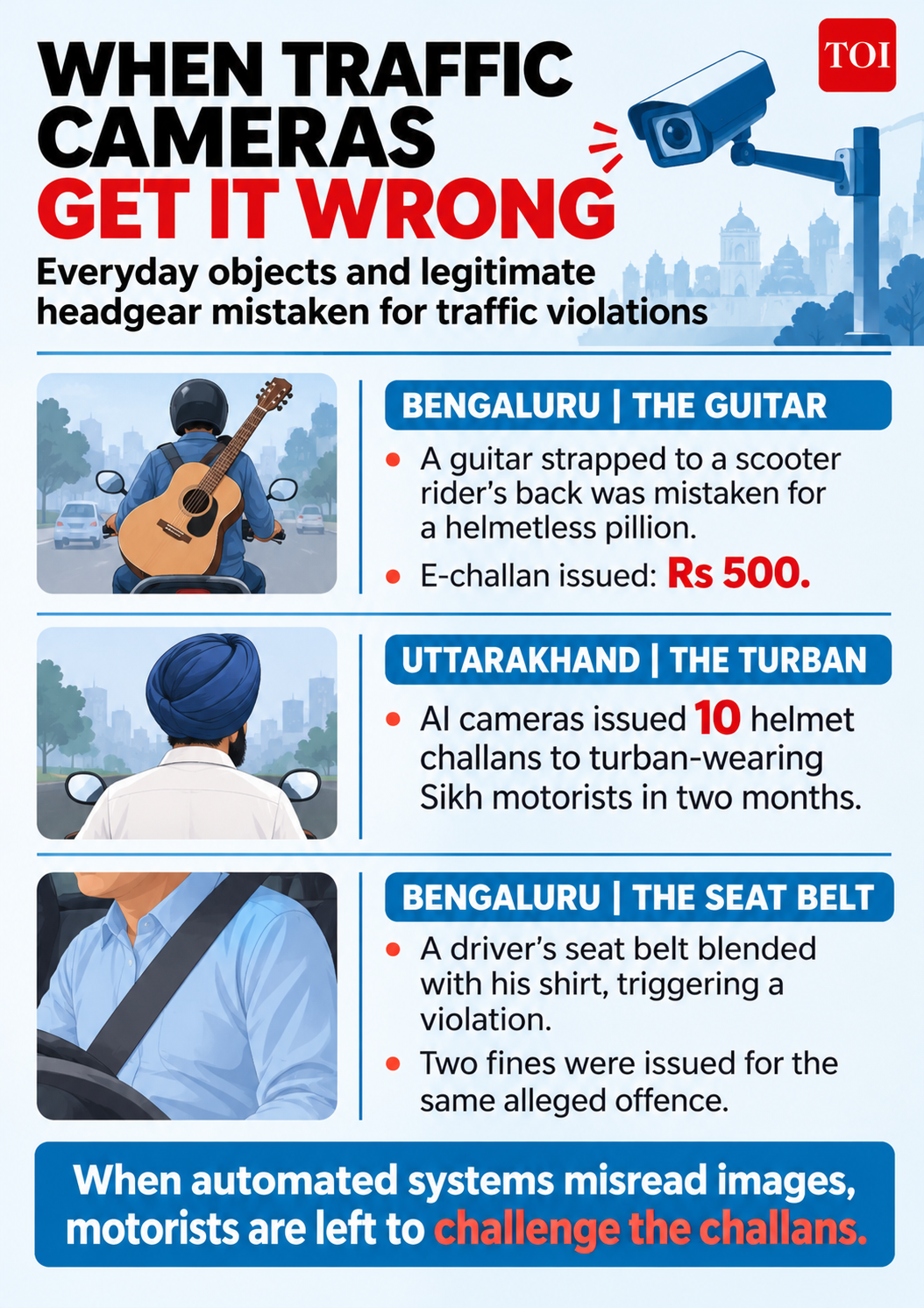
A guitar mistaken for a helmetless pillion, turban-wearing Sikh motorists fined for not wearing helmets, and a seat belt missed by an automated system
The system reportedly issued two fines for the same alleged violation.Traffic enforcement officers had begun reviewing images before fines were finalised.Hyderabad’s problem lay elsewhere in the enforcement chain. Figures from the Hyderabad, Cyberabad and Rachakonda commissionerates added up to more than 50,000 erroneous challans in the first 10 months of 2025.Officials identified automatic number plate recognition (ANPR) as a major source of errors. One system detects a violation, while another reads the vehicle’s registration plate. When the two do not match, the offence can be attributed to the wrong vehicle.DCP (traffic) Rahul Hegde said smudged plates make digits such as 8 and 9 easy to confuse. Officials also acknowledged “double challaning”, in which the same offence is recorded twice by separate cameras.
Not every wrong challan is an AI error
Some incorrect challans do not involve image recognition at all.In Pune, Moti Sutar’s father paid Rs 500 on the spot after a policeman told him that a helmetless-riding challan was pending. Sutar later found that the photograph showed a different person on a different two-wheeler: a Hero Passion carrying the same registration number as the family’s Hero Splendour.He said he approached Pune Traffic Police on Twitter and later submitted a written complaint, but received no response.Police inspector Vijay Bajare said cases involving duplicate number plates surfaced regularly. The complainant had to submit an application along with a copy of the vehicle’s registration certificate. The number was then circulated to all divisions, and the challan against the registered owner was cancelled, he said.Deputy regional transport officer Sanjay Raut said an error in the registration series, even at the dealer’s level, could result in two vehicles being assigned the same number.In Kharghar, the error was human. A policeman at Kurar police station read MH46 BF 2092 as BE-2092. A dot after the F made it look like an E.Resident Shailendra Sharma emailed additional commissioner of police Pravin Padwal, who revoked the challan and issued a fresh one to the owner of a Mahindra Bolero pickup.“Citizens can always challenge the e-challan served to them provided they submit sufficient evidence,” Padwal said.
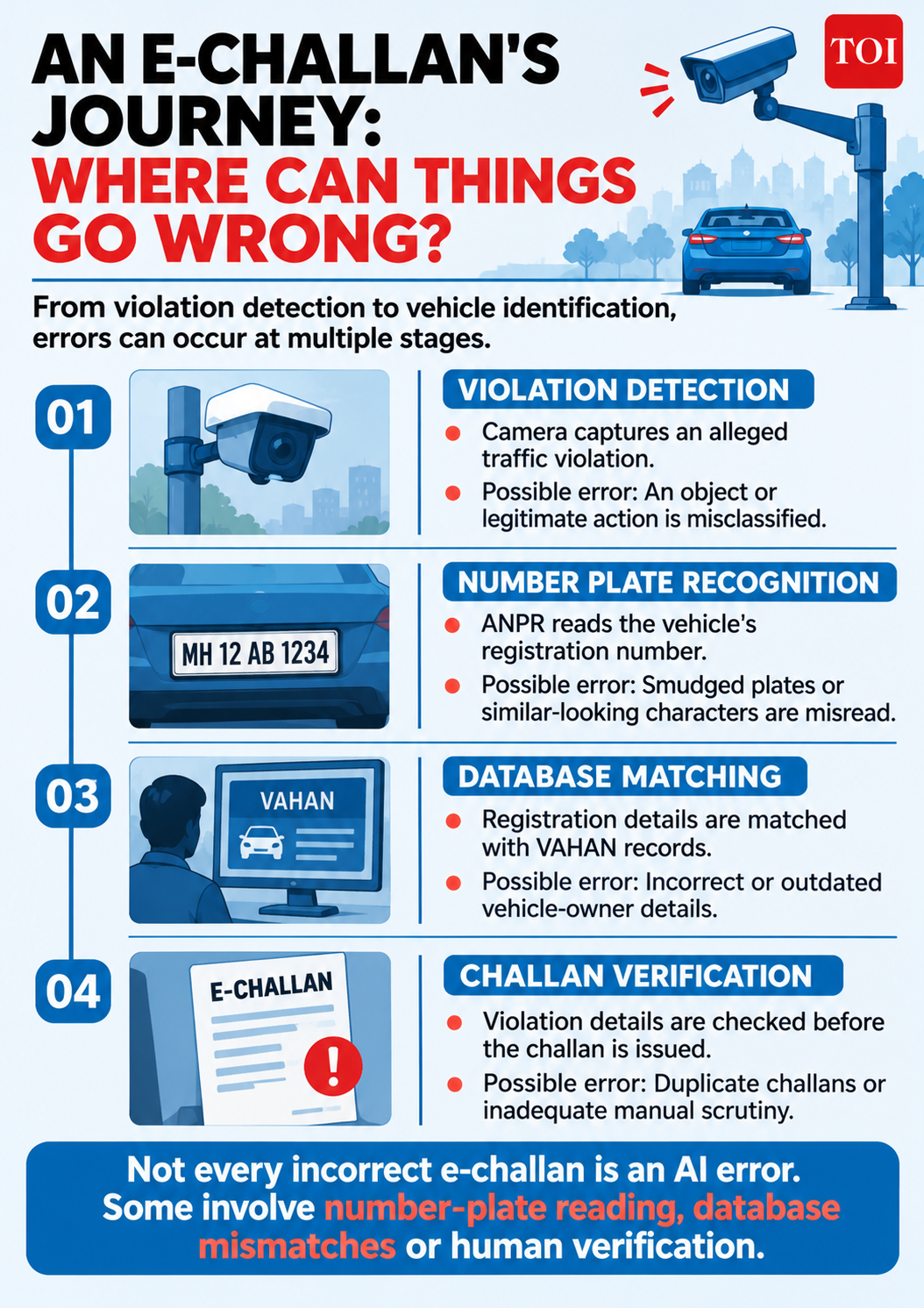
An e-challan’s journey from violation detection to vehicle identification, and where errors creep in
A subsequent Navi Mumbai case involved another motorist fined for a different vehicle because of a duplicated registration number.A separate Mumbai case pointed to a database problem. A media professional told TOI he received a challan for a KTM 200 Duke he did not own. The VAHAN app showed that the violation belonged to another owner.Senior officials acknowledged that the database was not perfect and said a person wrongly fined could write to the department to have their mobile number delinked from the vehicle.
A fast-growing system
The scale of digital enforcement explains why these errors matter. In Bengaluru, nearly 87% of traffic violations between January and July 2025, which is more than three million, were booked through contactless methods. These included AI cameras, digital field traffic violation reports, ASTraM app reports and crowdsourced evidence.Nationally, camera-generated challans rose from 2.04 crore in 2023 to 2.93 crore in 2024 and 3.74 crore in 2025, according to data shared by the ministry of road transport and highways in the Rajya Sabha on March 25, 2026. That represents an increase of about 28% in 2025 over the previous year.The state-wise figures show a sharp expansion in camera-based enforcement. Maharashtra’s camera-generated challans rose from 1.16 lakh in 2023 to 25.4 lakh in 2025. Karnataka’s increased from 1.94 lakh to 8.38 lakh, while Uttarakhand’s rose from 49,639 to 5.22 lakh.
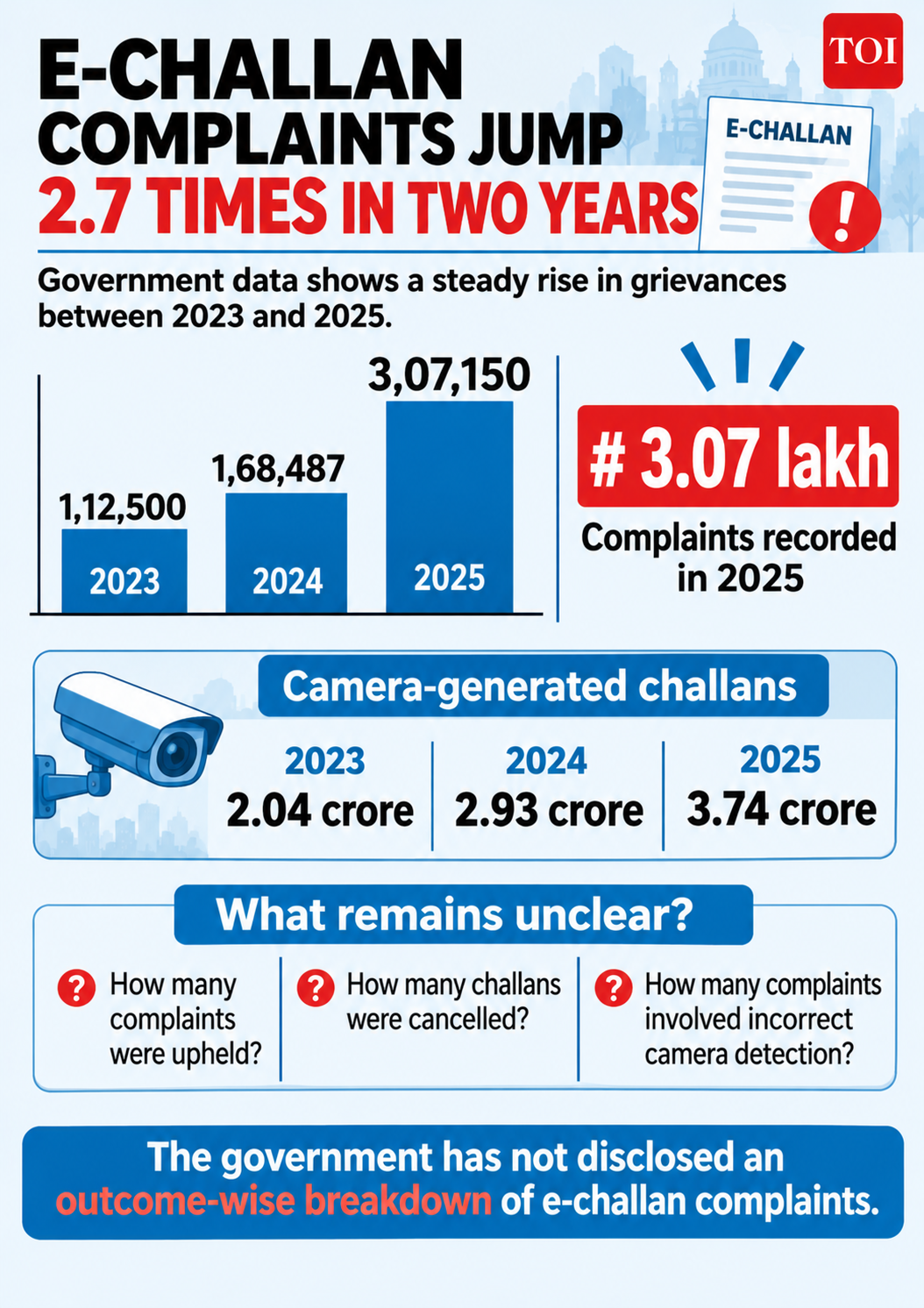
E-challan complaints surge 2.7 times in two years, rising to over 3 lakh in 2025
These figures show how quickly camera-based enforcement has grown. They do not establish how many challans were wrongly issued.The ministry’s annual report describes an integrated system using CCTV cameras, automatic number plate recognition, speed guns and over-speed and red-light violation detection systems.Linked to the e-Challan system and the VAHAN database, the system had been implemented in 22 states, the report said. It recorded more than 6.73 crore traffic violation notices issued through the system at the time.In broad terms, a violation is detected, vehicle registration details are identified and the information is processed before a challan is issued.
The complaints no one has broken down
Complaints against e-challans have also risen sharply.The ministry told the Rajya Sabha that 3,07,150 complaints were received in 2025, compared with 1,68,487 in 2024 and 1,12,500 in 2023. The 2025 figure was about 82% higher than the previous year and around 2.7 times the 2023 figure.But the ministry did not provide a breakdown of how many complaints were upheld, how many challans were cancelled or how many involved incorrect camera detection.A complaint is not proof of an error. The figures cover e-challan complaints in general, not just those involving camera-generated challans. The two sets of numbers therefore cannot be directly compared.What the data does not reveal is whether the reported errors are isolated or recurring, how often a motorist succeeds in challenging a challan, or whether departments are identifying and correcting repeated technical problems.
What a driver can do
The law now provides a formal route to contest an e-challan. Under Rule 167 of the Central Motor Vehicles Rules, 1989, amended through GSR 48(E) on January 20, 2026, a driver has 45 days from the date of issue to either accept and pay the challan or contest it on the designated portal with supporting documentary evidence.If the dispute is not resolved within the next 30 days after this 45-day period expires, the challan ceases to have effect. If the authority rejects the challenge, the driver can pay or approach the appropriate court after depositing 50% of the challan amount, subject to the prescribed procedure.The government’s e-challan portal allows drivers to check challans and access the grievance facility. A person disputing a challan should:
- Check the photograph and compare the registration number, vehicle model and violation details.
- Gather supporting evidence, such as the vehicle’s registration certificate or photographs.
- File a grievance through the designated portal or the relevant state traffic police channel.
- Keep the complaint reference number and track its status.
In Bengaluru, the reporting has referred to the traffic police website and ASTraM app as channels for raising complaints.But a formal procedure does not guarantee an outcome. Neither the rule nor the ministry’s published data tells us how many disputes are resolved within the stipulated time.
The accountability gap
A human check is only as effective as the evidence being examined.In Hyderabad, Cyberabad joint commissioner (traffic) Ghajarao Bhupal said officers usually checked whether a number plate existed in the transport database, rather than whether the vehicle shown in the image had actually committed the violation. Each constable could verify 350 to 500 challans a day, he said, while more than 10,000 were generated daily.Joint commissioner (traffic) Joel Davis said manual verification would not be needed once the technology became “100% reliable”.Until then, much of the burden falls on drivers.After all, a system designed to minimise human error must also have safeguards to ensure that technical errors do not become a burden on people driving vehicles.

Leave a Reply