
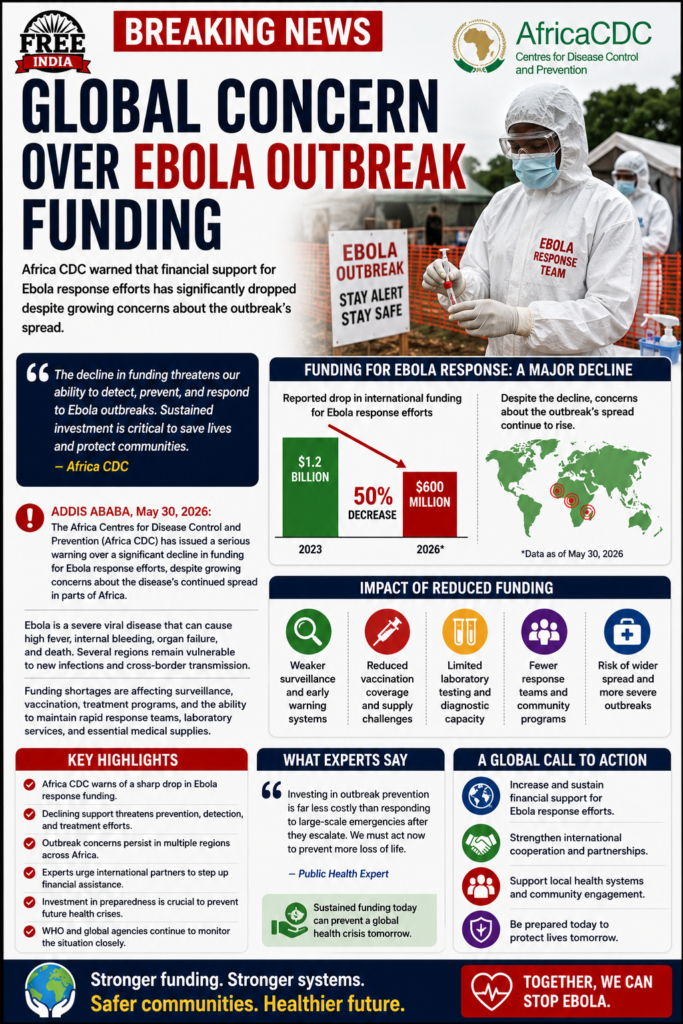
Addis Ababa, May 30, 2026: The Africa Centres for Disease Control and Prevention (Africa CDC) has issued a serious warning over a significant decline in funding for Ebola response efforts, despite growing concerns about the disease’s continued spread in parts of Africa. Health officials fear that reduced financial support could undermine critical containment measures and increase the risk of wider outbreaks.
According to Africa CDC, international funding and emergency health assistance directed toward Ebola surveillance, treatment, vaccination programs, and community awareness campaigns have dropped considerably in recent months. The decline comes at a time when several regions remain vulnerable to new infections and cross-border transmission.
Health experts warn that sustained financial support is essential for maintaining rapid response teams, laboratory testing capacity, contact tracing operations, and vaccination campaigns. Without adequate resources, authorities may struggle to identify and isolate new cases quickly, increasing the possibility of further spread.
Ebola is a severe viral disease that can cause high fever, internal bleeding, organ failure, and death. Although significant progress has been made in developing vaccines and treatment methods, outbreaks continue to pose a major public health challenge in vulnerable regions with limited healthcare infrastructure.
Africa CDC officials emphasized that funding shortages are affecting multiple aspects of outbreak preparedness. Several local health programs have reportedly reduced operations, while some emergency response teams face difficulties maintaining equipment, medical supplies, and staffing levels.
The warning has prompted renewed calls for international organizations, donor nations, and global health partners to increase support for disease prevention and emergency preparedness initiatives. Public health experts argue that investing in outbreak prevention is far less costly than responding to large-scale health emergencies after they escalate.
The World Health Organization (WHO) and other health agencies continue to monitor Ebola-related developments closely. Experts caution that weakened surveillance systems could allow outbreaks to spread unnoticed, especially in remote areas where access to healthcare services remains limited.
Global health specialists also stress that lessons learned from previous Ebola outbreaks and the COVID-19 pandemic highlight the importance of maintaining strong public health infrastructure even when case numbers appear under control.
The situation has attracted international attention as governments and health organizations assess the potential consequences of declining financial support. Officials warn that sustained cooperation and investment will be essential to prevent future health crises and protect vulnerable populations.
Key Highlights
- Africa CDC warns that Ebola response funding has declined significantly.
- Concerns are growing over the potential spread of the disease.
- Reduced funding affects surveillance, vaccination, and treatment programs.
- Health experts call for increased international financial support.
- Ebola remains a serious public health threat in vulnerable regions.
- WHO and global health agencies continue monitoring the situation.
Conclusion:
The Africa CDC’s warning serves as a reminder that global health threats require continuous attention and investment. As concerns about Ebola persist, health experts stress that maintaining strong funding and preparedness efforts is crucial to preventing future outbreaks and safeguarding public health across the region.

Leave a Reply