
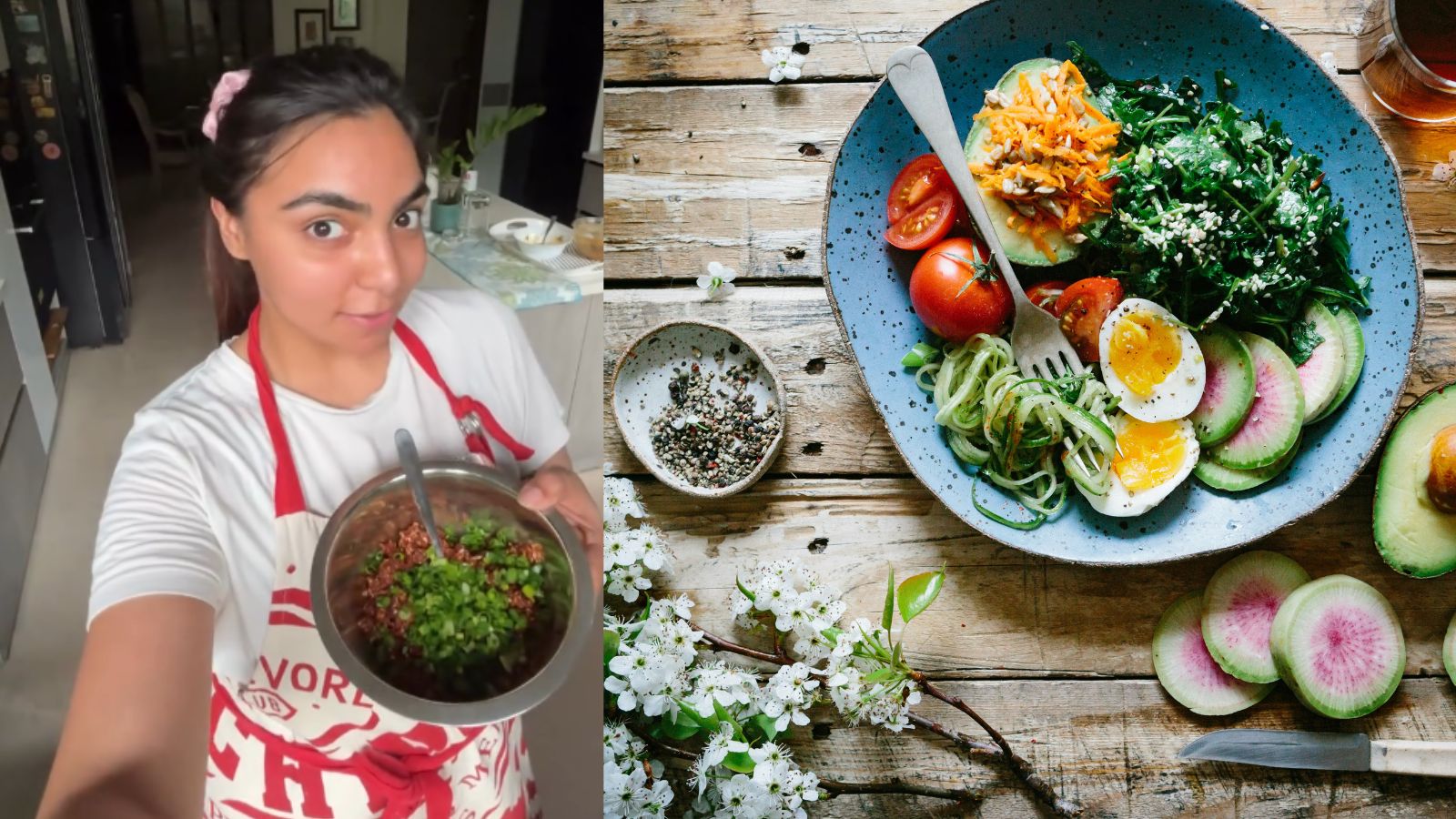
The fat-to-fit story excites us all. And why not? We are always looking for quick fixes to lose weight, stay healthy, and yes, skip the gym. Makeup content creator Abhiniti Sikka recently shared a reel claiming she went from 100 kilos to 75 without any crash diets.
Describing what she eats throughout the day, she says, “My day begins with kesar water, which is good for digestion and weight loss. Then, I have my three egg whites with some bagel seasoning on it. Next, I have dandelion tea, which is so good for bloating,” adding that her iced coffee time is the best part of her day.
DISCLAIMER: This article is based on information from the public domain and/or the experts we spoke to. Always consult your health practitioner before starting any routine.
Further talking about her lunch, Sikka says that it is “mostly a low-carb, high-protein roti. A fibre-rich sabzi and any source of protein”, which she pairs with a fresh batch of chilli oil made by herself.
This follows a post-gym protein shake, a homemade snack, and a plate of moong dal daliya for dinner.
But is this kind of diet sustainable long-term?
Samiksha Chordiya, senior dietician at DPU Super Specialty Hospital, Pimpri, Pune, says, “Healthy, sustainable weight loss is not about skipping meals, following extreme diets, or drastically cutting calories. It is about developing an eating pattern that provides adequate nutrition while supporting a gradual, manageable calorie deficit.”
Deepa Mishra, dietitian, Narayana RN Tagore Hospital, Mukundapur, Kolkata, highlighted that this plan appears to be low in fibre, with an inadequate intake of fruits and vegetables, and it may also fall short on protein, vitamins and other essential micronutrients.
Delving into details, she says, “Kesar (saffron) water is not essential for digestion or weight loss, and iced tea should ideally be prepared without sugar syrup to avoid unnecessary added sugars that can hinder weight-management efforts. Protein drinks are not mandatory when natural, whole-food protein sources can comfortably meet daily requirements.”
Story continues below this ad
She also mentions that diet alone is often insufficient for weight loss and increasing physical activity through structured exercise is equally important for sustainable results.
“Specifying portion sizes, diversifying food choices, prioritising less processed and more fibre-rich options, and balancing protein, fat and carbohydrates as per body weight, physical activity level and sleep pattern together support healthier and more sustainable weight reduction,” she adds.
What is potentially missing or inadequate in this day’s diet?
A diet can be low-calorie and still be nutritionally inadequate. Weight loss is not the same as nourishment. That is the biggest concern experts see in Abhiniti’s meal plan.
Mentioning the food items that are missing or inadequate in her diet, Nupur Gulati, nutrition and lifestyle transformation expert, lists the following:
Story continues below this ad
Starting the day: Saffron water should not be positioned as a weight-loss or digestion remedy. There is no magic morning drink that drives fat loss. I would keep it simple: warm water with lemon, primarily for hydration.
Breakfast: Three egg whites provide protein, but removing the yolks also eliminates important nutrients and healthy fats. If there is no specific medical reason to restrict them, prefer 1–2 whole eggs with 3–4 egg whites. Also add a quality carbohydrate —whole-grain toast, oats or an oats chilla — to improve satiety and make the meal more balanced.
Lunch: This is where the biggest gap appears. The meal seems very portion-controlled but lacks adequate vegetable volume, dietary fibre and a clearly defined protein serving. There is also no visible salad. I would start with a large plate of salad, followed by a substantial protein source like any lentil, paneer, chicken /or fish in a visible controlled portion, vegetables and a measured carbohydrate.
A roti is absolutely acceptable; whole wheat, jowar, bajra or amaranth can be excellent choices. Rather than buying a processed “high-protein atta”, I prefer using a naturally protein containing grain and adding a separate, identifiable protein source. Let a carbohydrate be a carbohydrate! Have roti for its complex carbohydrates and B vitamins, and get your protein from a real protein source rather than relying on highly processed, protein fortified atta.
Story continues below this ad
 Weight Loss Diet: What’s Missing From This Daily Meal Plan? (Image Source: Unsplash)
Evening snack: The evening snack is another weak point. Murmura with peanuts can be perfectly acceptable, but the combination is predominantly carbohydrate-based and can become calorie dense depending on the portion and preparation. Calling the finished mixture ‘fat-free’ is misleading when peanuts are included. Interestingly, the healthy fats from those peanuts are actually a positive thing but it’s definitely not fat free.
Better options could be Greek yoghurt with nuts, eggs with guacamole, or another protein-rich snack that keeps you satiated up till dinner. You could also pair some fruits with nuts or roasted chana with makhana are other options.
Dinner: This needs a protein anchor. Moong-dal daliya is wholesome, but for someone training at the gym, I would want to see a clearly defined protein source — chicken, fish, paneer or tofu — alongside vegetables. This helps support muscle protein synthesis, recovery and satiety.
The protein shake after exercise can stay, provided it genuinely delivers adequate protein.
Story continues below this ad
Lastly, Nupur says that she would move away from a diet built around ‘low-carb’, ‘fat-free’, ‘detox’, ‘anti-bloating’ and ‘weight-loss’ labels towards food that has adequate protein, fibre, micronutrient density, healthy fats and whole-food variety.
DISCLAIMER: This article is based on information from the public domain and/or the experts we spoke to. Always consult your health practitioner before starting any routine.

Leave a Reply