
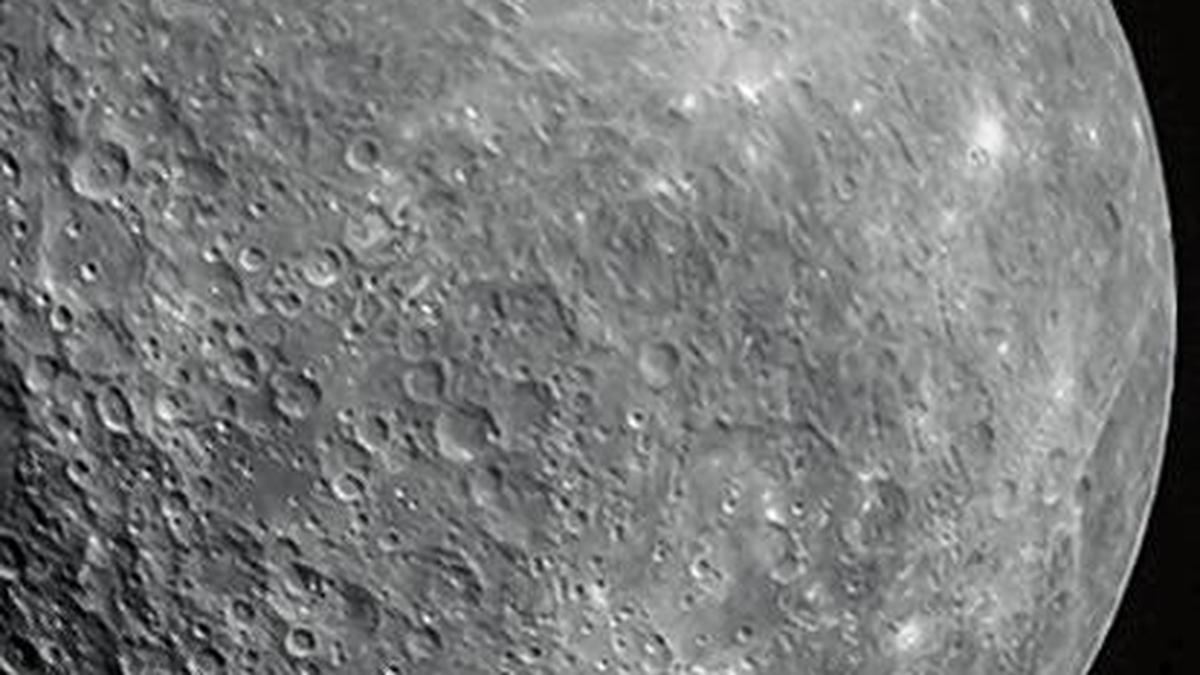
Nearly six years after it was launched, India’s second moon mission Chandrayaan-2 continues to provide valuable data on the satellite.
In a new finding, scientists have found the possible presence of subsurface ice in lunar south polar regions. These were the findings of scientists from Physical Research Laboratory (PRL) who used observations from the Chandrayaan-2’s Dual Frequency Synthetic Aperture Radar (DFSAR) payload.
In this study, scientists focused on doubly shadowed craters, which are special craters located inside permanently shadowed regions (PSRs) of the moon.
Due to continuous shielding from sunlight and thermal radiation, these regions remain extremely cold (temperatures -25K) and are considered favourable locations for preserving water-ice over long geological timescales.
Using advanced radar polarimetric analysis, scientists identified radar signatures consistent with the possible presence of subsurface ice beneath the floors of four doubly shadowed craters in the lunar South Polar Region.
“The study proposes a refined radar-based criterion for identifying subsurface ice, where Circular Polarization Ratio (CPR) values greater than 1, together with Degree of Polarization (DOP) values lower than 0.13, indicate volumetric scattering potentially associated with subsurface ice,” ISRO stated.
The DOP is a radar polarimetric parameter that measures how much of the reflected radar signal retains its original polarisation state after interacting with the surface, or subsurface material. This approach helps distinguish genuine ice signatures from radar signals produced by rough rocky terrain.
“Among the investigated craters, one crater of 1.1 km diameter within Faustini crater shows particularly strong evidence of subsurface ice, supported by both radar observations and distinctive lobate-rim morphological characteristics. A lobate-rim morphology refers to flow-like or lobed appearance, suggesting the impact may have penetrated subsurface ice, producing the observed lobate-rim crater,” ISRO added.
These findings are expected to provide important new insights into the distribution of lunar polar volatiles, and have significant implications for future lunar exploration missions, including identification of potential ice-bearing regions for future landing and in-situ resource utilisation (ISRU) activities.
India’s second moon mission
The Chandrayaan-2 mission was launched in July 2019. On September 7, while the Vikram lander was attempting to touch down on the moon surface, communication with the lander and ground station was lost.
However, Chandrayaan-2’s orbiter is healthy, and all the payloads are operational. The DFSAR is one of the mission’s eight payloads.

Leave a Reply