
Few state polls have been as dramatic as this round. TOI explains the verdicts through 10 decisive factors, from freebies becoming entitlements to women’s safety, and from Hindu vote to Gen Z angst1) Return of anti-incumbencyFor a while, anti-incumbency seemed like a fading ghost. Repeated successes of several incumbents, most notably Narendra Modi, had cast doubt on the old belief that time in power naturally breeds defeat. This set of verdicts, however, serves as a reminder: anti-incumbency lies dormant, unless neutralised by effective governance and sharp political instinct.Mamata Banerjee, MK Stalin, and Pinarayi Vijayan, each formidable in their own right, operating different theatres, were undone by the weight of accumulated public discontent, headlined by voter disenchantment around corruption and crime.Mamata was voted to office in 2011 by a public tired of 34 years of Left rule.
Election Results 2026
She was seen as an agent of change.But her own regime got entangled in the vocabulary of decay: “tolabazi,” “syndicate,” and the pervasive “cut money” culture. Governance, in many pockets, appeared outsourced to local strongmen. Stalin’s tenure struggled under the shadow of rising crime, particularly against women and SCs. Corruption, though not unique to his administration, became increasingly visible, amplified by the arrest of senior ministers, and damning judicial observations against figures like Senthil Balaji.
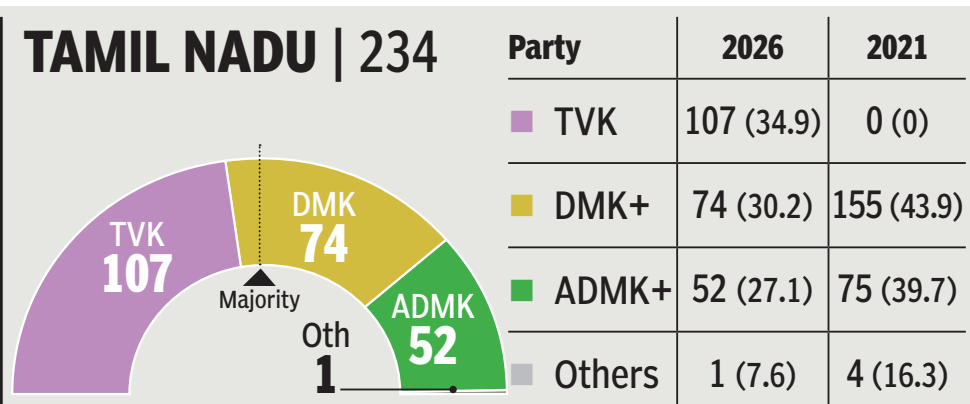
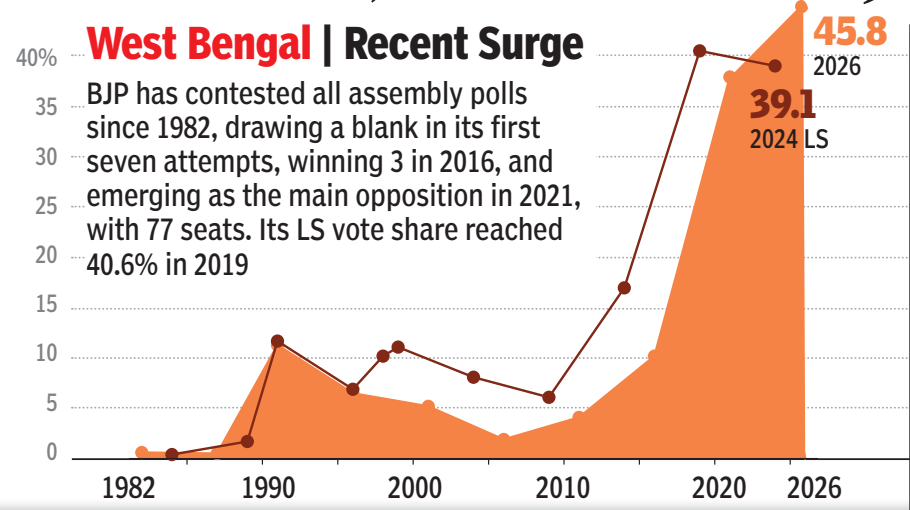
This was exploited by Vijay. As for Pinarayi, allegations of corruption, including the controversy surrounding the Sabarimala temple gold theft, eroded trust.Compounding this was a strategic misstep: putting Pinarayi above the party. That ensured CPM personalised both power and blame. So, why did Himanta buck the trend? His win lies in delivery, tangible development, welfare outreach, and sharp political rhetoric. Performance, coupled with narrative control, acted as his shield, while delimitation was a factor as well.2) Arc of Hindu ConsolidationBJP victories in Bengal and Assam demonstrate the steady consolidation of Hindu votes, despite substantial Muslim presence in both states. Bengal showcases a cultural pivot. Invocations of Ram may have outgrown earlier association with Hindi heartland.Mamata’s confrontational stance in 2021 transformed ‘Jai Sri Ram’ into a slogan against ‘appeasement’. Her governance choices fed this perception. Restrictions that appeared stringent, when contrasted with her outreach toward Muslims, became talking points.Also read| Assembly elections result: BJP is Bengal Janata’s Party, Vijay Divas in TN, Keralove for CongressViolence in Murshidabad, Malda, and Sandeshkhali were amplified as evidence of selective governance, whether fairly or not, and folded into a broader narrative of imbalance. Mamata attempted course correction. Stipends for Hindu priests, mirroring earlier support extended to imams, and state backing for Durga Pujas,were introduced. But they came too late.External developments sharpened the narrative. Reports of attacks on Hindus in Bangladesh lent urgency to BJP’s messaging on infiltration, framing the issue in terms of ‘demographic anxiety’. In Assam, similar themes have long been part of politics.BJP refined and expanded AGP’s anti-infiltration rhetoric. Crucially, ripple effects of Hindu consolidation extend beyond these two states. In Kerala, CPM’s stance during the Sabarimala controversy, particularly its alignment with activists pushing for women’s entry, triggered a backlash among sections of Hindu voters. Even a subsequent recalibration failed to fully reverse the political cost, with BJP getting a non-trivial vote share, despite a broader pro-UDF swing.
Tamil Nadu offers a different variation of the theme. DMK’s attempts to mobilise sentiment through sharp antiSanatan rhetoric did not quite hold its coalition together. Across these diverse terrains, the pattern is, of course, not identical, but the direction is clear.Identity, perception, and political signalling are converging in ways that are steadily reshaping electoral coalitions, with Hindu consolidation emerging as a quiet but potent force.3) The Muslim factor and a narrowing political spaceIn recent years, Muslim electoral arithmetic failed to halt BJP’s advance, whether in UP, Assam, or Bihar. Bengal was expected to offer a different script. It didn’t. In Assam and Bihar, BJP’s success has often been powered by its critique of ‘appeasement’.The resultant counter-consolidation has altered the operating space for ‘secular parties’. They now find that outreach to Muslim grievances risks alienating Hindu voters, while restraint invites disillusionment among minorities. Mamata’s positioning illustrates this dilemma.She was widely perceived to have leaned toward Muslim constituencies, a strategy that, over time, seemed to narrow her appeal among sections of Hindus. Such a balancing act was more manageable before Hindutva emerged as a dominant political force.In Assam, for instance, it successfully carried both Hindu and Muslim voters for Congress. Assam offers a different picture now. Congress is largely confined to Muslimdominated pockets in the state. Kerala reflects a different, but related dynamic. CPM found itself at a disadvantage in the contest for Muslim votes, as Congress-led UDF benefited from its alliance with the IUML.Left attempted to counter this by issuing warnings over IUML’s growing influence within UDF, but it stopped short of a full-scale confrontation, given by its own political calculus. Identity consolidation on one side has triggered strategic recalibration on the other, often leaving minority politics fragmented. And BJP has shown a consistent ability to step into these gaps.4) Modi’s enduring magnetismIf there were doubts about Modi’s political appeal after BJP’s underwhelming performance in 2024, these results have laid them to rest. That phase now appears less like a turning point, and more like an aberration. In Bengal, he emerged as a decisive force, helping BJP offset structural disadvantages: the absence of a local leader to rival Mamata’s stature, and an organisational network far less entrenched than Trinamool’s muscular machinery.Where the party lacked a road forward, his presence acted as a bridge. His persona continues to be carefully curated: incorruptible, pro-poor, nationalist, tireless, and projecting authority. In politically difficult, even hostile terrain, that image does more than attract attention; it converts sentiment into votes.Also read: ‘Poriborton hoye gechhe; let’s talk change, not revenge,’ says PM ModiModi softens the ground, and Amit Shah steps in to cultivate and harvest. Assam offers a telling vignette. In Dibrugarh, among tea garden workers, in what was once considered a dependable Congress bastion, Modi’s outreach carried a distinct resonance.State promises were not presented as routine governance, but wrapped in the persuasive stamp of “Modi ki guarantee.” The result was emphatic: BJP swept all six seats in the region. Modi’s appeal remains a force multiplier, capable of redrawing political maps where BJP might otherwise struggle to find its footing.5) SIR and the electoral chessboard EC’s SIR of voter rolls emerged as a pivotal factor in Bengal, acknowledged by both BJP and Trinamool, though interpreted through entirely different lenses.TMC claimed the exercise was nothing short of a calculated purge, aimed at disenfranchising Mamata’s core support base, particularly Muslim voters. It framed the revision as an institutional manoeuvre designed to tilt the electoral field. BJP, however, offered a starkly different narrative.It argued that the revision merely cleansed voter rolls, removing the “dead,” the “doubly registered,” and the “absent or shifted” categories it claims had long been exploited. According to this view, the pruning denied TMC an entrenched advantage, allegedly built through inflated voter lists, enabled by a pliant state machinery.BJP also argued that a significant portion of the nearly 27 lakh voters, who were flagged for “logical discrepancies”, fell into this grey zone, individuals whose eligibility was suspect, and whose inclusion, it claimed, had historically served to swell vote banks of both TMC and, earlier, Left.It also accused Mamata of attempting to blur distinctions between legitimate exclusions and questionable entries, turning the issue into a broader political narrative of Bengal versus Centre. Where the truth ultimately lies will likely be settled only through appellate scrutiny of contested exclusions.For now, one conclusion stands out: TMC was unable to effectively weaponise the issue against BJP. Whether this was because its narrative failed to resonate with ground realities is, as of now, an open question. Equally significant were EC’s measures to ensure freer voting conditions.By reducing fear and coercion, these steps may have not only diluted TMC’s claims, but also emboldened many voters who desired change. They had, possibly, previously hesitated to express their choice at the ballot box.6) Double engine promiseDismissed by critics as little more than a political jumla, BJP’s ‘double engine’ model has quietly gathered believers, even in states governed by its opponents.The idea is simple but potent: alignment with a ‘friendly’ Centre does not just unlock central schemes, especially big-ticket infrastructure, it also signals stability and policy coherence to private investors. Paradoxically, some non-BJP govts have strengthened this narrative through resistance.
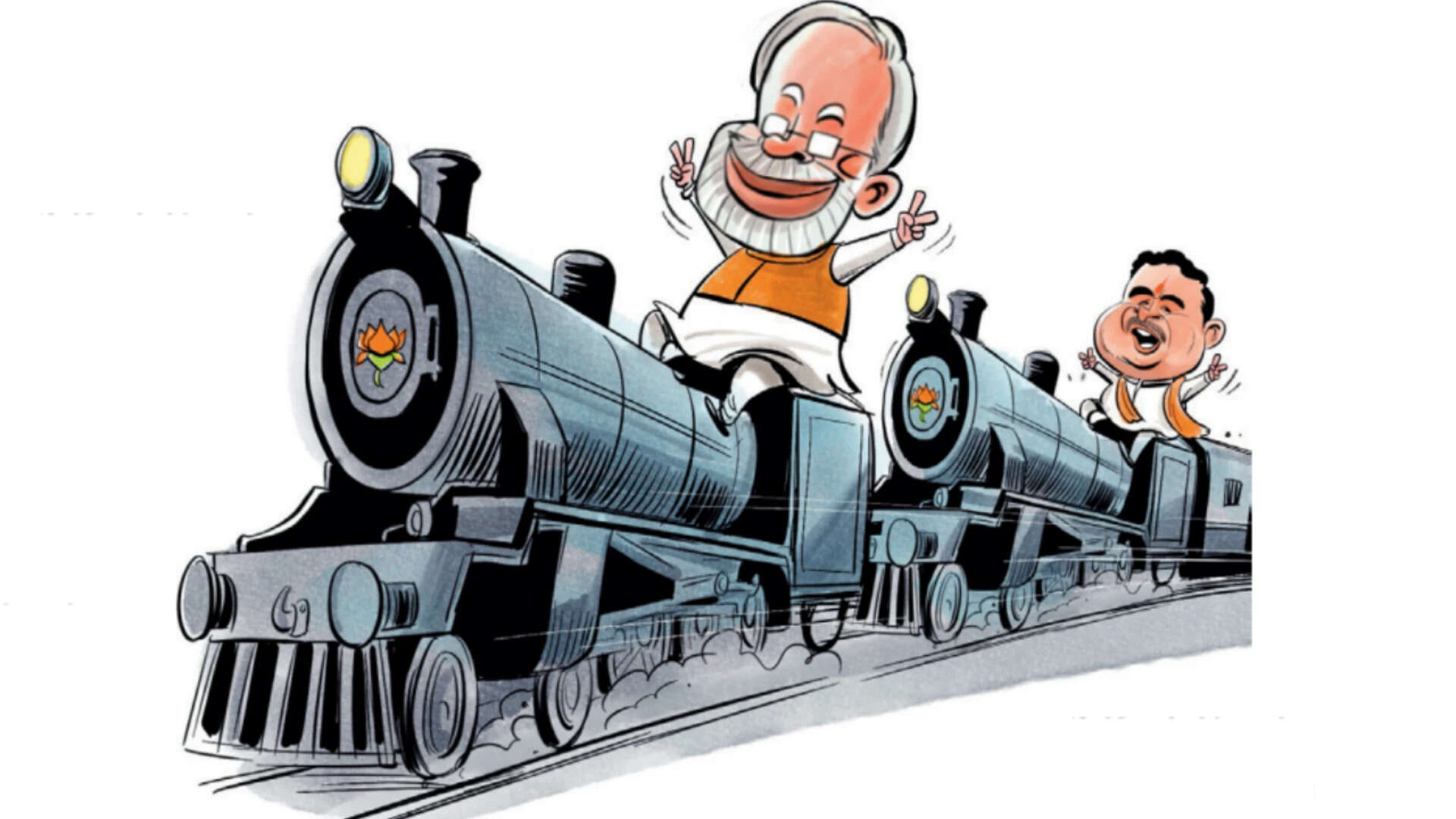
By opting out of schemes like Ayushman Bharat, or by sidestepping conditional frameworks tied to subsidized housing, rural roads, and employment guarantees, they seek to avoid ceding political credit to a Centre-branded welfare architecture.The schemes, after all, carry the unmistakable imprint of ‘Modi’. But this strategy carries a quiet risk. Governance gaps do not exist in isolation; they invite comparison. Voters look to other states, weighing what is delivered against what is withheld.Bengal offers a telling contrast. Its long arc of de-industrialisation appears sharper when set against Assam’s recent investment surge, crowned by high-profile projects like the Tata semiconductor plant. Similarly, its infrastructure story struggles to match the visible gains made by Bihar in recent years.The ‘double engine’ pitch, then, draws strength not just from promise, but from contrast. Some facts are buttressed by perception.7) Migration and the politics of lossMigration emerged as a powerful undercurrent in these elections, less a statistic and more a shared pain.Voters in Bengal spoke with unusual candour about the irony that shadows the state: once a magnet for industry and opportunity, it now exports its people, often as low-wage labour, not just to traditionally developed regions, but also to states that have surged ahead on the back of investor-friendly policies.This shift is more than economic, it is deeply personal.It lives in quiet households, where ageing parents navigate daily life alone, their children scattered across distant cities in search of work. Each departure is a small fracture, repeated thousands of times over, until it becomes a defining social reality.Politically, migration has come to symbolise something larger, the long arc of de-industrialisation, economic drift, and the perceived limits of Mamata’s ‘Maa, Maati, Manush’ model. What was once framed as a grassroots, peoplefirst approach, now faces a harder question: can it generate enough opportunity to keep its own people rooted?In that sense, migration is no longer just movement. It has become a verdict, quietly delivered, on the state’s economic direction.8) Women’s security and the shifting groundWomen had long been Mamata’s most dependable constituency. Their support was instrumental in helping her withstand BJP’s aggressive push in both 2021 assembly elections and 2024 Lok Sabha polls. But this time, that pillar showed visible cracks.A series of disturbing crimes against women altered the political mood. The rape of a junior doctor at R G Kar Hospital, the incident at Durgapur Medical College, and allegations of systematic harassment in Sandeshkhali, collectively eroded the trust that ‘Didi’ had carefully built among women voters.Also read| INDIA footprint fades on Bharat map as allies stumble in WB, TNWelfare schemes like Lakshmi Bhandar and Kanyashree had created a reservoir of goodwill, but that emotional bank began to run dry, in the face of fear and anger. The brutality of these incidents was, in itself, deeply unsettling. But what amplified their impact was the perception of govt’s response.In the R G Kar case, questions lingered over whether the administration acted decisively enough, or whether it allowed doubts to grow about accountability, and the handling of evidence.After the Durgapur tragedy, Mamata’s remark that “girls should not stay out after 8pm” struck many as horribly misplaced, shifting the burden of safety onto victims, rather than to the system meant to protect them. Her outright rejection of allegations in Sandeshkhali, which included claims of targeted harassment of Hindu women, further complicated matters.By dismissing these charges, and appearing to defend those accused, she made many women think her response lacked empathy and urgency.In politics, perception often travels faster than policy. For a leader whose connection with women voters had been both emotional and political, these moments added up to a critical rupture, where assurance gave way to anxiety, and loyalty began to waver.9) Cash transfer minus upper limitEvery party now competes in offering more cash to voters, turning what was once an electoral innovation into a baseline expectation.Early movers have lost their edge. Gratitude has matured into entitlement, and entitlement, once awakened, is politically restless. Beneficiaries have become discerning consumers in a crowded marketplace of promises, free to shift allegiance to whoever offers more.Mamata felt the force of this shift when women voters, once her most steadfast supporters, drifted toward a rival offering Rs 3,000 a month, double the benefit under Lakshmi Bhandar. The upper limit escalation is striking. In Assam, BJP promises include phased increases under the Orunodoi scheme, lump-sum payouts of Rs 25,000 for existing beneficiaries, and expanded coverage.Tamil Nadu, long the laboratory of welfare politics, has pushed the envelope further. Vijay’s pitch blends cash transfers with symbolic and material gestures, Rs 2,500 monthly for women heads of households, gold at marriage, gifts for newborn girls, and annual support for mothers with school-going daughters.It is welfare as spectacle. Per PRS, by 2025–26, at least 12 states will be running unconditional cash transfer schemes for women, with a combined outlay nearing Rs 1.7 lakh crore. But who pays for it all?Bengal, already grappling with strained finances and a projected fiscal deficit of 4.3%, faces mounting pressure to balance welfare commitments with capex. Tamil Nadu and Kerala, though better placed, are facing similar constraints.Economic Survey sounded a quiet alarm: while such transfers provide immediate relief, they carry long-term risks for fiscal stability and economic growth. Welfare wins elections, but it can also weigh down the very systems that sustain it. Politics races ahead, cheque in hand, while economics lingers behind, asking how long the engine can keep running.10) The Gen Z surgeDhaka to Sofia, Kathmandu to Nairobi, Gen Z has already shown its capacity to unsettle entrenched power. Now, that restless tide has touched Indian shores.In Tamil Nadu, it washed up with force, breaking against the familiar coastlines of Marina and Mahabalipuram, and in the process, shaking a Dravidian order that had stood firm for over five decades. This is a generation impatient with inertia, uneasy with the quiet acceptance of “chalta hai,” and eager to step out from the long shadow of inherited political scripts.Armed with the amplifying power of social media, and often moving in tandem with women voters, it helped propel Vijay from cultural icon to political contender with striking speed. To be sure, the ground was already shifting. Towering legacies of Karunanidhi and Jayalalithaa left behind shoes their successors have struggled to fill.But there was also a mismatch between aspirations of a younger electorate and the vocabulary of established politics. Where the old guard spoke in familiar cadences, Gen Z tuned into a different frequency. Yet, the scale of Vijay’s rise, while impressive, resists easy replication.India is not a single stage but a mosaic of political theatres, each with its own script. The Gen Z impulse can be absorbed, redirected, or even co-opted by established players.A seasoned challenger, even one shaped by older traditions, can still harness that energy. Enduring social structures like caste can act as breakwaters, slowing or reshaping the surge.Meanwhile, the adaptive nature of Hindutva has shown a remarkable ability to absorb the desire for change and redirect it against what is framed as a ‘decadent secular’ order. The Gen Z effect, then, is not a uniform wave.It is a shifting current, powerful but uneven, capable of redrawing coastlines in some places, while merely rippling the surface in others.

Leave a Reply