
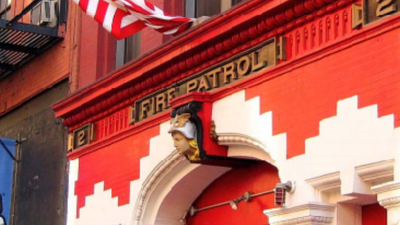
When Anderson Cooper bought a historic former fire patrol house in New York’s Greenwich Village for $4.3 million in 2010, the purchase raised concerns among local preservationists, according to contemporary reporting by DNAinfo and the Village Preservation Society. The four-storey building at 84 West 3rd Street had spent decades as a working Fire Patrol station, and its history was tied not only to New York’s firefighting past but also to one of the city’s most painful chapters: the September 11 attacks. Today, the 8,240-sq-ft property has been transformed into Cooper’s private home. Yet its historic identity has not disappeared. Cooper restored the building’s distinctive exterior, while elements of the former fire patrol house, including its original fire poles, were retained inside. The building was later protected as part of the South Village Historic District.
A firehouse that wasn’t part of the FDNY
Built in 1906 and designed by architect Franklin Baylies, Fire Patrol House No. 2 was not an ordinary New York firehouse. It belonged to the New York Fire Patrol, a privately funded service established by insurance companies to respond to fires and, importantly, protect buildings and their contents from damage caused by fire and water.The institution had roots stretching back to the early 19th century and predated New York’s municipal fire department. By the early 2000s, the New York Fire Patrol was the last operating insurance-supported firefighting organisation of its kind in the city. But in 2006, the service was disbanded and its properties were put up for sale.That triggered a preservation campaign. Village Preservation, then known as the Greenwich Village Society for Historic Preservation, had been pushing for the 84 West 3rd Street building to receive landmark protection, concerned that a private buyer could eventually alter or demolish it.
Cooper’s purchase raised fears, then changed the story
Cooper’s purchase initially worried preservationists and former fire patrol officers. The concern was straightforward: what would happen to a historic firehouse once it became a private home? Instead, the building underwent a major interior renovation while its distinctive historic character was retained. Village Preservation later described Cooper as having kept the building’s character intact while adapting it for residential use.The preservation battle also ultimately had a successful ending. The property was determined eligible for the State and National Registers of Historic Places in 2010. In 2013, it became part of the South Village Historic District, giving the building formal landmark protection.
Its most poignant connection is to 9/11
Perhaps the most remarkable chapter in the building’s history involves Keith Roma, a member of Fire Patrol No. 2. Roma, 27, had worked at the station for six years, following his father Arnold, who had also served with the Fire Patrol. On September 11, 2001, members of the patrol rushed to the World Trade Center alongside other first responders.Roma entered the North Tower repeatedly, helping people escape. He ultimately died at the World Trade Center and was the only New York Fire Patrol member killed there that day. His remains were recovered on Christmas Eve, 2001. Because the New York Fire Patrol was not part of the FDNY, Roma is not included in the official figure of 343 FDNY firefighters killed on 9/11. The State of New York, however, lists him among its fallen firefighters as a Fire Patrol member who died at the World Trade Center.
From working firehouse to protected home
Over a century after its initial construction, 84 West 3rd Street has experienced a truly astonishing metamorphosis. What was once a functioning station for a now largely forgotten private firefighting service has been transformed into a residential space. However, the exterior and architectural character of the building have been preserved and remain protected. The fire pole, which has been carefully maintained amidst this transformation, serves as perhaps the most straightforward reminder of the building’s illustrious past, a place that once served as both a home and operational base for firefighters who lived, worked, and responded to emergency calls long before it earned its reputation as one of New York’s most distinctive celebrity residences.

Leave a Reply