

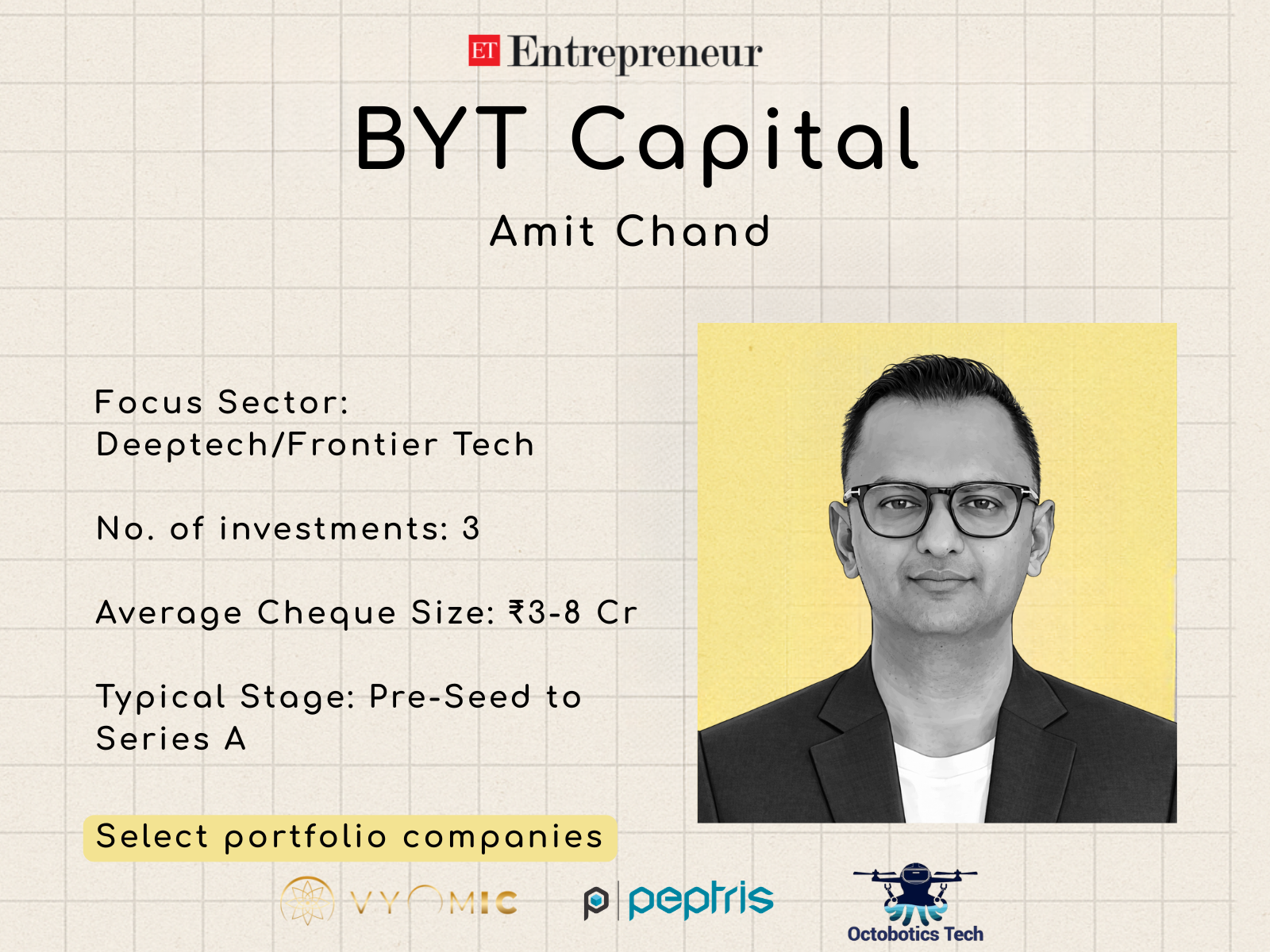
 BYT plans to invest in 18 to 20 companies over four years, writing first cheques of ₹2.5 to ₹3 crore and reserving more than half its capital for follow-on rounds
“BYT stands for building your tomorrow,” said Amit Chand. “That tomorrow is primarily for the nation.”
For Chand, investing in deeptech was a response to something he believes India still lacks: intellectual property-led manufacturing. He didn’t want to back startups that merely assemble components made elsewhere, or ones that provide services layered over global platforms. His thesis was to back products conceived and engineered from first principles in India, for the world.
BYT Capital, the Bengaluru-based deeptech fund he now runs, grew out of that conviction.
From angel idealism to institutional structure
Chand did not set out to become a venture capitalist. Trained in fashion technology and retail management, he spent years in the corporate world before leaving in 2017 to build his own business. Investing began almost accidentally in 2019, when he started backing startups as an angel.
At the time, capital for science-led startups was scarce. Chand began writing cheques anyway. Over six years, he made more than 30 deep-tech investments and became a limited partner in four VC funds to understand how general partners thought about portfolio construction and exits.
“I’m an accidental VC,” he explained.
The shift from angel to fund manager was more about legitimacy. Chand found that angels, no matter how involved, were sometimes seen as peripheral to cap tables. Structure mattered. Institutional capital travelled differently.
Between lab and scale
Chand’s investment thesis rests on a gap he believes defines Indian deeptech: the space between promising lab results and industrial-grade products.
In deeptech, he argues, companies face two kinds of death. The first happens in the lab, when research fails to translate into a viable prototype. The second is more brutal. A startup proves its science, builds early pilots, even generates revenue and then falters when attempting to scale manufacturing at Technology Readiness Levels 7 and 8.
“The translational gap,” he calls it.
This is where BYT intends to operate. The fund plans to invest in 18 to 20 companies over four years, writing first cheques of ₹2.5 to ₹3 crore and reserving more than half its capital for follow-on rounds. It targets startups from pre-seed to Series A, focusing on sectors such as space tech, robotics, applied materials, life sciences, photons, and eventually quantum.
The structure reflects a belief that deeptech winners require sustained capital beyond the first cheque.
Yet there is tension in the model. Deeptech often needs 10 to 15 years to generate meaningful outcomes. BYT’s fund life is nine years, extendable by two. Chand acknowledges the contradiction.
“As an individual investor, I would like to stay invested for 10 to 15 years,” he said. “As a fund manager, you have to work within the structure.”
The capital stack problem
India’s deeptech ecosystem has changed dramatically since 2017. Government policy has become more supportive. Private capital has increased. Reverse brain drain has brought experienced scientists and operators back to the country. Startups are now selling to global customers.
But Chand believes the real constraint lies further up the capital stack.
Early-stage money is available. Growth capital remains inconsistent.
The transition from Series A to larger growth rounds, especially for hardware-heavy businesses, is where capital intensity rises and risk perception sharpens. Chand expects this gap to narrow over the next three to four years as dedicated growth funds, private equity, and government-backed innovation vehicles expand their presence.
Until then, early-stage investors must underwrite not just product risk but ecosystem risk.
Unlike consumer or edtech cycles, the category has not seen speculative spikes. The discipline, however, must remain intact. “No FOMO,” he said. “Behavior, attitude, and discipline matter.”
Building for a developed India
Chand’s core thesis is simple but ambitious: India cannot become a developed nation without scaling IP-driven manufacturing.
That belief informs BYT’s sector focus. Space tech is one such example. The coming wave of private orbital launches and satellite manufacturing, he argues, could validate India’s ability to build complex systems for global markets. Robotics and advanced automation address domestic productivity gaps. Applied materials and life sciences speak to long-term industrial competitiveness.
The throughline is industrial depth.
Chand does not frame success purely in exit multiples. Instead, he speaks of continuity, building BYT into a long-term home for deeptech founders, running multiple funds over time, and contributing to what he calls the infrastructure layer of the ecosystem.
Returns, however, cannot be abstract. The fund is structured to begin generating liquidity around the fifth or sixth year, rather than waiting entirely for the final phase of the fund’s life.
Five to six years from now, Chand hopes BYT will be a fund that deeptech founders approach by default.
“Building your tomorrow,” he repeats.
In VC, tomorrow is usually measured in multiples.
For BYT, it is measured in whether the products are built at all.


Leave a Reply