
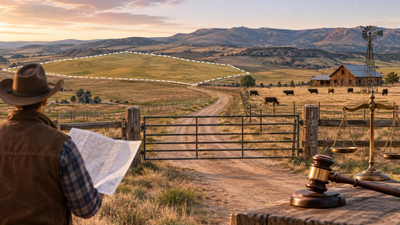
A 640-acre property is of little practical use if its owner cannot legally reach it by vehicle. That problem became the centre of a dispute between two Wyoming landowners after Wagonhound Land & Livestock Company sought access to an isolated parcel surrounded almost entirely by a neighbouring ranch. After negotiations failed, the company approached the court to establish a private road across the neighbouring property, but the ranch challenged the move and disputed the compensation.In its September 23, 2026, decision in Wagonhound Land & Livestock Company, LLC v. Little Medicine Creek Ranch, Inc., available on Justia, the Wyoming Supreme Court upheld the creation of the private road and the $61,200 compensation awarded to the neighbouring ranch. However, it overturned two restrictions imposed on the road, finding that they lacked sufficient supporting evidence.
The dispute over access to 640 acres
The dispute concerned Parcel 1, a roughly 640-acre tract in a remote and rugged part of northern Albany County, Wyoming. The property belonged to Wagonhound and was surrounded almost entirely by land owned by Little Medicine Creek Ranch, formerly known as Burnett Ranch.On April 21, 2023, Wagonhound sent the ranch a letter expressing interest in purchasing legally enforceable access to the isolated property. It proposed a 30-foot-wide right-of-way along existing ranch roads and indicated that it was willing to negotiate a fair price. However, the discussions failed to produce an agreement. Wagonhound subsequently filed a petition under Wyoming’s private road statute, seeking permission to establish access across the neighbouring ranch.Little Medicine Creek Ranch opposed the request, arguing that Wagonhound already had an outlet through adjoining Bureau of Land Management (BLM) land and could use an alternative route to reach a public road.
Why the property was considered landlocked
The ranch argued that an existing two-track route across BLM land provided Wagonhound with access. However, the route eventually crossed state trust land and required passage through approximately 1,700 feet of the neighbouring ranch’s private property. The Wyoming Supreme Court found that the existence of a rough track across public land did not, by itself, establish legally enforceable access to a public road. There was no evidence that the general public had used the route, and access to it was effectively controlled by the surrounding private property.The ranch also proposed the Parsons Creek Route, suggesting Wagonhound could obtain permission to construct a bypass across public land. However, that road did not physically exist. BLM employees also questioned whether the proposed route was accessible, while witnesses described parts of it as little more than a trail. The court concluded that neither option provided legally enforceable vehicle access to a public road. It therefore agreed that Wagonhound had established the necessity for a private road.
The $61,200 compensation award
The district court appointed three independent viewers and appraisers to examine possible routes and assess the impact on the neighbouring property. They recommended Wagonhound’s proposed route because it was shorter, more direct and more practical than the alternative suggested by the ranch. The alternative would require construction across a rocky ridge and could make winter access difficult.The viewers estimated that the private road would affect 680 acres of the neighbouring ranch. Using comparable property sales and an earlier appraisal report, they calculated a reduction in value of $90 per acre. This resulted in a total compensation award of $61,200, which the district court approved. Little Medicine Creek Ranch challenged the calculation, arguing that the assessment did not account for potential operational losses, including livestock health problems linked to dust, additional staffing expenses and reduced hunting opportunities.However, the Supreme Court upheld the award. It explained that Wyoming’s private road statute requires a before-and-after appraisal to determine the reduction in the value of the affected property. It does not provide compensation for indirect future business losses. The court also noted that the ranch had not presented evidence disputing the viewers’ calculation of the affected acreage or the $90-per-acre reduction.
Changes to the private road conditions
Although the court upheld the private road and compensation, it overturned two conditions imposed by the district court. The first required Wagonhound to pay for any damage to the road, regardless of whether its own vehicles, the neighbouring ranch or their guests had caused it. The Supreme Court found no evidence justifying this requirement. Wagonhound remained responsible for maintaining the road for its use, but could not automatically be held liable for damage caused by others.The second restriction prohibited vehicles with more than four axles, including semi-trailers, from using the road. The court found insufficient evidence that heavy vehicles would create unreasonable noise, lighting problems or other disturbances. However, it upheld the requirement that Wagonhound regularly apply water to suppress dust, citing evidence about its potential impact on livestock. The court also rejected the ranch’s request to restrict the road exclusively to agricultural use, finding insufficient evidence to justify such a limitation.
Final ruling and its implications
On September 23, 2026, the Wyoming Supreme Court affirmed the findings on necessity, good faith, route selection and compensation, while reversing parts of two road conditions. The decision allows Wagonhound to obtain legally enforceable vehicle access to its 640-acre property while requiring it to pay the neighbouring ranch $61,200. It also clarifies that a landowner cannot be denied access simply because a rough track crosses public land when no legally usable connection to a public road exists.The ruling was therefore partly in favour of both parties: Wagonhound secured the private road, while Little Medicine Creek Ranch retained its compensation and dust-control protections.

Leave a Reply