
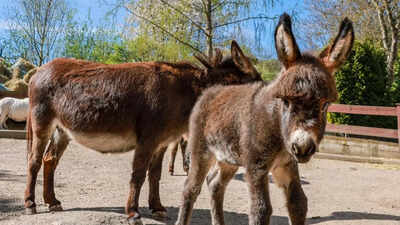
Brazil is developing lab-grown donkey collagen to counter a global decline in donkey populations driven by rising demand for China’s traditional anti-ageing medicine, ejiao. Through the effort, scientists are aiming to deliver a scalable alternative by 2027 that could reduce slaughter and stabilise the species.At the centre of this effort is Carla Molento, a veterinarian and professor at the Federal University of Parana, who is leading a project to produce donkey collagen using precision fermentation. According to a South China Morning Post report, the method involves inserting donkey collagen DNA into microorganisms such as yeast to create a protein identical to that derived from donkey skins, but without the contamination risks or need for animal slaughter.“We are hoping to offer a donkey collagen product which retains all the qualities of the conventional one, as it will be encoded by the same DNA,” she said. “Except that we will be able to ensure its purity, as none of the contamination, such as heavy metals and disease risks like pathogens exist in the new production system.”Molento said her team is working towards “a novel system ready for scale production” and expects the technology to be ready by the end of 2027, producing powdered collagen that can be supplied to ejiao manufacturers. “So it will be more of a business-to-business commerce, where the industry of different ejiao presentations may benefit as best for each business,” she said.
Ejiao boom and rising global demand
The push comes as global concern grows over the rapid depletion of donkey populations, fuelled by soaring demand for ejiao, a 2,000-year-old Chinese medicinal product traditionally made by boiling donkey hides. Once a niche luxury, ejiao has become a billion-dollar industry amid China’s expanding middle class and appetite for anti-ageing products believed to improve skin, reduce wrinkles and strengthen bones.Researchers estimate the industry requires about 4.8 million donkey hides annually, putting pressure on a global donkey population of roughly 53 million. With donkeys reproducing slowly, typically producing one foal after a year-long pregnancy, supply has struggled to keep pace.“Bluntly put, almost the entire global donkey population risks being shipped to China and turned into medicinal jelly within the next decade or two,” historians Natalie Kohle and Gregory Clancey wrote in the journal Asian Medicine.
Global impact and policy pushback
The consequences are already visible across multiple regions. Countries in Africa and Latin America have become major sources of donkey skins, often through unregulated or illegal trade networks. In 2024, the African Union imposed a 15-year ban on the donkey skin trade, while Brazil followed with a ban on donkey slaughter in April, effectively shutting down its last major slaughterhouse.Brazil’s donkey population has seen a dramatic decline, dropping from 1.3 million in 1996 to just 78,000 in 2025, according to The Donkey Sanctuary, although some researchers attribute much of this fall to agricultural mechanisation rather than ejiao demand alone.
Disease risks and illegal trade
Animal welfare experts warn that the trade poses broader risks beyond population decline. Emily Reeves of The Donkey Sanctuary described it as “extractive and opportunistic,” with sourcing shifting from country to country as local populations collapse or regulations tighten.“The trade is a ticking time bomb for disease spread risk because animals are sourced and moved, often illegally, without oversight or traceability,” she said. “Large herds are gathered from a multitude of locations. Animal mistreatment and stress increase susceptibility to disease. Skins are usually treated minimally, either by wet salting or sun drying, and can carry these pathogens when shipped.”Such risks were underscored by a major seizure in Hong Kong in October, when customs officials intercepted 150 tonnes of smuggled donkey skins falsely declared as frozen food in a HK$200 million operation.
Consumer awareness and future outlook
Despite the scale of the industry, awareness among consumers remains limited. A January survey of 1,000 Chinese adults found that 46 per cent did not know ejiao is made from donkey skin, and 70 per cent were unaware of associated animal welfare, environmental and disease concerns. However, the same survey showed strong openness to alternatives, with 76 per cent of respondents indicating they would consider lab-produced ejiao if it were affordable.Molento’s team is continuing to study variations in donkey collagen across breeds to refine their product, while also seeking partnerships to move from research to commercial production. “We are open to partnerships, as we are highly motivated to help supply pure donkey collagen without all the difficulties related to the donkey skin trade,” she said.If successful, the Brazilian effort could offer a technological route to ease pressure on donkey populations worldwide, even as demand for ejiao shows little sign of slowing.

Leave a Reply