
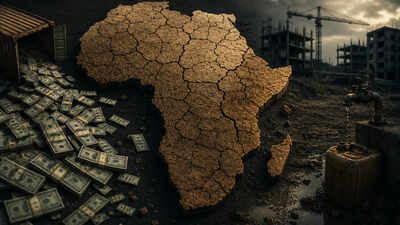
‘Give a man a fish, and you feed him for a day. Teach a man to fish, and you feed him for a lifetime.’But what if you keep giving the man a fish, then also ask your friends to give him a fish, your friends ask their friends and they ask their friends and so on and so forth. The conclusion to the experiment would be that the man may not know how to fish but would have plenty, right?Well Africa shows us our conclusion is wrong, at least partially.A heavily cited figure is that since the 1960s more than $2.6 trillion dollars of aid has been funneled into Africa, this is more than half of India’s GDP just in ‘charitable donations’. Aid support to Africa was at its peak between 1970-1988 yet, between those years Africa’s share of the world’s extreme poor rose from 11% to 66%.Things are yet to get truly better as a World Bank data report shows that even in 2025 nearly 46% of Sub-Saharan Africa still lived in extreme poverty.Dambisa Moyo, a Zambian born economist and author has done the most seminal work on understanding why aid continues to fail Africa. Her heavily contested work titled ‘Dead aid: Why aid is not working and how there is a better way for Africa’, points to how aid has helped make the people poorer and growth slower.Moyo’s central thesis is that systematic aid, billions transferred directly to African governments, acts exactly like a cursed natural resource, such as oil or diamonds. Because this money is “fungible” (easily stolen or redirected), it has become one of the greatest enablers of corruption.
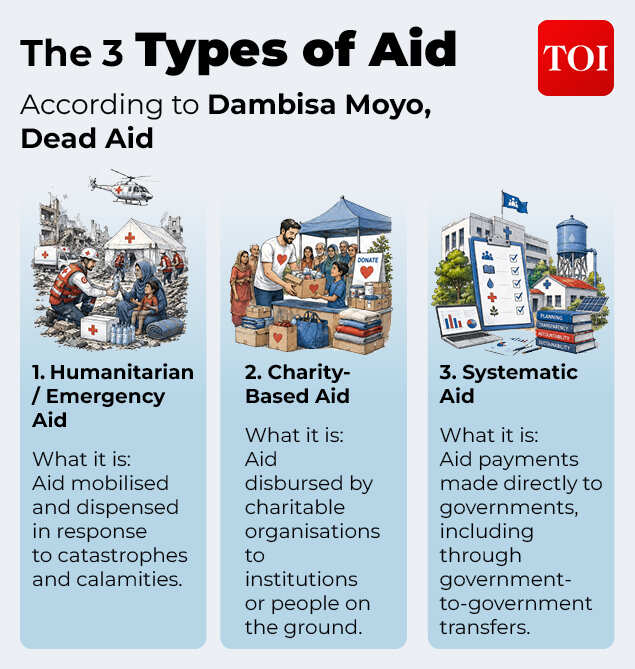
The 3 Types of Aid according to Dambisa Moyo
She points to Zaire’s President Mobutu Sese Seko, who managed to steal an amount equivalent to his country’s entire external debt, even leasing a Concorde jet to fly his daughter to a wedding while his people starved.
How aid harms Africa
When the West looks at Africa they come with an extremely simplistic equation in their heads:Poverty + Aid Money = No Poverty + Credit for us But the world does not exist in a vacuum. America had successfully helped Europe with the Marshall Plan, creating long-term economic partners and allies. Africa presented similar opportunities. Rich in oil, minerals, and diamonds, an aid partnership would also benefit the West by opening a new economic frontier.But the West missed a crucial difference. When the Marshall Plan was implemented, Europe had the infrastructure of functioning states. Ministries, legal systems, and public institutions—though damaged by war—had existed for decades. They could collect taxes and distribute resources. In much of Africa, however, states were newly formed or inherited from colonial administrations designed largely to extract wealth.
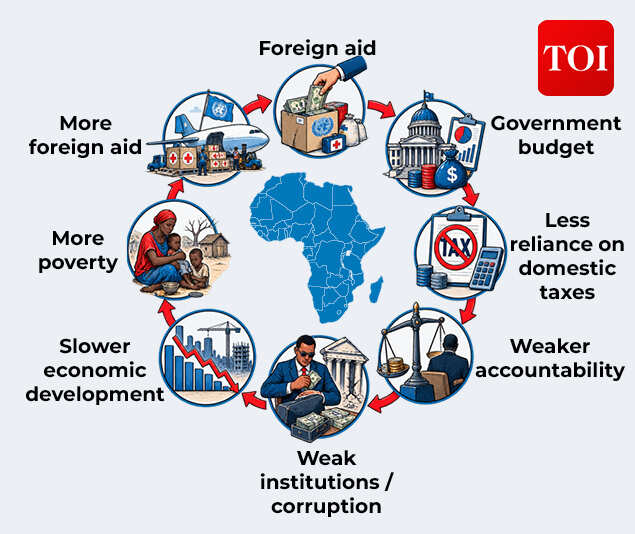
How aid traps Africa
Not slowly and not steadily, Africa became home to a few of the most aid-reliant countries. By the 1990s, aid money made up over 60% of the government budget for countries like Mali, Uganda, and Burkina Faso. Yet things did not really become better. From 1970 to 2000, the average income in Africa actually declined despite receiving almost $600 billion.The tragic reality is far more insidious than mere theft. When billions are handed directly to governments with weak institutions, the money severs the democratic “social contract.”In a healthy economy, leaders tax citizens and are forced to be accountable to them.When a state’s budget is underwritten by Western donors, African politicians answer to Washington and Geneva, not their own people.Take Malawi, for example.At various points in the 2000s, foreign aid made up more than 40% of the national budget. Huge amounts of money were being stolen by government officials to pay for luxury cars and international shopping trips. You might expect a scandal to spark mass outrage. But it simply never happened. Because the government’s funding came from foreign sources, the Malawian citizens had very little power to demand systemic change.Corruption aside, aid ruins a country’s economy by never letting it develop. The analogy of teaching a man to fish becomes relevant again. If you freeload a country with fish, you destroy their fishermen.Moyo points to the heartbreaking reality of local African mosquito net manufacturers who are aggressively pushed out of business simply because well-meaning Western NGOs flood the market with free nets.By the early 2000s, nearly 80% of the clothing sold in some African nations came from abroad. In Ghana alone, over 80% of domestic textile factories shut down between 1990 and 2010. Thousands of jobs disappeared, and with them, the knowledge and networks needed to sustain a homegrown industry. In the last two decades, Africa’s industrial sector has actually shrunk from 15% of the continent’s economy to just 10%.Then there is the invisible economic damage. When massive inflows of aid money are converted into local currency, it pushes up the value of that currency on foreign exchange markets. A stronger currency sounds good, but it makes African exports artificially expensive on the global market. The export-led model that lifted East Asia becomes impossible to replicate. In Africa today, exports account for about 20% of the average GDP, less than half of most successful East Asian economies.But perhaps the most damning evidence against aid is not just the corruption or the economic distortion—it is the sheer, systemic incompetence of its delivery.A 2012 report by the Center for Global Development found that up to 70% of aid projects either failed to meet their targets or had no measurable impact whatsoever.An audit of health aid in Uganda found that nearly a third of donated medical supplies never reached their intended recipients, lost to theft or logistical failure.
The funded lack of consequence
To understand why this keeps happening, look at how a normal business operates. If a company provides a bad product, consumers switch to a competitor, and revenues drop. The provider is accountable to the user.Foreign aid doesn’t work that way.
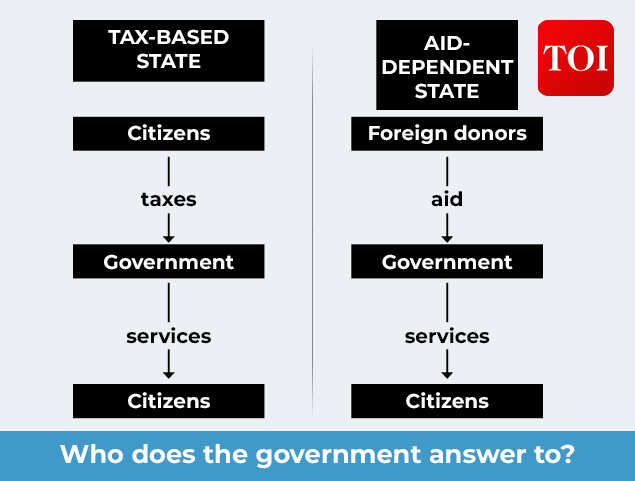
Who does the government answer to?
If an aid project fails, the recipients can’t withhold their taxes or vote for someone else. Because the funding comes from foreign governments and donors, there is no mechanism for rewarding success or punishing failure. The result is an enormous lack of incentive to actually do things well.The story of foreign aid in Africa is not simply one of good intentions gone wrong; it is a story of deeply misplaced assumptions. What began as an effort to lift nations out of poverty has created systems of dependence, weakened institutions, and stifled local industries.That doesn’t mean aid has no role to play—in moments of acute crisis like famine or natural disasters, it provides vital short-term relief. The evidence is impossible to reduce to a simple verdict. But the problems Moyo identifies are real enough to raise a more uncomfortable question: what happens when aid stops being temporary assistance and becomes part of the way an economy functions?Many economists have argued against Moyo’s thesis. Development economists, notably Owen Barder, have pointed out that Moyo relies on a dangerously simplistic reading of data—confusing correlation with causation.But while the jury is out on whether perpetual aid is good or bad, what remains imperative is the need for a fundamental shift in how we help.It’s time we stopped just handing out the fish, and stopped funding the people hoarding them. It’s time to fix the pond and train some fishermen.

Leave a Reply