

Around 200 employees at a Russian anti-plague institute are being monitored after coming into contact with a 27-year-old woman who died following severe pneumonia, amid reports that she may have contracted pneumonic plague.The incident in Irkutsk, a city in eastern Siberia, has raised concerns about a possible outbreak. However, Russian health authorities have said extensive testing has so far found no evidence that the woman was infected with plague or any other microorganism linked to her professional activities.
What happened in Irkutsk
The woman, an employee of the Irkutsk Anti-Plague Institute, was admitted to hospital on September 29 with symptoms of severe pneumonia and was placed on a ventilator.She died overnight between October 1 and 2.On October 2, The Moscow Times reported that an emergency meeting of the Sanitary and Anti-Epidemic Commission was held jointly by Irkutsk region governor Igor Kobzev and Anna Popova, head of Rospotrebnadzor, Russia’s national public health and consumer rights agency.“All identified contacts have been placed under medical observation. Currently, they show no signs of illness, and laboratory tests are negative,” Kobzev said.He added that Rospotrebnadzor was implementing “a full range of anti-epidemic measures”.Local media reported two theories about how the woman could have been exposed to the bacterium.One theory was that she had recently returned from a work trip to the Buryatia region, where a plague outbreak was reportedly being reported near the border with Mongolia.Another suggested that she may have accidentally broken a test tube containing a dangerous bacterium in a laboratory.These reports led to speculation that she had contracted pneumonic plague. But on Sunday, Rospotrebnadzor said she had been diagnosed with “pneumonia of unknown etiology”. It said “extensive” testing had found “no microorganisms associated with the patient’s professional activities”.
What is pneumonic plague
Plague is a serious infectious disease caused by Yersinia pestis, a bacterium that normally circulates among small mammals and their fleas but can infect humans.It is a zoonotic disease, meaning it can spread between animals and humans. Plague has three main forms: bubonic, septicemic and pneumonic.Pneumonic plague is the most serious form because it infects the lungs and can progress extremely rapidly. Unlike bubonic plague, which primarily affects the lymph nodes, pneumonic plague can also spread directly from person to person through respiratory droplets.According to Dr Vikas Mittal, Director and Pulmonologist at CK Birla Hospital in Delhi, pneumonic plague presents as a rapidly progressive form of pneumonia, typically causing fever, chest pain, cough and breathlessness.The infection can develop in two ways.Primary pneumonic plague occurs when a person inhales respiratory secretions or aerosolised droplets from an infected animal or person. It can also occur following laboratory exposure.Secondary pneumonic plague develops when the bacteria spread through the bloodstream in someone who already has bubonic or septicemic plague. This can happen when treatment is delayed.
What happens when someone gets pneumonic plague
The illness usually begins abruptly and can worsen very quickly.
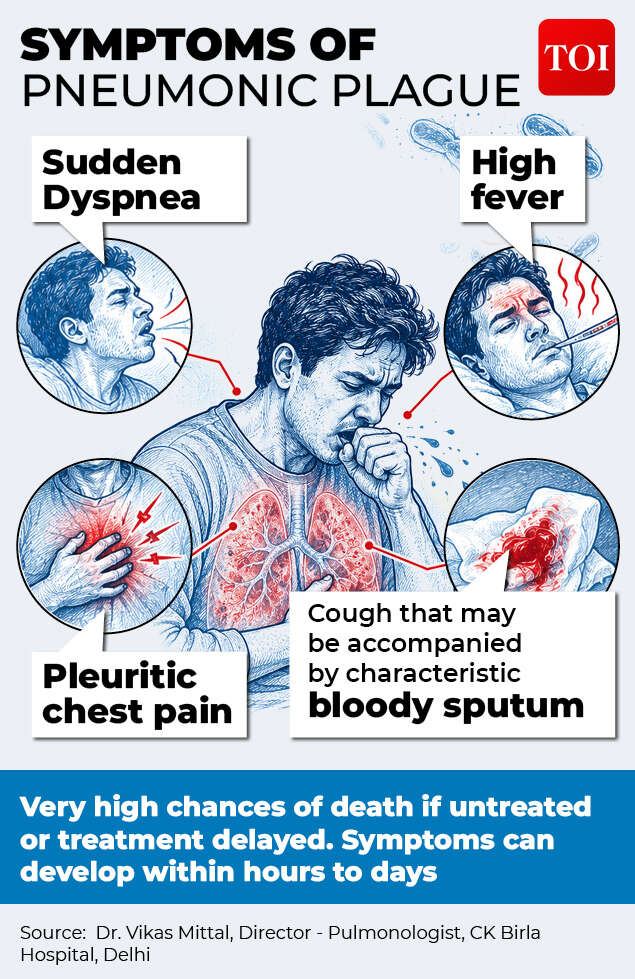
Symptoms that can indicate Pneumonic Plague
“Illness is typically abrupt, with sudden onset of dyspnea, high fever, pleuritic chest pain, and cough that may be accompanied by characteristic bloody sputum,” Dr Mittal said.The disease can initially resemble other severe forms of pneumonia, making early recognition important.Chest imaging also does not provide a definitive diagnosis. “Chest imaging is not specific and may show bronchopneumonia, consolidation, cavities, or pleural effusions; hilar or mediastinal adenopathy can sometimes be seen,” Dr Mittal said.The speed at which treatment begins is critical.“Pneumonic plague can be rapidly fatal unless effective antibiotics are started early, and untreated mortality is very high,” Dr Mittal said, adding that delays in starting antibiotics are associated with a higher risk of death.
How does pneumonic plague spread
Primary pneumonic plague can occur after inhalation exposure to respiratory droplets from an infected person or animal.
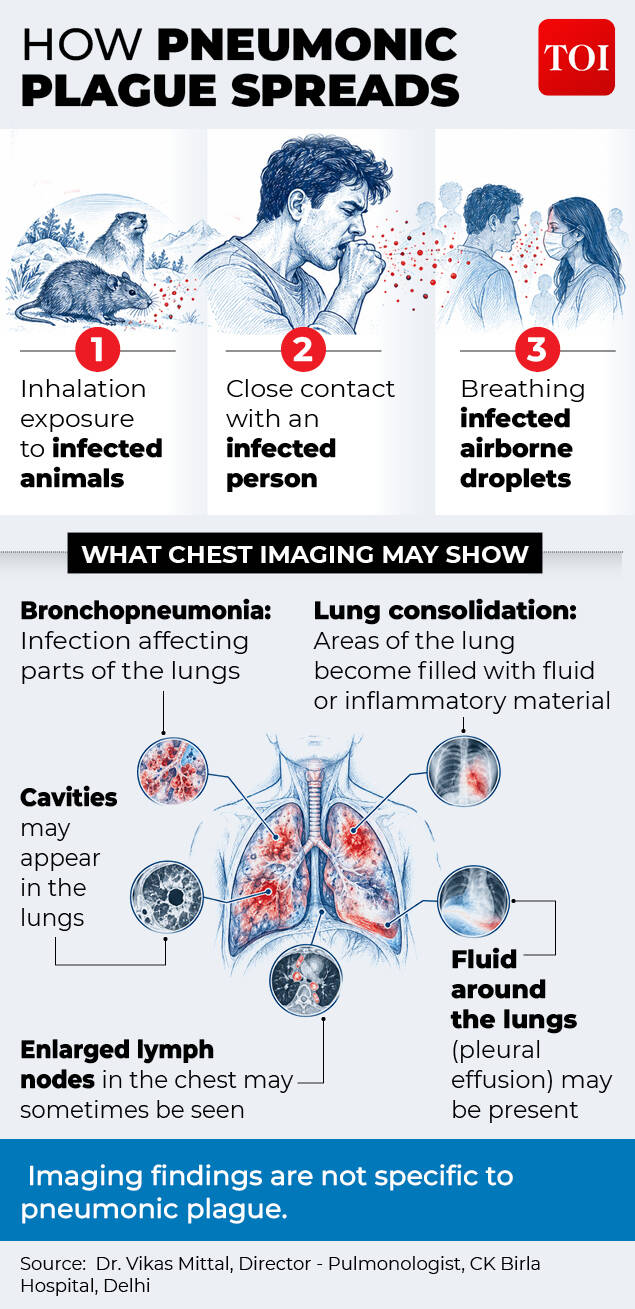
How the Pneumonic Plague gets transmitted, and what chest imaging may show.
The incubation period is short, ranging from a few hours to a few days. Human-to-human transmission through respiratory droplets has been documented, but Dr Mittal said it appears most likely to occur after very close contact.This means a suspected case can have significant public health implications, particularly if the illness is not recognised quickly.However, outbreaks can be contained. Treating infected patients promptly and providing preventive treatment to people who have been exposed are key measures used to stop transmission.
How is pneumonic plague diagnosed
Because the early symptoms can resemble severe pneumonia caused by many other infections, doctors need a high degree of suspicion when there is a relevant exposure history.Diagnosis can be established by isolating Yersinia pestis through culture, or through appropriate serological or rapid testing.“Timely diagnosis requires a high index of suspicion,” Dr Mittal said.Because of the possibility of respiratory transmission, infection-control measures are also important.“Patients suspected of having plague should be placed on droplet precautions until pneumonia has been ruled out, sputum cultures are negative, and at least 48 hours of effective antimicrobial therapy has been administered,” Dr Mittal said.
Russia’s neighbours raise alert
The reports from Irkutsk have also prompted neighbouring countries to increase precautionary measures, according to The Moscow Times.Kazakhstan’s health ministry said sanitary and quarantine checks were being carried out at state border crossings. So far, it said, no arrivals had been found to have elevated temperatures, signs of illness or suspected particularly dangerous infections.In Kyrgyzstan, sanitary and quarantine checkpoints were placed on high alert, with specialists screening people, vehicles and cargo crossing the border.Uzbekistan’s sanitary and epidemiological committee also increased the readiness of services responsible for preventing the entry of particularly dangerous infections.
Kremlin urges Russians to ignore rumours
Amid growing speculation online, Kremlin press secretary Dmitry Peskov on Monday urged Russians not to believe rumours about a possible plague outbreak in Irkutsk.“The lead agency with jurisdiction in this area is Rospotrebnadzor. And we should rely on Rospotrebnadzor’s official statements, without listening to various rumours and speculation,” he said.Additionally, governor Kobzev said no new cases of staff from the Anti-Plague Institute seeking medical attention were identified.For now, Russian authorities say the people who came into contact with the woman are under medical observation, with no signs of illness and negative laboratory tests.

Leave a Reply