
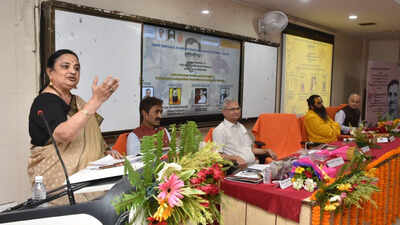
LUCKNOW: Jawaharlal Nehru University vice-chancellor Santishree Dhulipudi Pandit said that her cash-strapped institution should emulate BHU’s Vishwanath temple model and establish a Lord Venkateswara temple on JNU campus to generate funds.Speaking at an Indian Knowledge Tradition conference at Banaras Hindu University earlier this week, Pandit cited BHU founder Madan Mohan Malaviya’s idea of creating sustainable sources of income for academic institutions. “After the Vishwanath Temple, I suggested to JNU that since we are beggars, we should bring a temple of Lord Venkateswara here. I come from Andhra (Pradesh). A lot of money would come our way,” Pandit said.She accused JNU historians of turning the order of facts and interpretations upside down. “Facts are sacred, interpretations can vary. But our JNU historians turned it upside down. They said interpretation is sacred, facts can vary,” she said.Pandit criticized academic orthodoxies and argued that universities cannot not flourish when one ideology dominates academic discourse. Indian Knowledge Systems (IKS), she said, should encourage intellectual pluralism rather than replace one dominant school of thought with another. She contested the description of IKS as a “right-wing project” and said it was not “anti-West” but opposed to intellectual monopoly.“IKS is against wokeism, Left and others who say they are the only intellectual tradition,” she said.The JNU VC also waded into the debate on feminism, arguing that Indian ideas about women should not necessarily be viewed through the Western intellectuals’ lens and added that Draupadi was the first feminist.“I would not like anybody who says that feminism began with Simone de Beauvoir, Draupadi is the first feminist. Look at all the questions she asked her husband. Nobody will ask them even today,” she said. She cited traditions of goddess worship, including Chamundeshwari and Madurai Meenakshi, and the prevalence of female gram devatas and forest deities to underline her argument.Pandit also contrasted the growth of Left and Right intellectual traditions in India, arguing that while the Left invested heavily in universities, journals, publishing houses and research networks, the Right had not built institutions on a similar scale. “As a result, much of the Right’s intellectual output remained reactive, topical and event-driven rather than grounded in long-term scholarship,” she said.Highlighting India’s civilisational legacy, Pandit said many are unaware about the country’s maritime achievements. Referring to the Marathas, Kanhoji Angre and Rajendra Chola, she urged students to take pride in India’s past. “Do you know we conquered Southeast Asia, defeated China?” she asked.She rejected the notion that India was civilised by foreign rulers. “Mughals did not come and civilise us. We are older than all civilisations in the world,” she said, while questioning the view that democratic traditions arrived solely through British rule.On language, Pandit said English should not be seen as an enemy, given its importance in science, diplomacy and technology. At the same time, she stressed the need to strengthen Sanskrit along with Tamil, Pali, Prakrit and other Indian languages so that English does not become the only medium through which India understands itself.Pandit cautioned against reducing IKS to a single language, region or community. “If IKS becomes confined to one language, one region, one tradition or one community, it defeats its own civilisational foundations,” she said.A truly Bharatiya knowledge system, she argued, must draw from diverse traditions including Tamil Sangam literature, Shaiva and Vaishnava thought, Buddhist and Jain philosophies, tribal knowledge systems, oral traditions, folk sciences and India’s maritime heritage.

Leave a Reply