
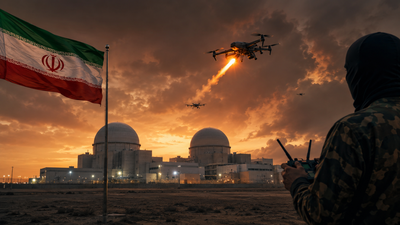
NEW DELHI: A drone attack on the UAE’s Barakah nuclear power plant has intensified fears of a wider regional escalation, with analysts warning that Iran-backed militias in Iraq are emerging as a key front in Tehran’s confrontation with the US and Israel.The United Arab Emirates said the attack targeting the Barakah plant on Sunday originated from Iraq and condemned it as a “terrorist” act. Senior presidential adviser Anwar Gargash blamed “Iranian militias in Iraq” for the incident in a social media post.Calling the strike alarming, Gargash said it was “a grave indicator of the scale of the threat facing the region.” The attack forced the plant to activate backup power systems, considered one of the final safeguards for maintaining nuclear safety.Barakah is the Middle East’s largest nuclear power plant and one of only two operational facilities in the region, alongside Iran’s Bushehr plant. While authorities reported no casualties or abnormal radiation levels, the incident highlighted the vulnerability of critical civilian infrastructure amid rising tensions.Analysts quoted by Bloomberg warned that the attack appeared to be a signal from Tehran as uncertainty grows over the future of the fragile ceasefire between Iran, Israel and the United States.“This was a warning shot by Iran,” Mohammed Baharoon, director of the Dubai Public Policy Research Center, or B’huth, told Bloomberg. “It’s also a way for Iran to keep pressure on Gulf states and tell them ‘you won’t be immune and even if we don’t attack you directly, our proxies will’,” he added.Neither Iran nor Iran-backed militias in Iraq claimed responsibility for the Barakah attack or for three drones launched toward Saudi Arabia around the same time, which Saudi authorities said were intercepted.The attack comes as Washington and Tehran attempt to convert a ceasefire agreed on April 8 into a broader settlement. However, negotiations remain fragile, with US President Donald Trump alternating between optimism about a deal and threats of renewed military action.Tehran has warned that any fresh strikes would trigger a more powerful retaliation extending beyond the Middle East.Iran-backed militias linked to the Islamic Revolutionary Guard Corps (IRGC) are increasingly being seen as a central part of Iran’s regional military strategy. Groups such as Kataib Hezbollah and Harakat Hezbollah Al-Nujaba have claimed responsibility for hundreds of missile and drone attacks targeting US interests in Iraq and Gulf states.“These groups are under direct orders from the IRGC to be part of Iran’s war effort, which includes targeting the Gulf,” Renad Mansour, deputy director of the Middle East and North Africa Program at Chatham House, told Bloomberg.Independent conflict monitor ACLED said it documented more than 65 incidents involving Iraqi militias targeting Gulf countries during the conflict, though the organisation noted that the real number was likely higher.“Many attacks originating from Iraq are never publicly claimed, and distinguishing between attacks directly conducted by Iran and those carried out by Iraqi militias remains extremely difficult,” ACLED said in a statement.Dania Thafer, executive director of the Gulf International Forum, said the use of Iraqi proxy groups provides Tehran “a degree of plausible deniability,” while still delivering a clear strategic message.“Iran is trying to showcase to Gulf states that they’re not out of the woods yet, so they can pressure the Trump administration not to attack,” she told Bloomberg.According to Bloomberg, the UAE has been the target of nearly 60% of the roughly 5,000 missiles and drones launched by Iran against Gulf states since the conflict began on February 28. Bloomberg also reported that the UAE responded to Tehran’s aggression on at least two occasions in March and April in coordination with the US and Israel.The growing role of Iraqi militias has also created political complications for Iraq’s newly sworn-in Prime Minister Ali al-Zaidi. Experts say attacks launched from Iraqi territory risk undermining Baghdad’s efforts to improve economic and political ties with Gulf Arab states.The Iraqi prime minister’s office condemned the attacks on the UAE and Saudi Arabia and announced the formation of a high-level committee to investigate the incidents.However, Mansour suggested the Iraqi leadership has limited control over the militias operating inside the country.“Iraq is very much now part of the battle,” he said.

Leave a Reply