
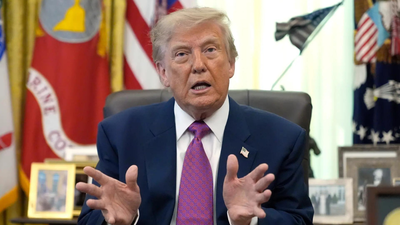
Another setback for President Donald Trump’s administration came on Monday after a federal judge blocked a new rule that would have imposed stricter limits on how long foreign students and journalists can remain in the US.US District Judge F. Dennis Saylor in Boston issued the ruling a day before the Department of Homeland Security (DHS) was due to implement the policy. The rule would have ended the decades-old system under which many foreign students could remain in the country for the “duration of status” of their academic programme.Saylor ruled in favour of a coalition of unions and higher education advocacy groups that challenged the policy. He said DHS had adopted the rule based on “exceptionally weak” rationales, rejecting the agency’s arguments that the changes were necessary to combat visa fraud and strengthen national security.
Judge warns of wider economic damage
Under the rule, F visas for international students and J visas for cultural exchange visitors would have been capped at four years. I visas for foreign journalists, which can currently remain valid for years, would have been limited to 240 days.Students would also have faced tighter restrictions on changing programmes or transferring between universities. The new system would have given them 30 days to leave the US after graduation or after changing to another visa category, down from the previous 60-day grace period.The Trump administration has argued that the changes are needed to prevent people from exploiting the student visa system by repeatedly enrolling in courses to remain in the US.DHS General Counsel James Percival criticised Monday’s ruling, saying it would require US Immigration and Customs Enforcement to “permit this rampant abuse of our immigration system.”“Come on a student visa, take one class per semester, and stay here for decades,” he said.But Saylor, an appointee of Republican President George W. Bush, said the government had failed to properly consider the consequences of replacing a system that had operated for nearly five decades.He said the existing system had enabled tens of millions of foreign students and researchers to study in the US, contributing to “groundbreaking research in science, medicine, and technology, substantial economic growth, and a host of other benefits, often on a vast scale.”The judge also warned that major research universities, including Massachusetts Institute of Technology and Harvard, could face hundreds of millions of dollars in costs and declining enrolment.“The damage to the higher education system and to the economy of the United States is likely to be catastrophic,” Saylor wrote.

Leave a Reply