

You have a new job. But what about the money owed by the old one?Changing jobs is usually associated with excitement. There may be a better role, higher salary, new city, new team or simply a fresh start. But between leaving one organisation and joining another, many employees face a practical concern that does not always get enough attention: when will the previous employer release the final dues?For an employee, the last salary from the previous organisation is not just a payroll entry. It may be needed for rent, relocation expenses, family commitments, education fees, loan repayments or simply to manage the gap before the first salary from the new employer. Yet, for many employees, full and final settlement has often been one of the most uncertain parts of the exit process.An employee may serve the notice period, complete handover, return the laptop, submit the access card and attend the exit interview. Even then, the final payment may take several weeks. Sometimes the delay is because of payroll cycles. Sometimes leave balances, reimbursements, recoveries or approvals are still being checked. In some cases, employees do not receive a clear explanation of what is pending.This is where the Labour Codes could make a practical difference.
What changes under the Labour Codes?
One of the less discussed changes under the new labour framework relates to the timeline for payment of wages when employment comes to an end. The broad principle is simple: employees should not have to wait indefinitely for wages that have already been earned.Under the wage-related provisions, wages payable to an employee on resignation, removal, dismissal, retrenchment or closure of an establishment are required to be paid within two working days. For employees, this could be a meaningful shift. It may not sound as dramatic as a new social security benefit or a change in salary structure, but it directly affects the employee experience at the time of exit.However, this should not be misunderstood. The exact position will depend on when the relevant provisions are notified and become operational. Also, the two-working-day timeline does not mean that every amount connected with employment separation will automatically be paid within two working days. A full and final settlement can include several components, and different components may be governed by different laws, company policies or contractual terms.
Full and final settlement is not one single payment
Employees often use the expression “full and final settlement” as if it refers to one simple payment. In reality, it is a reconciliation exercise. The employer calculates what is payable to the employee and what is recoverable from the employee.The final settlement may include salary for days worked, leave encashment, approved reimbursements, bonus or incentives where payable, notice period adjustments, recovery of loans or advances, tax deductions and statutory benefits such as gratuity, where the employee is eligible. For many employees, leave encashment can be one of the larger components of the final settlement, making it important to understand how accumulated leave is treated on exit.This is why expectations need to be managed carefully. The wage component may become more time-sensitive, but other payments may follow a different timeline.
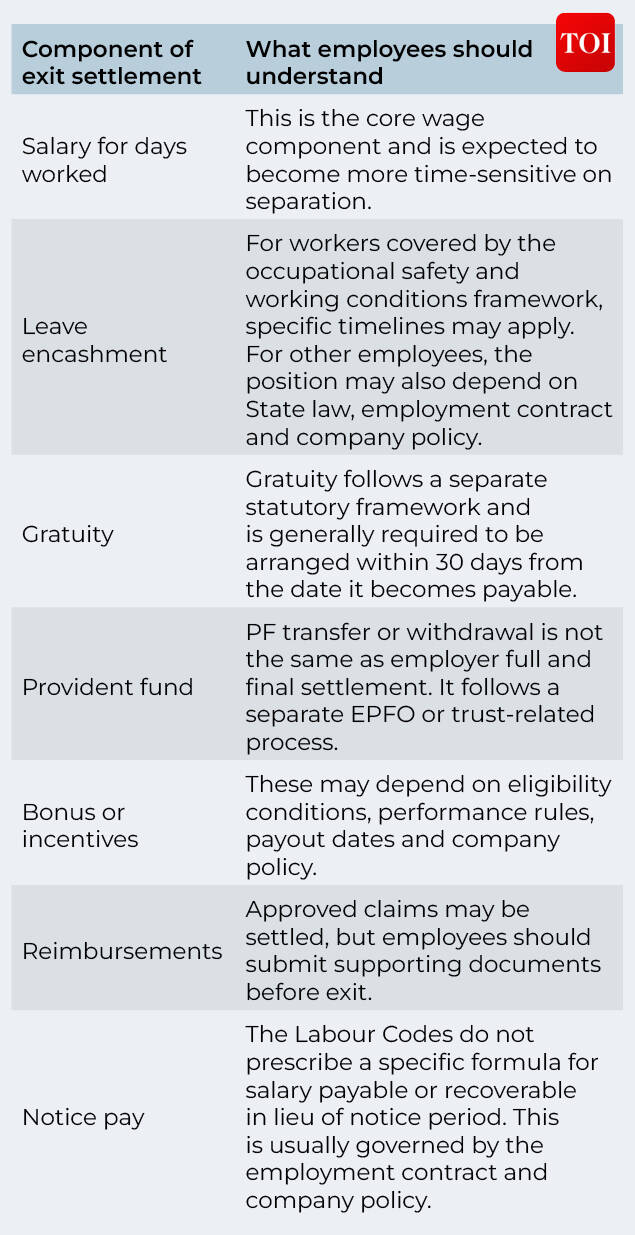
Different components of exit settlement
Does two working days mean everything will be paid immediately?
Not necessarily. This is perhaps the most important point for employees to understand.The two-working-day requirement should be understood mainly in relation to wages payable on separation. Other dues may follow separate treatment. Gratuity has its own statutory timeline. PF transfer or withdrawal involves a separate process. Bonus or incentives may depend on scheme rules. Reimbursements may require supporting documents and approvals.Leave encashment may also need a separate review. In certain cases involving workers, the labour framework provides specific treatment for wages in lieu of leave. For other employees, the position may depend on applicable State law, employment terms and company policy.This distinction is important because many employees may otherwise believe that the entire full and final settlement must be credited within 48 hours. That may not always be correct. The more accurate expectation is that wage dues should become faster and more predictable, while other components may need to be reviewed separately.
Why two employees may have different exit experiences
Consider two employees resigning on the same date.The first employee completes handover before the last working day, returns all company assets, submits pending reimbursement claims, checks the leave balance and confirms bank details with HR. In such a case, the employer is likely to have the necessary information to process the wage-related settlement quickly.The second employee leaves with an incomplete handover, pending travel claims, an unreturned laptop and an unresolved salary advance. In this case, the settlement may become more complicated. The delay may not be because the legal position is unclear, but because the facts required for payroll closure are incomplete.The lesson is simple. Labour law can create timelines, but employees can also reduce delays by keeping exit documentation clean.
What employees should do before the last working day
Employees should not treat full and final settlement as an HR formality that begins after resignation. It is better to start preparing before the last working day.An employee should check whether the last month’s salary has been correctly recorded, whether leave balances are accurate, whether expense claims have been submitted, whether there is any notice period shortfall, whether company assets have been returned and whether any loans, advances or recoveries are outstanding.It is also useful to keep copies of resignation acceptance, last payslips, reimbursement submissions, asset return acknowledgements, leave balance confirmation and final settlement statements. These records can help if there is a later disagreement on what was paid or deducted.This becomes even more important for employees who change jobs frequently. If every exit leaves behind unresolved payments, missing documents or unclear recoveries, the problem can build over time. A clean exit is part of sound financial planning.
Why deductions need to be transparent
Final settlement is not only about amounts payable. It may also involve deductions. Employers may deduct notice recovery, loans, salary advances, tax or other permissible recoveries, but deductions from wages cannot be treated as an unlimited area.For employees, the most important point is transparency. The settlement statement should clearly show what has been paid and what has been deducted. If an amount is being recovered, the employee should be able to understand the basis for the recovery.For example, if notice pay is deducted, the employee should know whether the deduction is based on the employment contract, company policy or resignation terms. If an advance is recovered, the settlement statement should ideally show the outstanding amount and adjustment. Clear communication can reduce avoidable disputes.
The overlooked issue: nominations for wage dues
Most employees think nominations are relevant only for provident fund, gratuity or insurance. That is not correct. Wage-related nominations can also become important.The labour framework recognises situations where amounts payable to an employee cannot be paid because the employee dies before payment or because the employee’s whereabouts are not known. In such cases, the dues may be payable to the nominee. If there is no nomination, or if payment cannot be made to the nominee for any reason, the amount may need to be dealt with under the prescribed legal process.This may sound technical, but it has real consequences for families. Imagine an employee who updated PF nominations after marriage but forgot to update wage-related nominations recorded with the employer. If something unfortunate happens before pending dues are paid, the family may assume that all amounts will automatically be released to the spouse or dependants. In practice, outdated or incomplete nominations can create delays and administrative complications.
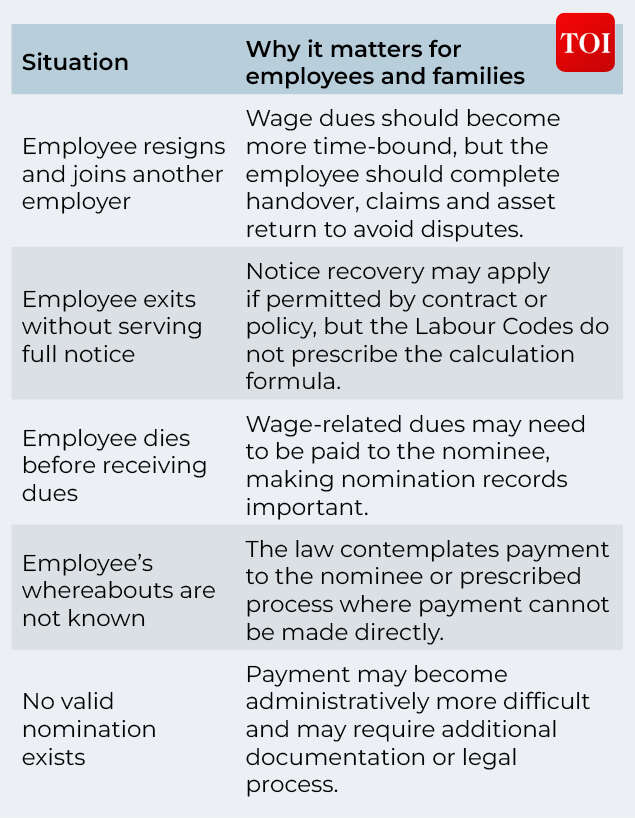
How different situations matter for employees and families
When should employees update nominations?
Nomination records should not be completed once and forgotten. Employees should review them after major life events such as marriage, childbirth, divorce, death of a nominee or any significant change in family circumstances.Job change is also a good moment to review nominations. When employees join a new organisation, they often submit bank details, tax declarations and PF information. The same seriousness should be given to nominations for wages and other employment-related dues. A few minutes spent updating records can prevent complications for family members later.What employers may need to changeFor employers, the new framework means full and final settlement can no longer remain a slow, post-exit administrative process. To meet faster timelines, many organisations may have to streamline exit processes, reduce manual approvals and ensure that information relating to attendance, leave, reimbursements, loans, recoveries, tax declarations, incentive eligibility and asset return is available in time.Employers may also revisit appointment letters, payroll policies and exit policies to clearly explain employee obligations at the time of exit. However, such policies should support timely processing rather than create unnecessary hurdles for departing employees.
Key takeaways for employees
The first takeaway is that full and final settlement should not be seen as one single payment. Salary for days worked, leave encashment, gratuity, PF, incentives, reimbursements and notice pay adjustments may all have different treatment. Employees should therefore read the settlement statement carefully rather than assuming that all exit-related dues follow the same timeline.The second takeaway is that the Labour Codes could make wage payments on exit faster and more predictable, but employees should still complete their part of the exit process on time. Handover, asset return, reimbursement claims, confirmation of leave balances and closure of outstanding advances can all affect the smoothness of the final settlement process.The third takeaway is that nominations should not be ignored. Employees often update PF or insurance nominations but may not think about wage-related dues. Where an employee dies before receiving pending amounts, or where the employee’s whereabouts are not known, nominee details can become very important. Keeping nominations updated is not only an administrative task; it is a practical safeguard for the family.The fourth takeaway is that employees should ask for clarity, not just payment. A timely payment is important, but so is a clear explanation of what has been paid, what has been deducted and what may follow later under a separate process. Transparency can reduce confusion and avoid unnecessary disputes after exit.
The bottom line
The Labour Codes may not remove every dispute around full and final settlement. They also do not mean that every exit-related payment will always be credited within two working days. But they do signal an important shift in principle: employees should receive wage dues promptly when employment ends.For employees, the message is simple. A resignation letter should not mark the end of your involvement with the employer. Before your last working day, make sure your records, claims, leave balances, nominations and settlement details are in order. Labour Codes may help employees get their dues faster, but being prepared remains the best way to ensure a smooth exit.(The author, Puneet Gupta is Partner, People Advisory Services Tax at EY India)

Leave a Reply