
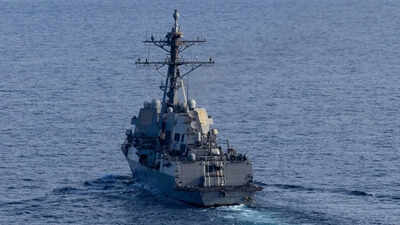
Iran and the United States have said that the Strait of Hormuz has been reopened ahead of the second round of negotiations scheduled in Pakistan.But, subsequent statements and clarifications from both sides left uncertainty over how quickly shipping might return to normal, and some vessels could be observed making unsuccessful attempts to cross the strait on Friday before turning back.‘Need further clarification’According to a Reuters report, vessel traffic data showed a group of around 20 ships, including container ships, bulk carriers, and tankers, moving through the Gulf toward the Strait of Hormuz on Friday evening. However, most ended up turning back, although it was not clear why. The group included three container ships operated by French shipping group CMA CGM, which declined to comment.It was the largest group of vessels to attempt the transit since the start of the war.According to a BBC report, maritime groups say they are still verifying whether it is safe for vessels to travel through the strait, and tracking shows minimal ship movement.The International Maritime Organization said it needs further clarification that there will be no risks for ships passing through the strait.“I need further clarification for the shipping industry that there will be no risks for the ships to navigate and that it will be in accordance with international law,” head of the International Maritime Organization Arsenio Dominguez told BBC World Business Report.“The IMO has information that some ships have started to sail, but it still needed to verify this as some ships turn off their identification systems in order not to be targeted,” he added.Cormac McGarry, director for maritime security at the consultancy firm Control Risks, said he was “no more optimistic than he was yesterday” about the strait reopening, despite Araghchi’s announcement.He told the BBC that the statement “basically changes nothing,” as the implicit threat of mines remains.Earlier on Saturday, US President Donald Trump said that the strait is “fully open and ready for full passage.” However, he added that the American blockade “will remain in full force” until Tehran reaches a deal with the US, including on its nuclear programme.US CENTCOM said that its guided-missile destroyer USS Michael Murphy is patrolling the Arabian Sea.In a social media post on X, CENTCOM said that 21 ships have complied with directions from US forces to turn around and return to Iran.“Guided-missile destroyer USS Michael Murphy (DDG 112) patrols the Arabian Sea, April 17, as US forces enforce the naval blockade on ships attempting to enter or exit Iranian ports,” CENTCOM said.“Since commencement of the blockade, 21 ships have complied with directions from US forces to turn around and return to Iran,” it added.Meanwhile, Tehran is also maintaining its tight grip on who gets access through and warned it could close the strait again if the US keeps in place its blockade of Iranian ships and ports.The announcement by Abbas Araghchi, Iran’s foreign minister, came on Friday — the first full day of a 10-day ceasefire between Israel and Lebanon.“In line with the ceasefire in Lebanon, the passage for all commercial vessels through the Strait of Hormuz is declared completely open for the remaining period of the ceasefire on the coordinated route as already announced by the Ports and Maritime Organisation of the Islamic Republic of Iran,” he wrote on X.Iranian state TV later quoted a “senior military official” as saying that the passage of these vessels would be through a “designated route” and that the passage of military vessels through the strait would still be “prohibited.”This is likely referring to a map and two routes designated by Iran’s Islamic Revolutionary Guard Corps (IRGC) and widely reported by Iranian media last week.About 20% of the world’s oil and liquefied natural gas (LNG) usually passes through the strait, but the number of ships transporting this has dramatically decreased during the recent hostilities. Before the Iran-US war, around 138 ships passed through the Strait of Hormuz, hauling one-fifth of global oil and vital fertilisers for worldwide crops.But as conflict erupted, Iranian threats and attacks halted nearly all traffic through the narrow chokepoint. March traffic plunged below 100 ships.At the beginning of the blockade, Trump tried to resolve this with diplomatic efforts and backchannel dialogue. After this tactic failed, he deployed a thousand more troops to the Middle East and looked into possible US Navy escorts for oil tankers.

Leave a Reply