
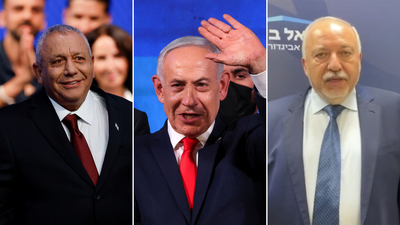
Israeli Prime Minister Benjamin Netanyahu is exploring ways to form a national unity government with opposition leader Gadi Eisenkot following the October 27 election. Meanwhile, Yisrael Beytenu chairman Avigdor Liberman also appears to be distancing himself from the opposition bloc and favouring a unity arrangement, according to reports published in The Jerusalem Post and Maariv.According to the report, sources close to Netanyahu are reportedly promoting a plan to bring Eisenkot into a government led by the Likud chief, despite Eisenkot’s pledge not to serve under him. Meanwhile, N12 News reported on Wednesday that Liberman had cut off contact with Eisenkot and former prime minister Naftali Bennett, and had stopped answering calls from his opposition counterparts.The developments come as the Central Elections Committee continues to update the results. Its final report is not expected to be submitted to the president until next week. Netanyahu’s ability to form a government will depend on the final seat count and whether he can secure support beyond his existing bloc.
Netanyahu camp explores power-sharing deal
Netanyahu declared in his speech at the Jerusalem International Convention Center that “We must establish a strong national right-wing government.” However, sources close to him began briefing reporters that same night on a possible unity government involving Eisenkot.According to the sources, Likud officials believe Eisenkot has few viable alternatives. They argue that the opposition bloc has exhausted its electoral potential, including among Israelis who travelled from abroad to vote. They also believe the high turnout in the Arab sector would be difficult to replicate in another election.The officials say Israelis living abroad are unlikely to purchase expensive plane tickets to vote again just a few months later.Sources close to Netanyahu claim that “Eisenkot will not survive another round and may even lose his position as head of the bloc.”They believe Eisenkot could eventually agree to join a Netanyahu-led government despite his previous commitments. However, the reports do not indicate that Eisenkot has agreed to consider the proposal.
Two possible arrangements under discussion
The briefings from Netanyahu’s circle have outlined different versions of a possible agreement.Under one proposal, Netanyahu would offer Eisenkot the second half of the prime ministerial term under a rotation arrangement. Likud officials say Netanyahu would remain in office until the end of US President Donald Trump’s term, “finish the job in Iran”, and lead regional peace initiatives before handing over the premiership to Eisenkot after about two years.Under another version, Netanyahu would refuse to agree to a rotation and instead offer Eisenkot a senior ministerial portfolio.The proposed framework would initially bring together Netanyahu, Eisenkot, National Security Minister Itamar Ben-Gvir and Finance Minister Bezalel Smotrich, without the ultra-Orthodox parties.According to Likud figures promoting the plan, the ultra-Orthodox parties want to resolve the military conscription issue. However, their rabbis fear that public and political responsibility for legislation allowing ultra-Orthodox men to be drafted into the Israel Defence Forces (IDF) would fall on them.Under the proposal, the government would first pass the conscription law without the ultra-Orthodox parties participating in the coalition. Those parties could then join the government after the legislation is approved, expanding its support.Netanyahu’s associates believe the arrangement could give Eisenkot a significant achievement on military conscription and persuade him to join the government.
Opposition rejects prospect of Eisenkot joining Netanyahu
Eisenkot has previously pledged not to serve under Netanyahu, and political figures remain sceptical about the proposed arrangement.Sources in the opposition bloc have categorically rejected the possibility of Eisenkot joining a Netanyahu-led government, describing such a move as “complete suicide, both morally and politically”.Some political figures, including those on the Right, argue that joining Netanyahu at this stage could end Eisenkot’s political career. They also question whether pressure from President Isaac Herzog or Trump would change his position.They point to the precedent of Benny Gantz agreeing to a rotation arrangement with Netanyahu only after three rounds of elections, amid the coronavirus crisis and growing public frustration over political deadlock.The political climate has since changed, these figures argue. Opposition voters are reportedly more willing to lift the boycott of Arab parties than to accept a government with Netanyahu and his political partners.They also question why Eisenkot would need to join the coalition if a security escalation with Iran occurred. He could instead follow Liberman’s approach after October 7 and support the government from outside the coalition without formally joining it.“As long as his voters oppose joining Netanyahu, Eisenkot will not go against their wishes,” political sources estimate.
Liberman cuts contact with opposition leaders
In a separate development, N12 News reported on Wednesday that Liberman had cut off contact with Eisenkot and Bennett and had not answered calls from opposition counterparts since the day after the election.Liberman’s Yisrael Beytenu party is currently projected to win seven Knesset seats, below pre-election polls that had suggested it could secure as many as nine.According to N12, Liberman lost ground to Bennett, whose B’Yachad party absorbed some of his mandates. His election strategy had also relied on Likud fracturing internally, but official results show the party retaining its position as the largest faction in the Knesset.Liberman had launched his campaign with the ambition of becoming prime minister, but fell short. Despite his reported shift towards a unity government, he has remained adamant in his refusal to join Netanyahu’s coalition.His opposition to Netanyahu was also evident in his recent call for Attorney-General Gali Baharav-Miara to open a criminal investigation into the prime minister. Liberman alleged that Netanyahu had attempted to draw the IDF into a military confrontation to delay the election.According to N12, Liberman does not intend to be the one to cross over to Netanyahu’s bloc and allegedly prefers that Eisenkot do so alone.Sources close to Liberman told N12 that he is “choosing to lie in wait”, as a security escalation could create further opportunities for political realignment.
Netanyahu’s options depend on final results
Netanyahu’s associates believe recruiting opposition lawmakers could become a simpler route to forming a government if his bloc approaches 60 Knesset seats. Likud officials claim they have already identified potential candidates who could be persuaded to cross political lines.However, the final results remain pending, and there is no indication that Eisenkot is prepared to join Netanyahu or accept either proposed arrangement.The central question is whether Netanyahu can secure enough support to govern without relying solely on his existing right-wing and ultra-Orthodox allies. The opposition, meanwhile, faces the challenge of maintaining unity as leaders reassess their options following the election.

Leave a Reply