
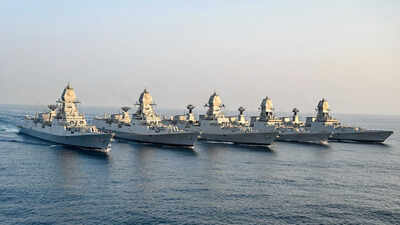
The Indian Navy is steering toward a 200-ship force by 2035, pursuing an atmanirbhar (self-reliant) defence strategy to reach that goal.The commissioning of INS Mahendragiri, built by Mazagon Dock Shipbuilders Limited, is a key step: it is the sixth ship of the Project-17A class to enter service.With the pending induction of Vindhyagiri, being constructed by Garden Reach Shipbuilders & Engineers, the seventh and final ship of the class will be delivered in the coming months.These frigates were designed in-house by the Navy’s Warship Design Bureau.To date, more than 100 indigenously designed warships have been commissioned, with INS Udaygiri — another Project-17A frigate commissioned in August 2025 — marking the 100th domestically designed warship to enter service.The Navy’s objective is to become fully atmanirbhar: able to operate independently and project power across the Indian Ocean and the wider Indo-Pacific.That capability is being built through collaboration with the Defence Research and Development Organisation (DRDO), public and private shipyards, Steel Authority of India Limited, IITs, private industry and academic institutions, with the aim of creating a thriving domestic naval production ecosystem.These efforts are being driven under the Indian Naval Indigenisation Plan (INIP), first unveiled in 2015.The INIP organises indigenisation under three pillars: float (hull and ship structure), move (propulsion systems) and fight (combat management systems, armament and sensors).Substantial progress has been made across all three.Today, over 90% of float systems and roughly 60% of move systems have been indigenised. Work on fight systems has also advanced: many components are already produced domestically and development on others is underway, with about 50% of fight-system projects in progress, according to the Navy.The Navy aims to achieve full blue‑water capability — the ability to operate effectively far from India’s coast — to protect national interests across the region.Efforts are focused on strengthening anti-submarine warfare, improving surveillance of the Exclusive Economic Zone, and sustaining a credible deterrent. As a regional first responder for humanitarian assistance and disaster relief, India also requires additional platforms and resources to project stability in the Indian Ocean Region.The push for indigenisation is driven by India’s strategic geography and its economic dependence on the seas: around 90% of trade and 80% of critical freight move via maritime routes. Securing these lines of communication is therefore essential.The Navy’s sustained anti-piracy deployments since 2008 have safeguarded thousands of merchant vessels and seafarers, demonstrating India’s capacity for long-duration operations. As the fleet grows, these responsibilities will increase, making reliable, cost‑effective, domestically supported platforms even more important.The Navy is also investing in unmanned systems, artificial intelligence and advanced sensors to operate as an effective multi-domain force; these technologies will enhance maritime domain awareness and combat effectiveness. Initiatives such as Swavlamban, the Naval Innovation and Indigenisation Organisation, and Innovations for Defence Excellence (iDEX) give industry and academia a roadmap for required technologies and help align stakeholders.India has moved from buyer to builder of major naval platforms, progressing through milestones such as INS Vikrant, the development of strategic submarine capability, and the steady induction of indigenous frigates and destroyers. By 2035, with a fleet of 200 warships and submarines, India aims to field a navy that is not only larger but technologically advanced and strategically autonomous.

Leave a Reply