

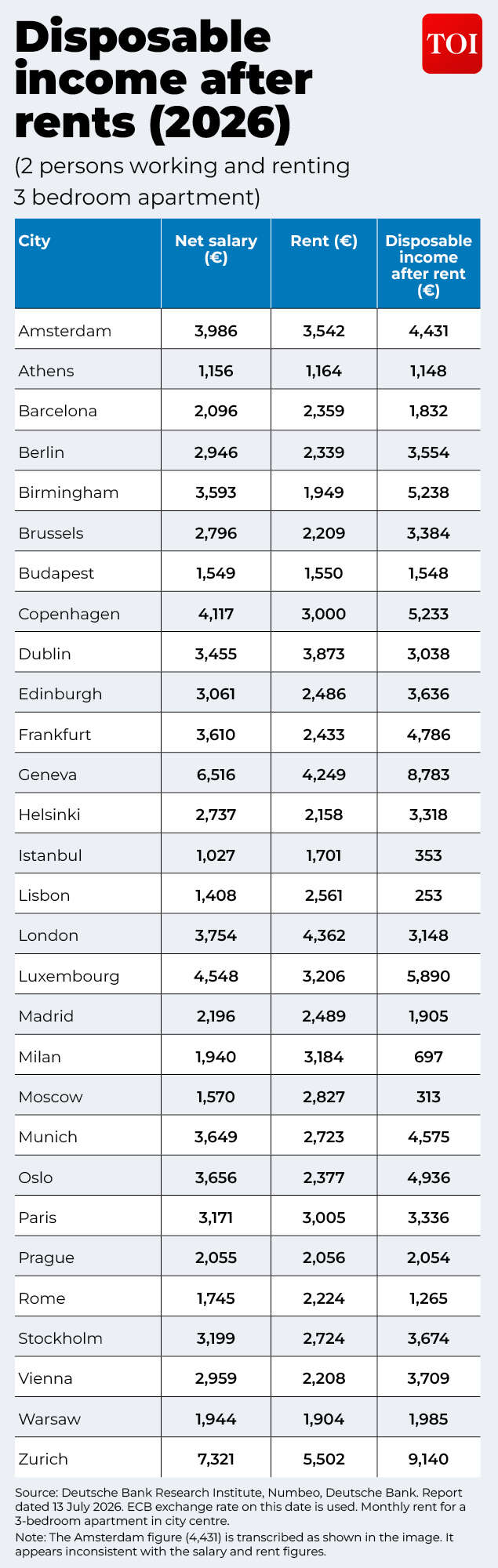
NEW DELHI: On Halloween, France is bracing for something far more unsettling than the usual festivities. Thousands are expected to take to the streets on Saturday, as 70,000 police and gendarmes are mobilised across the country amid fears of fresh unrest. Shops have boarded up, security has been tightened and authorities are seeking to prevent a repeat of the violence that erupted earlier this month. Behind the protests lies a familiar frustration: rising living costs, strained public services and the growing difficulty of making ends meet.The anger is not confined to France. Europe has long been associated with high living standards, strong social security and the promise of a comfortable life. But for a growing number of its residents, that promise is being tested by the monthly arithmetic of survival. In Lisbon, two people earning local salaries and sharing a three-bedroom city-centre apartment are left with just €253 after paying rent. In Milan, the amount is €697. Across the continent, rising housing costs, expensive essentials, stagnant wages and mounting pressure on public services are turning household budgets into a source of public discontent.From housing demonstrations in Spain and Portugal to protests over wages, education and government policies in France, Italy, Belgium and Germany, the grievances differ but point to a broader unease. The question confronting Europe is no longer simply whether people have jobs or earn a salary, but whether their earnings are enough to afford the life they were promised.The contrast with northern Europe is stark. The same calculation leaves a working couple in Zurich with €9,140 after rent, while €8,783 remains in Geneva.These figures, drawn from Deutsche Bank Research Institute’s Mapping the World’s Prices 2026 report, compare the combined net salaries of two local earners with the monthly rent of a three-bedroom city-centre apartment. They do not account for groceries, electricity, transport, healthcare or other household expenses. The calculation illustrates the gap between local earnings and city-centre rents rather than the actual spending patterns of every household.
How much remains after paying rent
The difference is not simply about how much people earn. Zurich has Europe’s highest rent in the comparison, at €5,502, but also the highest average net salary, at €7,321 per person. Lisbon, by contrast, has an average net salary of €1,408 against a city-centre rent of €2,561. In 11 of the 28 European cities examined, rent exceeds one local net salary.The difference is not simply about how much people earn. Zurich has Europe’s highest rent in the comparison, at €5,502, but also the highest average net salary, at €7,321 per person. Lisbon, by contrast, has an average net salary of €1,408 against a city-centre rent of €2,561. In 11 of the 28 European cities examined, rent exceeds one local net salary.
The rent-to-income gap is only the beginning
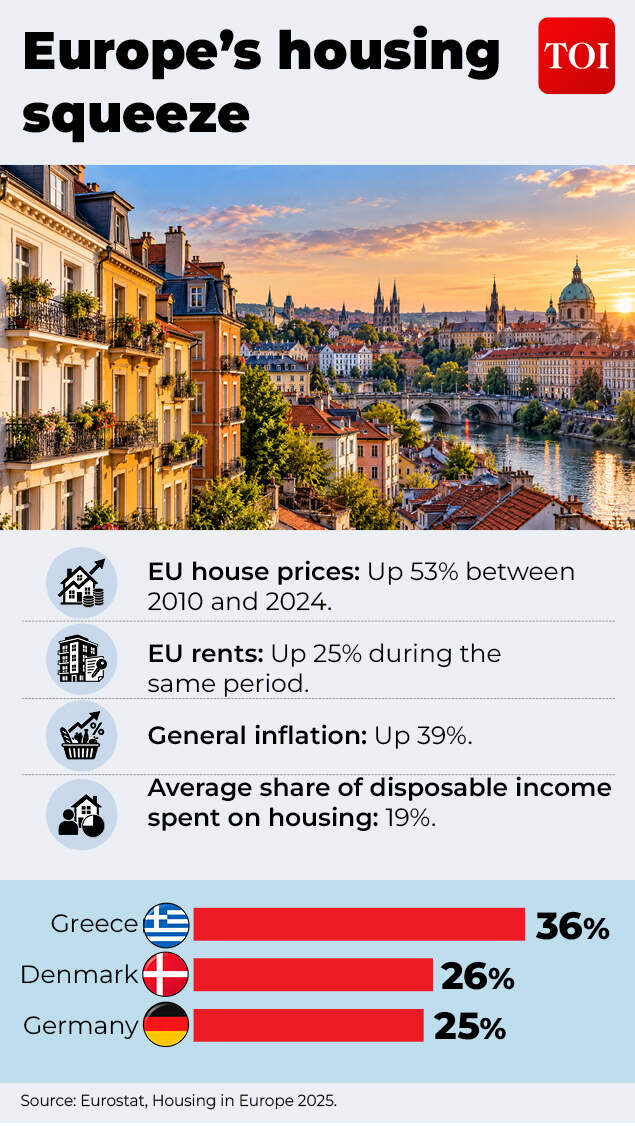
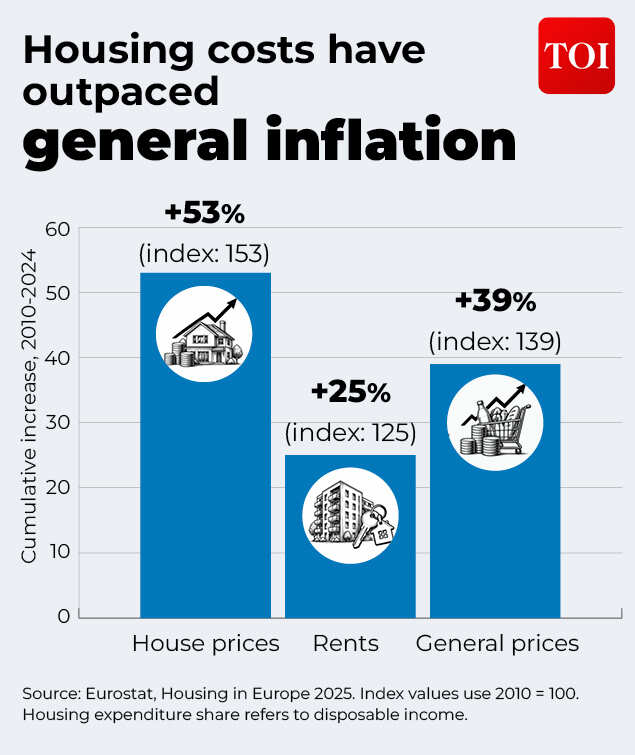
The housing burden becomes clearer when measured against household income rather than nominal rent. Eurostat’s Housing in Europe 2025 report found that EU households spent an average of 19% of their disposable income on housing in 2024. The share was 36% in Greece, 26% in Denmark and 25% in both Germany and Sweden. For households at risk of poverty, housing consumed 37% of disposable income across the EU.The longer-term trend is equally revealing. Between 2010 and 2024, house prices across the EU increased by 53%, while rents rose 25%. General consumer prices increased by 39% during the same period. In other words, housing prices outpaced overall inflation, adding to the pressure on tenants and prospective homeowners.
Europe’s housing problem
Greece presents one of the clearest examples of the squeeze. Apart from having the highest housing expenditure relative to disposable income among the countries listed, it also recorded a 43% share of people living in households with arrears on mortgage, rent or utility bills in 2024, the highest in the EU.For younger Europeans, the challenge extends beyond finding a job. Eurostat’s 2025 data show that 9.1% of people aged 15-29 lived in households spending at least 40% of disposable income on housing. The figure was 25.6% in Greece and 26.9% in Denmark. Across the EU, 26.9% of young people aged 15-29 lived in overcrowded households.The problem is not confined to rent. Food, another unavoidable household expense, accounts for a substantial share of monthly expenditure. Eurostat estimates that food and non-alcoholic beverages accounted for 13.1% of total household expenditure in the EU in 2024. The share was 18.1% in Portugal, 15.7% in Greece and 14.7% in Italy. In Germany, it was 11.1%, while France recorded 12%.
Food may be cheaper, but is it affordable?
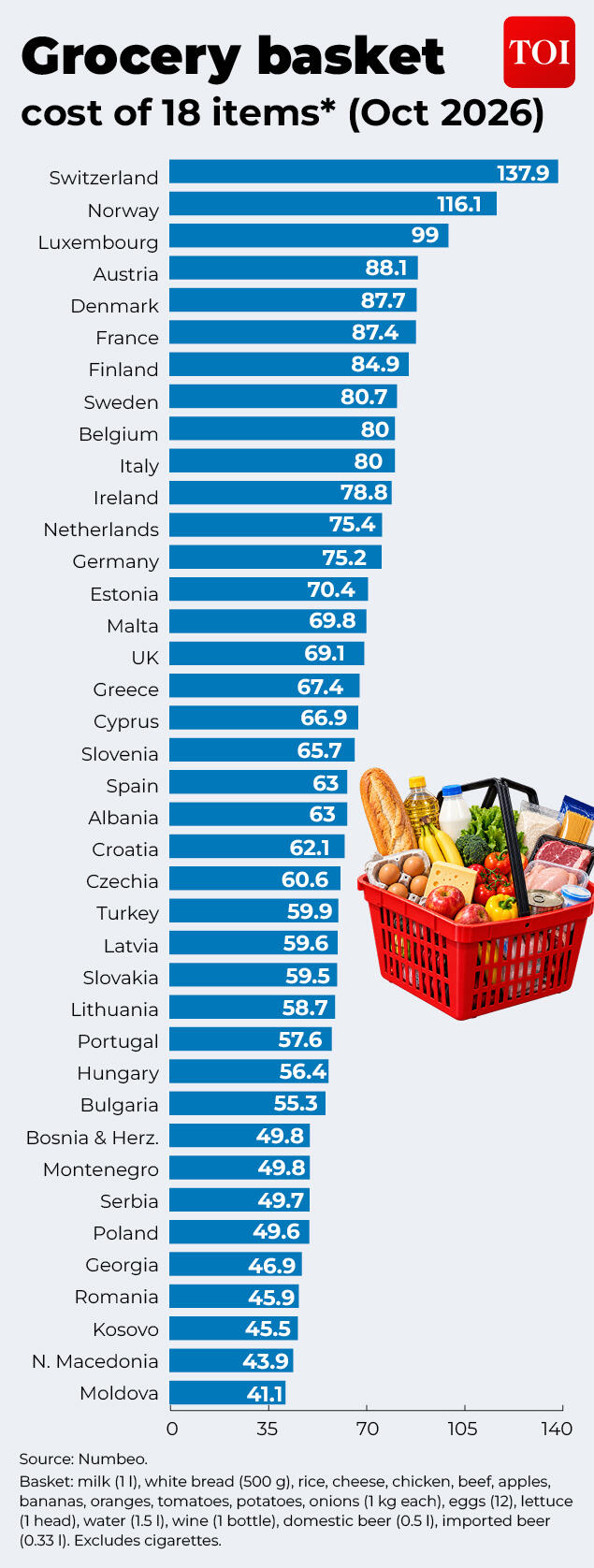
A comparison of food prices across Europe also reveals a gap between the cost of a grocery basket and the ability to pay for it.Eurostat’s 2025 comparative price-level index, which sets the EU average at 100, puts food and non-alcoholic beverage prices at 106.8 in France, 105.3 in Greece, 104.5 in Belgium, 102.4 in Germany, 102 in Portugal and 101.1 in Italy. Spain, at 95.3, is below the EU average. Romania recorded one of the lowest levels, at 79.8.
How much grocerries cost in different parts of Europe
The comparison also exposes why cheaper groceries do not automatically translate into greater affordability. Romanian households, for example, spent 23% of their total expenditure on food and non-alcoholic beverages in 2024, compared with the EU average of 13.1%. Portugal’s share was 18.1%. Lower prices can still absorb a larger portion of household budgets when incomes are lower.The latest inflation figures add another layer. Eurostat reported that eurozone inflation reached 3.8% in September 2026, up from 3.2% in August. Energy prices rose 18.9% year-on-year, while food, alcohol and tobacco prices increased 1.3%. Within the food category, unprocessed food inflation was 4%.
” msid=”135398719″ imgsize=”433790″ resizemode=”4″ width title=”Food, energy and other necessities get costlier” placeholdersrc=”https://static.toiimg.com/photo/83033472.cms” offsetvertical=”0″ placeholdermsid=”47529300″ type=”thumb” src=”https://static.toiimg.com/photo/83033472.cms” class data-src=”https://static.toiimg.com/photo/imgsize-433790,msid-135398719/food-energy-and-other-necessities-get-costlierbr.jpg” data-api-prerender=”true”>
Food, energy and other necessities get costlier
The distinction between inflation and price levels is important. Slower inflation does not mean groceries have become cheaper. It means prices are increasing at a slower pace. The accumulated increases of previous years remain part of household bills.
Why are Europeans taking to the streets?
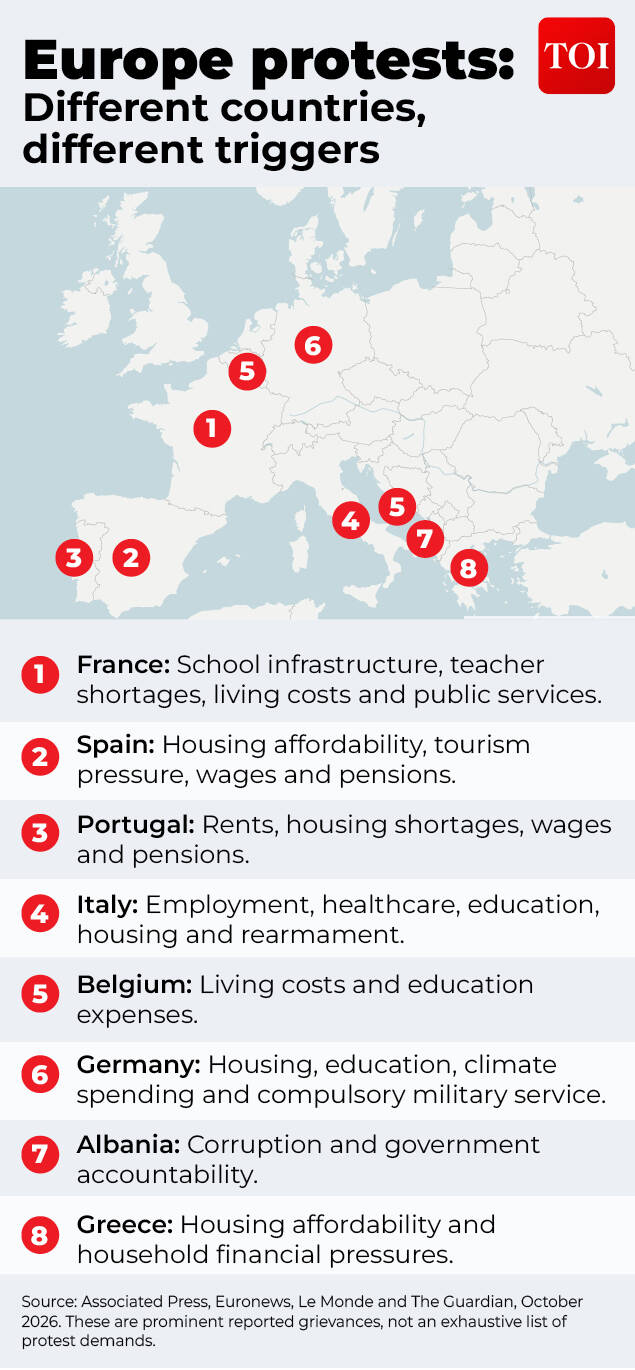
The data help explain the economic pressure, but the protests have several immediate triggers. They are not one coordinated European movement, nor are they driven by a single political ideology.In France, demonstrations that began with complaints about school infrastructure, overcrowding and teacher shortages expanded into wider protests over living costs, wages and public services. The country has also witnessed clashes during demonstrations, prompting large-scale security deployments.In Spain and Portugal, housing affordability has become a central grievance. Protesters have opposed rising rents and the pressure of tourism on local housing markets. In Portugal, demonstrations have also demanded higher wages and pensions. In Italy, protests have brought together demands relating to employment, healthcare, education, housing and opposition to rearmament.Belgium has witnessed demonstrations over living costs and education expenses, while Albania’s protests have focused on corruption and government accountability. In Germany, youth-led demonstrations have raised demands concerning schools, housing and climate spending, alongside opposition to restoring compulsory military service.
What is each country protesting against
“Every protest has its own dynamics. One needs to examine the specific reasons behind demonstrations in Spain, France, Belgium or any other country because each has its own history, economic difficulties and political context,” Gulshan Sachdeva, Professor of European Studies at Jawaharlal Nehru University (JNU), told TOI.However, he believes there is a common economic thread connecting several of these demonstrations.“What we are witnessing is a combination of several crises: economic stagnation, rising living costs, housing shortages, demographic pressures, immigration-related anxieties and changing political dynamics. It is a broad cocktail of problems rather than a single cause of public unrest,” Prof. Sachdeva said.The pressure on housing is particularly visible in southern Europe, where the growth of tourism has added to competition for residential properties. Sachdeva said local residents in cities such as Barcelona and Madrid increasingly feel priced out of their neighbourhoods as properties are used for tourism and short-term rentals.“The cost of living has risen, housing has become increasingly unaffordable, and younger people feel that the welfare state they inherited is no longer providing the same level of support,” he said.
A crisis of growth, public spending and political trust
Economists and political analysts say the problem extends beyond household expenditure. Years of weak economic growth, demographic changes, pressure on government finances and growing competition from emerging economies have reduced the room available to European governments to respond to public demands.Rajan Kumar, Professor at JNU, said the economic difficulties have been compounded by the Ukraine conflict and Europe’s move away from Russian energy supplies. Higher energy costs have affected production, transportation and other commodities, adding to the cost pressures faced by households and businesses.
Inflation in Europe
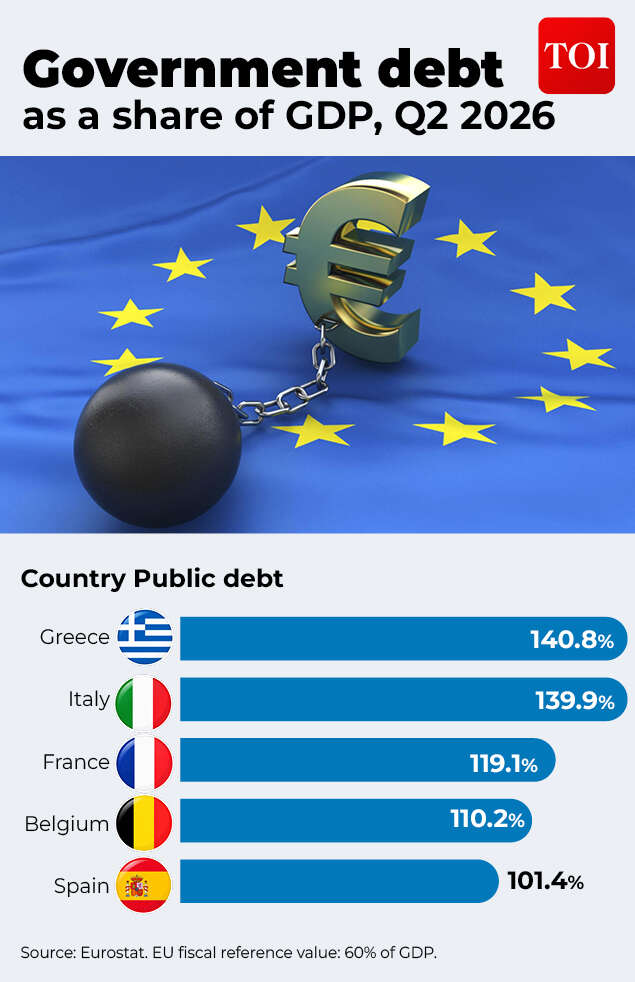
The pressure on government finances is another part of the problem. Under the EU’s fiscal framework, the reference values for government deficits and public debt are 3% and 60% of GDP, respectively. These are not absolute spending ceilings, but countries exceeding them can face corrective procedures. France’s public debt, for instance, stood at 119.1% of GDP at the end of the second quarter of 2026. Greece, Italy and Belgium were also above the 100% mark.Kumar argued that governments are finding it difficult to maintain welfare expenditure while responding to demands for higher defence spending. More money allocated to defence could put additional pressure on other spending priorities, including education and healthcare.He also pointed to Europe’s ageing population, declining working-age population and loss of some of its traditional industrial and technological advantages to countries such as China and India.“The real issue is that the centre of gravity of global economic development has shifted towards countries such as India and China. Europe’s technological and industrial dominance is no longer what it used to be.”The growing political focus on immigration is another dimension. Both experts cautioned against treating migration as the primary cause of economic distress. Sachdeva said younger Europeans are more concerned about affordable accommodation, educational infrastructure and employment opportunities than about migrants taking their jobs.“The younger generation is not necessarily worried about outsiders taking their jobs. Its immediate concerns are better university infrastructure, improved educational facilities, better employment prospects and affordable housing.”He also rejected the argument that generous welfare systems have made young Europeans unwilling to work. Rather, he said, the problem is that employment opportunities and public services are not expanding at the pace people expect.Meanwhile, right-wing political parties have increasingly used immigration and national identity as political issues, sometimes directing public anger towards migrants instead of the underlying economic problems.
Government debt as a percentage of the GDP
France’s warning and the road ahead
The economic pressure is particularly visible in France, where finance minister Roland Lescure warned on October 30 that the country needed a budgetary turnaround to avoid a deeper crisis.France’s GDP contracted by 0.1% in the third quarter of 2026, following stagnation in the second quarter and a 0.2% contraction in the first. Lescure warned that without the proposed budgetary correction, the country was “headed straight for a wall”.
“For three quarters now, there has been no growth. If we fail to achieve the turnaround outlined in the budget, we are headed straight for a wall. The conclusion to be drawn from all this is that, as of 2026, the French economy is at a standstill. “
Roland Lescure, French finance ministerOn France’s economic performance in 2026, speaking to France Info, October 30.
But an economic turnaround alone may not guarantee social stability. Sachdeva pointed out that protests are also being shaped by domestic electoral calculations, with political parties using public discontent to advance their interests.With elections approaching, Spain is set to vote on November 29, 2026, followed by France’s presidential election on April 18, 2027, with a possible May 2 runoff. Greece is expected to hold parliamentary elections in spring 2027, while Italy’s election is due by December 22, 2027, though a snap poll in April 2027 is possible.There is no clear timeline for when Europe will return to relative social and political calm. While protests may subside in individual countries, the pressures driving them are unlikely to disappear through a change of government or a temporary slowdown in inflation. If two people working full-time can have just €253 left after rent in Lisbon, before accounting for food, electricity and transport, the crisis is ultimately about how much of their earnings they can retain to live.

Leave a Reply