
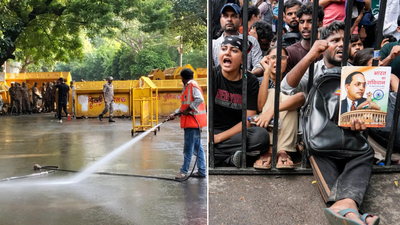
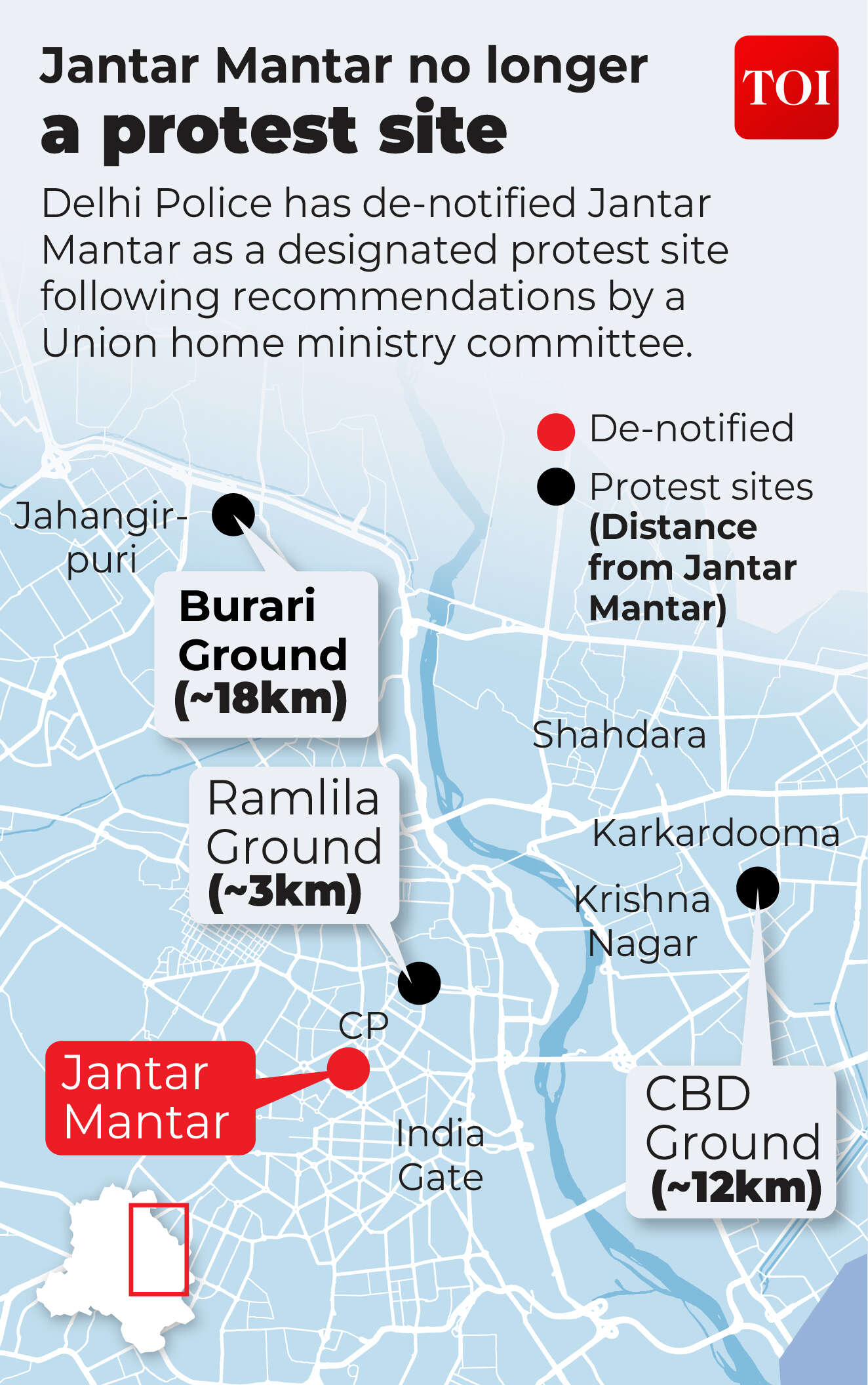
NEW DELHI: Jantar Mantar, one of Delhi’s best-known protest venues, has lost its status as a designated site for demonstrations. On October 12, Delhi Police de-notified the site and named three alternatives: Ramlila Ground, Burari Ground and CBD Ground in East Delhi.The decision follows recommendations from a committee constituted by the ministry of home affairs (MHA) to examine alternative venues for protests and demonstrations.For several decades, Jantar Mantar has been synonymous with protests in the national capital, a place where farmers, students, workers and political organisations have gathered to raise their demands. More recently, it became the centre of youth-led protests over the NEET paper leak, with demonstrators demanding reforms to the examination system and the resignation of then Union education minister Dharmendra Pradhan.
Jantar Mantar’s legacy: A landmark site of dissent faces a shift
However, Delhi’s address for protests has not always been Jantar Mantar. Before it emerged as a prominent hub for demonstrations, the sprawling lawns around India Gate and the Boat Club, close to Parliament and the government’s principal offices, were among the capital’s most important spaces for political mobilisation.The latest decision marks another chapter in the history of how authorities have regulated where citizens can assemble to make their voices heard.
Before Jantar Mantar, there was Boat Club
For decades after Independence, the Boat Club lawns near India Gate were an important venue for political rallies.The lawns near modern-day Central Vista gave demonstrators proximity to Parliament, the government’s principal offices and other institutions at the centre of national power.The scale of the gatherings, however, also presented challenges for the authorities.One of the defining episodes came in 1988, when farmer leader Mahendra Singh Tikait led a massive agitation in Delhi. Farmers gathered at the Boat Club and surrounding lawns to press their demands, bringing a large mobilisation into the heart of the capital.The episode became a turning point in the debate over whether such prominent public spaces should remain open to large demonstrations.Authorities increasingly sought to regulate gatherings in central Delhi, citing concerns around security, traffic and public order.
When Rajpath became a protest ground
In ‘India After Gandhi: The History of the World’s Largest Democracy’, historian Ramachandra Guha recounts how the lawns along present-day Kartavya Path, formerly Rajpath and known as Kingsway during British rule, became a prominent site of political dissent in the early 1990s.The book recalls tents occupied by people from different parts of the country, representing causes ranging from demands for a separate state and better prices for agricultural produce to recognition for regional languages.Other groups included industrial workers, Tibetan refugees seeking Indian citizenship and Hindu religious organisations campaigning on cow slaughter.The lawns near the country’s most prominent government buildings in Lutyens’ Delhi became a temporary home for movements that wanted their demands to be seen and heard.But the encampments did not last. Guha writes that the tents were dismantled in the early 1990s, with the government concerned about the impression created by visible demonstrations near the ceremonial heart of the capital.Protesters subsequently regrouped near Jantar Mantar, where they remained visible to people passing through the busy commercial district.The restrictions on gatherings around Boat Club and Rajpath helped set the stage for Jantar Mantar’s emergence as a prominent location for demonstrations.
How Jantar Mantar became Delhi’s protest address
Built by Maharaja Sawai Jai Singh II in the 18th century, Delhi’s Jantar Mantar is an open-air astronomical observatory designed to track celestial movements.Over time, the area around the historic site evolved into a major hub for protest movements, offering demonstrators a prominent public platform while remaining easier to manage than larger, more central locations.Located close to busy Connaught Place and within reach of Parliament and government offices, it allowed demonstrators to bring their demands into public view without occupying the expansive lawns around India Gate.The site hosted protests involving workers, farmers, civil society groups and citizens campaigning on a range of social and political issues.Its prominence grew further during the anti-corruption movement led by social activist Anna Hazare in 2011, when demonstrations demanding a stronger Lokpal mechanism brought corruption and accountability to the centre of national political debate.As the movement grew, Ramlila Maidan became the venue for larger gatherings and Hazare’s prolonged fast. The two locations demonstrated how different sites in Delhi could accommodate protests of different scales.The significance of Jantar Mantar was not simply a matter of geography. It became an established public address for people seeking to draw the attention of political leaders, government officials and the media to their grievances.Over the years, Jantar Mantar has witnessed protests on a range of issues, from Anna Hazare’s campaign for a Lokpal Bill and the 2017 Tamil Nadu farmers’ agitation to demonstrations against the Citizenship (Amendment) Act and the wrestlers’ protests against Brij Bhushan Sharan Singh in 2023.More recently, it became the centre of demonstrations by the Cockroach Janta Party (CJP) over the NEET paper leak and demands for the resignation of then Union education minister Dharmendra Pradhan.However, its status as a designated protest venue did not mean that demonstrations could take place without restrictions. Police permissions, public-order measures and court directions continued to determine how the site could be used.
When the right to protest reached the Supreme Court
In October 2017, the National Green Tribunal (NGT) ordered an end to protests at Jantar Mantar following complaints about noise, sanitation and disruption to residents.The restrictions were subsequently challenged before the Supreme Court.In its July 23, 2018, judgment in Mazdoor Kisan Shakti Sangathan v Union of India, the Supreme Court examined restrictions on protests at Jantar Mantar and the Boat Club, including the effects of demonstrations on residents and public spaces.The court recognised peaceful assembly and protest as fundamental rights under Articles 19(1)(a) and 19(1)(b) of the Constitution. At the same time, it acknowledged that the exercise of these rights could be regulated to protect public order and the interests of other citizens.The judgment addressed the competing claims of demonstrators and residents, making clear that one group’s rights could not simply extinguish those of another.It called for a balance between the right to protest and the need to prevent unreasonable disruption.The constitutional basis for that balance is set out in Article 19. Article 19(1)(b) guarantees citizens the right to assemble peacefully and without arms, while Article 19(3) permits reasonable restrictions in the interests of the sovereignty and integrity of India or public order.
What changes now?
The latest decision comes amid protests by opposition parties and the youth-led CJP against Chief Election Commissioner Gyanesh Kumar over alleged electoral irregularities and the Special Intensive Revision (SIR) of electoral rolls.The proposed CJP protest on October 10 was met with extensive security arrangements, detentions and restrictions on movement in parts of Delhi.Under the new arrangement, Jantar Mantar will no longer be a designated protest venue. Ramlila Ground, Burari Ground and CBD Ground in East Delhi have been identified as alternatives.Delhi Police has said a detailed and revised standard operating procedure for demonstrations at these three venues will be issued separately.The decision changes where organisers can hold demonstrations under the designated-venue system. However, de-notification should not be confused with a blanket prohibition on all peaceful assembly, which remains subject to constitutional protections and lawful restrictions.
Why the location of a protest matters
The significance of the decision extends beyond the physical relocation of demonstrations. The location of a protest affects its visibility, the ease with which people can reach it and its proximity to the institutions being addressed.A venue in central Delhi offers demonstrators a different kind of access and public visibility from a ground farther away from the corridors of power.For organisers, the choice of location can therefore be an important part of how a protest communicates its message.
Join conversation
Share your thoughts in the comments
Be respectful · TOI community guidelines
Among the newly designated venues, Burari Ground and CBD Ground in East Delhi are farther from the central government district than Jantar Mantar.At the same time, large demonstrations in central Delhi can create challenges for traffic management, security and the daily movement of residents.The October 10 protests, for instance, were accompanied by extensive security arrangements and disruptions to movement across parts of the city.The latest decision once again brings into focus a question that has shaped Delhi’s protest history for decades: how to balance the right to peaceful demonstrations with security, public order and the functioning of the national capital.

Leave a Reply