
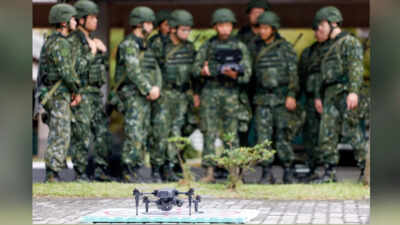
Taiwan is accelerating efforts to build fleets of aerial and unmanned surface drones as part of a strategy to make any potential Chinese invasion more difficult and costly, drawing lessons from Ukraine’s use of drones in its war with Russia, according to a report by The New York Times.The strategy, described by US military commanders as a “hellscape”, involves using large numbers of drones, missiles and artillery to detect and attack an invading force across multiple domains.Taiwan is now seeking to put elements of the approach into practice through military exercises, new commands and plans to expand domestic drone production.Lt Gen Huang Wen-chi, director general of strategic planning for Taiwan’s defence ministry, said the island’s drone and counter-drone efforts had initially developed slowly.“Our drone and counter-drone efforts started relatively late, and initially we were trying things out as we went along,” Huang told lawmakers, according to The New York Times.He said the approach had begun to change over the past two years.
Taiwan trains troops in drone warfare
Taiwan’s military allowed reporters to observe troops practising drone reconnaissance in central Taiwan on Thursday as part of the 10-day Han Kuang military exercises, which began on Wednesday.Maj Gen Lu Wen-yuan, who helped plan the exercises, said troops would also train to counter enemy drones.The focus on unmanned systems reflects Taiwan’s concern over China’s growing military capabilities. China, which is about 110 miles from Taiwan, claims the self-governed island as its territory and has expanded its fleets of warships, aircraft, missiles and drones, while also increasing coast guard patrols and landing exercises.Taiwanese officials have been studying Ukraine’s battlefield experience, particularly its use of relatively inexpensive drones against a much larger military.“Drones are entering a new chapter,” Max Lo, chairman of the Taiwan National Drone Industry Association, told The New York Times.“Taiwan, for its own survival and national defense, is in urgent need of these drones.”
From buying drones to changing military doctrine
Building drones is only one part of Taiwan’s planned approach. Military experts say the island would also need to change how its forces operate, including improving training, mobility, intelligence-sharing and the ability to deploy large numbers of drones while protecting them from enemy jamming and other countermeasures.“The army’s frontline military operations must undergo a total change from the past,” Shu Hsiao-Huang, an associate research fellow at Taiwan’s Institute for National Defense and Security Research, said.Taiwan has already begun incorporating drone tactics into military exercises. The army released images last month of a drill in which a unit used drones to search for enemy forces threatening islands off Taiwan’s east coast.President Lai Ching-te also watched an exercise in southern Taiwan on Saturday in which troops tested two prototype drones designed to strike invading forces.Taiwan has additionally established a Littoral Combat Command that integrates drones, mobile missiles and artillery into a coastal defence structure.However, experts caution that acquiring more unmanned systems does not by itself create the capabilities required for a “hellscape” strategy.Taiwan would also need to develop the organisational structures, doctrine and training needed to use the technology effectively.
Taiwan targets 100,000 drones a month by 2030
Taiwan is also seeking to expand its domestic drone industry, partly because China could attempt to isolate the island from external support in the event of a conflict.The government has set a target of producing 100,000 drones a month by 2030, with about half intended for export. It also wants its military to acquire more than 210,000 aerial and maritime drones.The government has proposed spending $6.5 billion over five years on drones. Two opposition parties that control a majority in the legislature have rejected that proposal, citing concerns about potential waste and corruption.The main opposition Kuomintang has instead proposed $7.4 billion over six years, with requirements for increasing domestic production.The debate over drone spending comes amid wider disagreements over Taiwan’s defence budget. The legislature recently approved an opposition-backed special defence budget capped at NT$780 billion ($24.82 billion), below the Cabinet’s proposed NT$1.25 trillion package, according to the Taipei Times.The Cabinet proposal included funding for unmanned systems and countermeasures, AI-assisted surveillance, defence supply chains, domestic defence manufacturing and joint US-Taiwan research and procurement programmes, the Taipei Times reported.
Taiwan expands drone exports and manufacturing
Taiwan is also trying to develop its drone industry as an export sector and reduce dependence on Chinese components.In the first three months of 2026, Taiwan exported $115 million worth of drones, exceeding its total exports for all of 2025.The Czech Republic was the largest destination, while research indicated that some Taiwanese drones were subsequently reaching Ukraine.Taiwanese companies are also developing maritime drones. Thunder Tiger, a Taiwanese manufacturer, and US defence technology company Shield AI recently conducted trials of two sea-drone models designed to identify enemy vessels and attack them.Taiwan’s drone industry is also seeking to expand production of components such as motors and optical equipment, with US drone companies expecting demand for such parts to grow.
China is also developing counter-drone capabilities
Taiwan’s preparations are taking place alongside China’s own expansion of unmanned systems and counter-drone technology.Military experts cited by the NYT said China is closely watching the lessons emerging from the Russia-Ukraine war and is investing in technology to detect and jam drones.A Taiwanese national security official previously told the Taipei Times that Chinese military assessments had examined a potential Taiwanese deployment of aerial, surface and underwater drones combined with smart command systems.According to the official, such a combination could form the basis of a “hellscape” strategy and impose significant losses on a Chinese invasion force.The same official said Taiwan’s proposed defence spending cuts could affect the timetable for developing unmanned systems and other capabilities.For Taiwan, the challenge therefore extends beyond building large numbers of drones. The island is seeking to integrate unmanned aircraft and boats with missiles, artillery, surveillance and command systems while developing the domestic industrial capacity needed to sustain them during a prolonged conflict or blockade.

Leave a Reply