
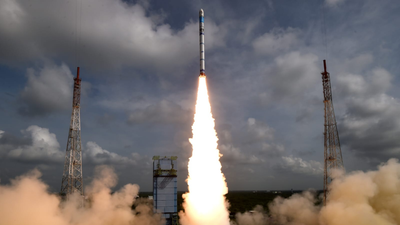
BENGALURU: August 23, 2023, gave India an image it had waited decades to see: a spacecraft settling on the Moon, its lander and rover beginning work near the lunar south polar region. But the significance of Chandrayaan-3 was perhaps easier to understand if one looked backwards.Six decades earlier, India was still figuring out how to launch a sounding rocket from a small range at Thumba, near Thiruvananthapuram.
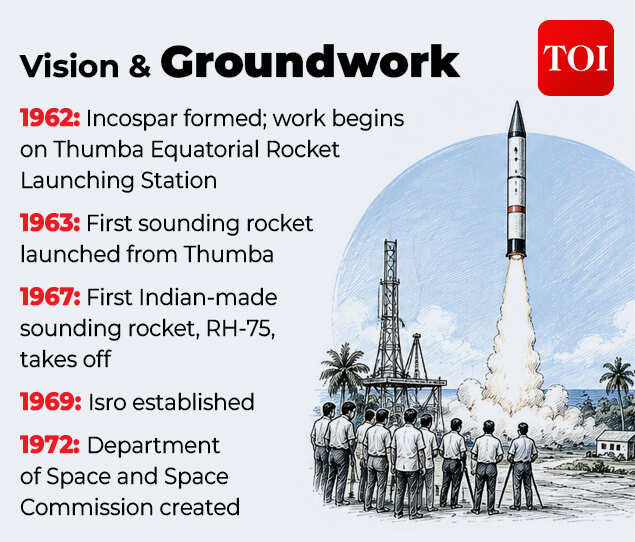
There were no Indian satellites, no launch vehicles capable of placing them in orbit, no sprawling network of mission control centres, tracking stations and testing facilities. The Indian space programme itself did not yet exist in the form we know it today.On Sunday, as India marks National Space Day, the distance between those two moments offers perhaps the clearest measure of how far the programme has travelled.The journey began in 1962 with the creation of the Indian National Committee for Space Research, or Incospar, and the decision to establish the Thumba Equatorial Rocket Launching Station.The first sounding rocket was launched from Thumba on Nov 21, 1963. Six years later, on Aug 15, 1969, the Indian Space Research Organisation (Isro) was formed. In 1972, the govt created the Space Commission and the Department of Space, bringing Isro under the latter.
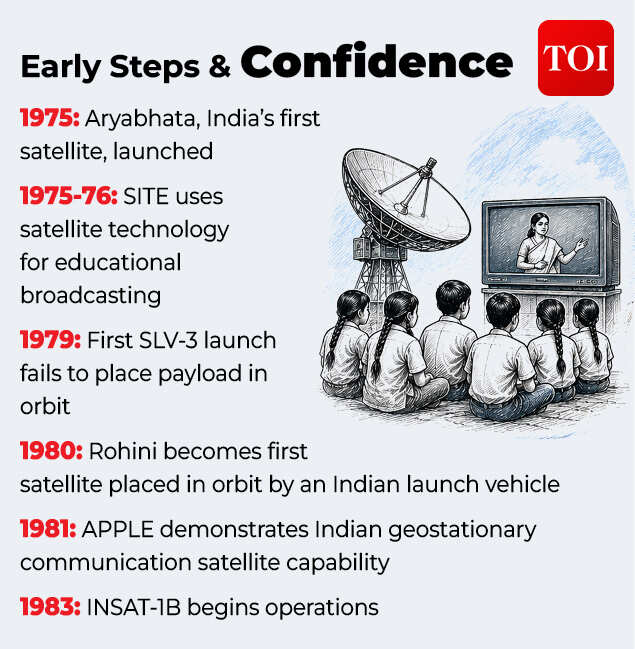
The ambition, however, was never simply to join the global race to space. Vikram Sarabhai’s vision was shaped by a more practical question: what could space technology do for a country that still faced enormous developmental challenges?That question defined the first phase of the programme. The launch of Aryabhata, India’s first satellite, in 1975 was a technological landmark. But the same period also saw experiments that revealed how satellites could be used to reach people on the ground.The Satellite Instructional Television Experiment, or SITE, used satellite broadcasting to bring television programmes to remote communities.This was followed by the Satellite Telecommunication Experimental Project. Earth observation, communication and weather services gradually became as important to the programme as the act of launching a satellite itself.The 1980s brought another transition: India began learning to build its own means of reaching space. The first experimental flight of the SLV-3 in 1979 failed to place its Rohini payload in orbit. Less than a year later, on July 18, 1980, the second experimental flight succeeded, placing Rohini in orbit and making India a member of the small group of nations capable of launching a satellite using an indigenous rocket.APPLE, launched in 1981, demonstrated communication satellite capability, while the INSAT system began building the backbone for telecommunications, broadcasting and meteorological services.
Not every step worked the first time. The Augmented Satellite Launch Vehicle, or ASLV, suffered early failures too. But the pattern that would define much of Isro’s subsequent history was already visible: build, fail, diagnose, redesign and fly again.By the late 1980s, the programme was also beginning to acquire another defining purpose. IRS-1A, launched in 1988, became India’s first operational remote sensing satellite. Satellites would increasingly become tools for mapping crops, forests and water, monitoring weather, planning infrastructure and responding to disasters.The next major leap came with the Polar Satellite Launch Vehicle, or PSLV. Over time, the vehicle became the workhorse of the Indian space programme, carrying Indian satellites and eventually spacecraft from other countries into orbit. More importantly, it gave India a dependable route to space.The programme had, by then, evolved into a chain of capabilities. Satellites were designed and built in India. Launch vehicles were developed in India. Ground stations tracked them. Mission control operated them. Data from space was converted into information that could be used by governments, scientists and citizens.Data shows the scale of that system today. The UR Rao Satellite Centre (URSC) alone has built more than 130 satellites for applications ranging from telecommunications and weather forecasting to navigation, disaster warning and space science. The Satish Dhawan Space Centre at Sriharikota now operates two launch pads, while a network of centres across the country handles propulsion, remote sensing, navigation, tracking, space science and human spaceflight.Then came the phase that changed how the world saw India’s space programme. Chandrayaan-1, launched in 2008, took India to the Moon and helped establish the presence of water molecules on the lunar surface. In 2013, the Mars Orbiter Mission lifted off aboard a PSLV. It entered Martian orbit in 2014, making India the first country to reach Mars on its maiden attempt.
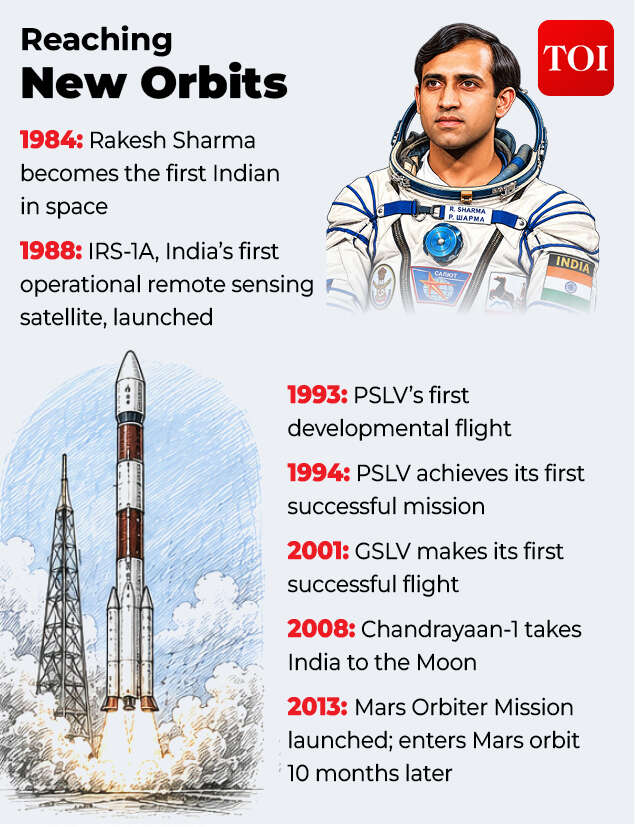
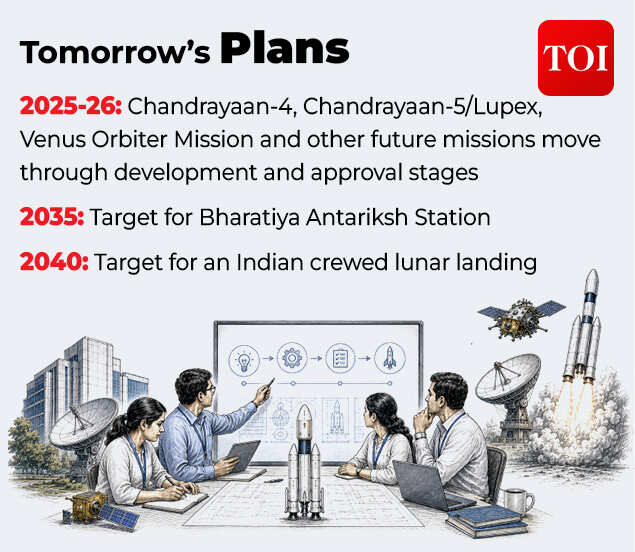
These missions were different from the earlier application-driven satellites. India was no longer using space only to look back at Earth. It was using its growing technological capability to ask scientific questions about the Moon, Mars, the Sun and the wider universe.The distinction matters. A space programme that once depended heavily on external launchers and imported technologies was beginning to attempt increasingly complex missions of its own.The launch vehicle story evolved alongside it. The PSLV was joined by the GSLV, which was developed to place heavier satellites in more demanding orbits, and later by the LVM3, India’s heavy-lift launcher. The SSLV added a vehicle aimed at the small-satellite market. Today, the annual report says the next step is already underway: a Next Generation Launch Vehicle is being developed even as work continues on reusable launch vehicle technologies and advanced propulsion systems.The symbolic high point of this journey, of course, came with Chandrayaan-3. Its landing on Aug 23, 2023, made India the first country to land near the Moon’s south polar region and provided the date for National Space Day. But the mission was also a reminder that the programme’s evolution has rarely been a straight line. Chandrayaan-2 had fallen short of a soft landing in 2019. Chandrayaan-3 returned with changes to the lander and mission design and succeeded.Since then, the horizon has widened again. Aditya-L1 has taken India into solar observation. Gaganyaan is pushing the programme into human spaceflight. Chandrayaan-4 is being planned as a lunar sample-return mission, while Chandrayaan-5 or Lupex, a collaboration with Japan, is intended to study lunar polar volatiles. A Venus Orbiter Mission and a future Mars Lander Mission are also part of the longer scientific pipeline.
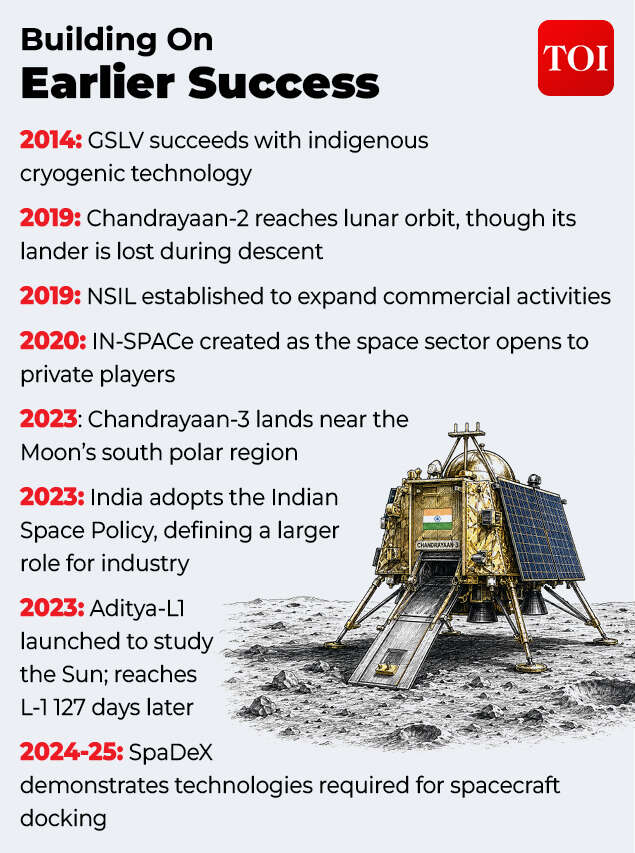
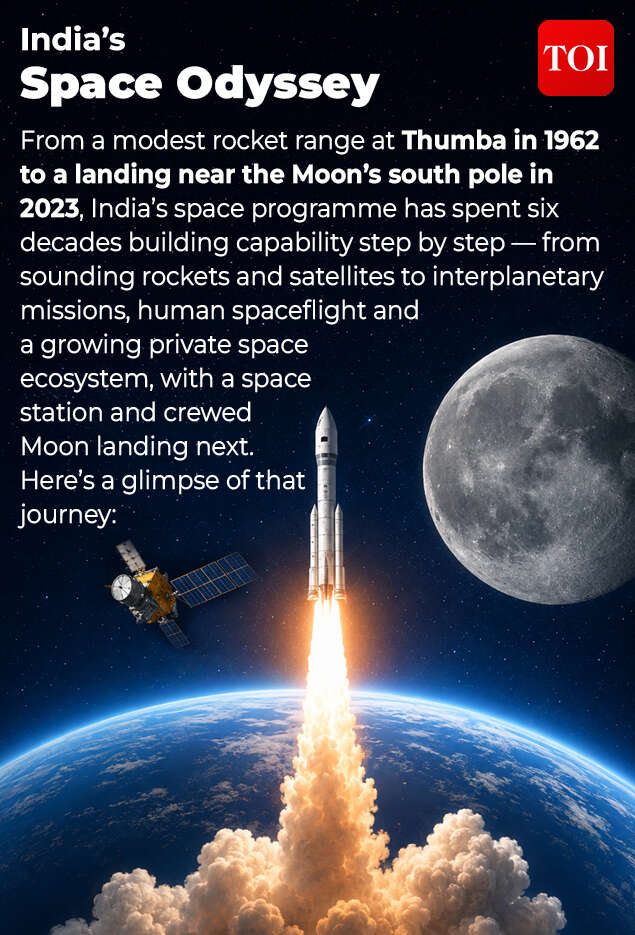
But perhaps the most consequential change is not a spacecraft at all. For most of its history, India’s space programme was synonymous with Isro. Today, that equation is beginning to change. The opening of the sector has created a role for private companies and startups to build satellites and launch vehicles and offer space-based services.IN-SPACe was created as the agency to promote, authorise and regulate private space activity, while NSIL has been tasked with expanding the commercial and industrial side of the programme.That may prove to be as significant a transition as the move from sounding rockets to satellites. The Indian space programme is shifting, however gradually, from a model in which Isro built almost everything itself to one in which it must increasingly create technologies, enable industry and focus on missions that push the frontier.The future targets are correspondingly larger. Under India’s Space Vision 2047, the govt has set goals of establishing the Bharatiya Antariksh Station by 2035 and landing an Indian on the Moon by 2040. Isro is to also develop the Next Generation Launch Vehicle (NGLV) before the space station.
Whether all those timelines hold is a question for the future. Space programmes are shaped as much by budgets, industrial capacity, technology and setbacks as by vision.
Which mission do you think has been the most transformative for India space program?
3k+ users shared opinion today
5k+ users already voted today
3k+ users shared opinion today
But the direction of travel is clear. From a rocket range at Thumba to a landing near the Moon’s south pole, India has spent six decades building capability layer by layer — something the emerging private sector in the country, whether or not it will willingly acknowledge publicly, benefits from tremendously.The first challenge was to enter space. Then came the task of making space useful. After that came the ability to explore beyond Earth. The next challenge may be the most difficult yet: turning a programme built around one organisation into a much wider national space ecosystem, without losing the scientific and technological strengths that brought it this far. On its third National Space Day, that may be the most important evolution to watch!

Leave a Reply