
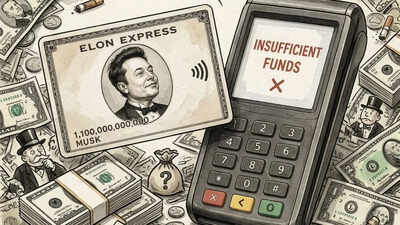
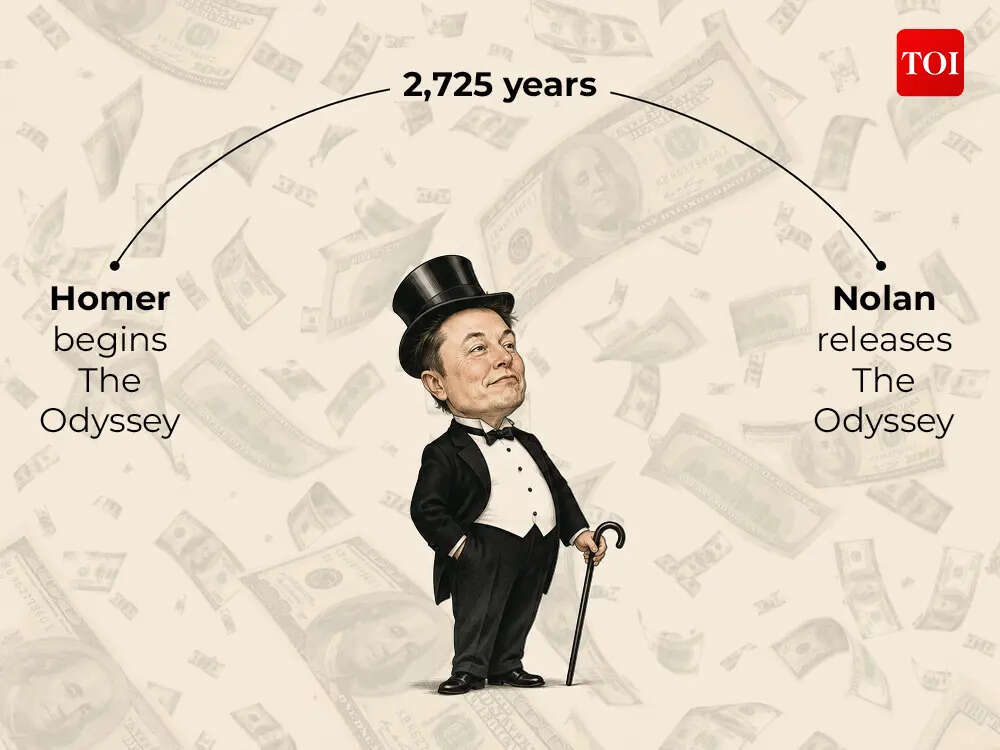
On an unremarkable Friday this June, a number appeared across every headline. A trillion.Since then, people have been attempting to understand it. What can it buy? How tall would a trillion dollar bills stacked be? How fast would you need to spend to burn through it in a lifetime?The internet, which excels at this kind of arithmetic, got to work. A trillion seconds, someone noted, is 31,688 years. A trillion dollar bills laid end to end would reach the Sun and come back twice. To spend it down at a million dollars a day would take more than two thousand seven hundred years, which means Musk would have needed to start in 700 BC, roughly around the time Homer was composing the Odyssey, and keep going, every single day, without interruption, to be broke by now.
But what can a trillion not do?Honestly, very little. The list of what it can buy would wrap around the earth countless times. The list of what it cannot is short enough to fit in a single article, which is, in a way, the most unsettling thing about it.
He can go to the Moon. He cannot own it.
SpaceX, the company whose IPO made Musk a trillionaire on Friday, estimates a Starship launch will eventually cost around ten million dollars. At that rate, his trillion could send him to the Moon one hundred thousand times. Once a day for two hundred and seventy-three years. He could go to the Moon more times than any civilization has ever built anything, and return, and go again, and the number would barely move.He still cannot own a single acre of it.
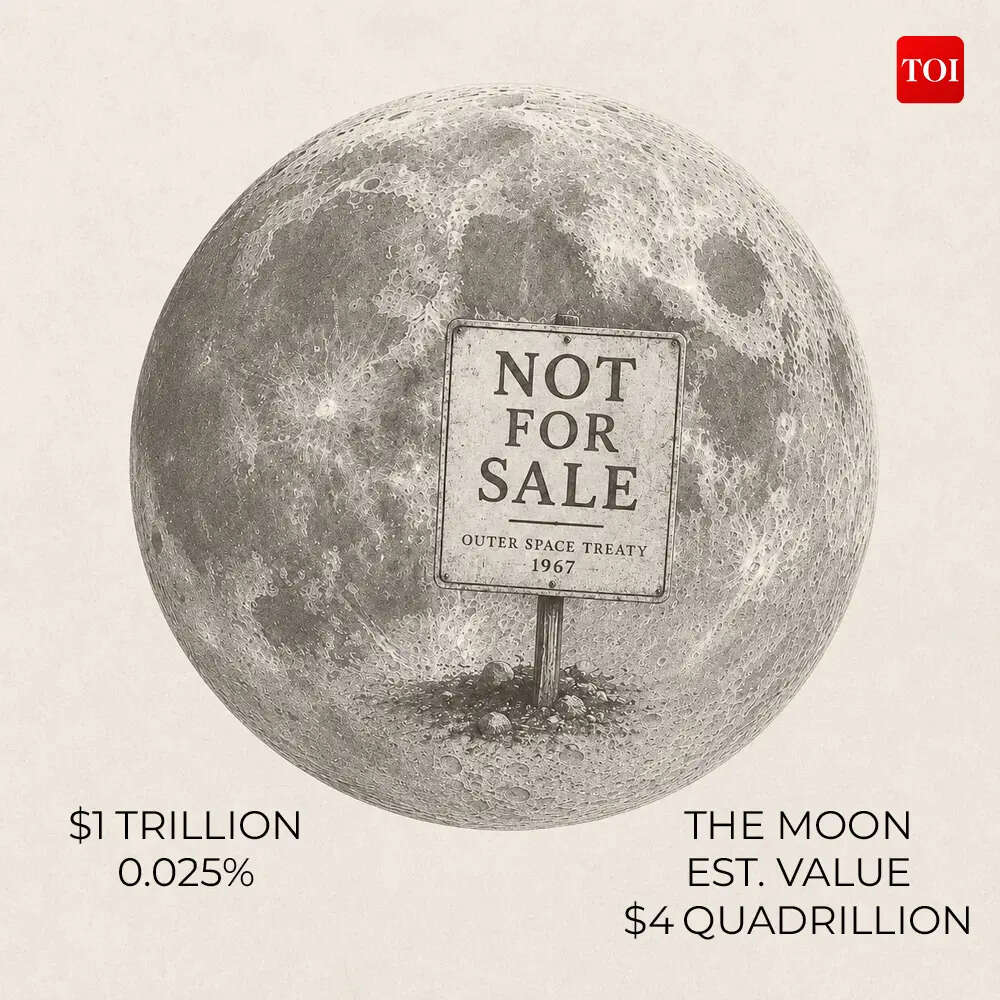
The Outer Space Treaty of 1967, signed by the United States, the Soviet Union, and over a hundred other nations, is unambiguous: no country, and no person, may claim sovereignty over the Moon or any other celestial body. There is no provision for sufficiently large offers, absolutely no loopholesWhich would be a simple enough fact, a legal technicality, the kind of thing that gets amended, were it not for what the Moon is actually worth. The rock that Musk cannot buy contains an estimated 600 million metric tons of water, valuable in space not for drinking but for splitting into hydrogen and oxygen — rocket fuel, essentially, an interplanetary gas station. It contains Helium-3, a rare isotope that could power nuclear fusion reactors, scarce on Earth and abundant up there, worth an estimated $640,000 per pound. Mine only the accessible portions of the lunar surface and the conservative estimate of its total value lands at four quadrillion dollars.Four quadrillion. Musk’s trillion, the number that stopped the world on Friday, is 0.025 percent of what sits, untouchable, 238,000 miles above our heads.It is a bit amusing that the list of things he cannot afford to buy started from something that isn’t even part of our Earth. But the next item on the list is 100% on the surface of our planet.
Antarctica – truly no-man’s land
The continent at the bottom of the world is, by any reasonable measure, the most valuable piece of real estate on Earth that no one owns.Its geology mirrors the richest mineral provinces on the planet but none of it can be touched. The Protocol on Environmental Protection to the Antarctic Treaty bans commercial mining entirely, and the ban holds a peculiar structural guarantee: it can only be lifted if every single signatory nation agrees.As of now there are 54 parties to the treaty. Musk could fund the lobbying effort of a lifetime and still need unanimous consent from nations that include, among others, countries with no particular reason to do him any favors.There is a review provision. The Protocol can be reconsidered in 2048 but money cannot move that date.Antarctica is, in the precise legal sense, not for sale. It has no owner, no seller, no price. Musk’s trillion, which can buy almost anything with a price tag, arrives here at a continent that simply never got one.The next item on the list has a price tag, a growing one.
Fix Middle East
One of the latest assessments of post-war reconstruction needs across the Middle East estimates it would cost approximately $1.5 trillion.Gaza alone accounts for $70 billion — not for development, but simply to clear 61 million tons of rubble before a single foundation can be poured. Lebanon needs $40 billion to restore what the conflict dismantled. Syria, after fifteen years of civil war followed by renewed bombardment, requires an estimated $400 billion.Yemen, Iraq, Libya and Sudan add hundreds of billions more. And Iran, whose petrochemical sector was struck hard enough to disrupt 85 percent of its export capacity, has formally demanded $270 billion in compensation.Musk’s trillion is not enough. He could liquidate every share, empty every account, sell every company at peak valuation, and still come up a little less half a trillion dollars short as of now.But the more important truth is that money was never the constraint. Even if Musk’s trillion were doubled, tripled, multiplied by ten, the region would not rebuild faster. Reconstruction requires political agreements that do not exist, security guarantees that cannot be bought, ceasefires that hold for more than a week, and governance structures that have either collapsed or were never built. These are not purchasable. They become possible only when enough parties decide that the cost of fighting finally exceeds the cost of building.A trillion dollars can buy a lot of cement. It cannot buy a reason to stop bombing.The last item on the list is something even Musk could not afford.
The debt that ate a trillion for breakfast
The United States national debt currently stands at $39.2 trillion. Musk’s trillion is approximately 2.5 percent of it. He could donate his entire net worth – every dollar, every equity stake, every share of every company liquidated at current valuations – and it would cover roughly one year of interest payments. The debt would resume accumulating the morning after the check cleared, at its current rate of $8.19 billion per day, and within forty days the contribution would be mathematically erased.
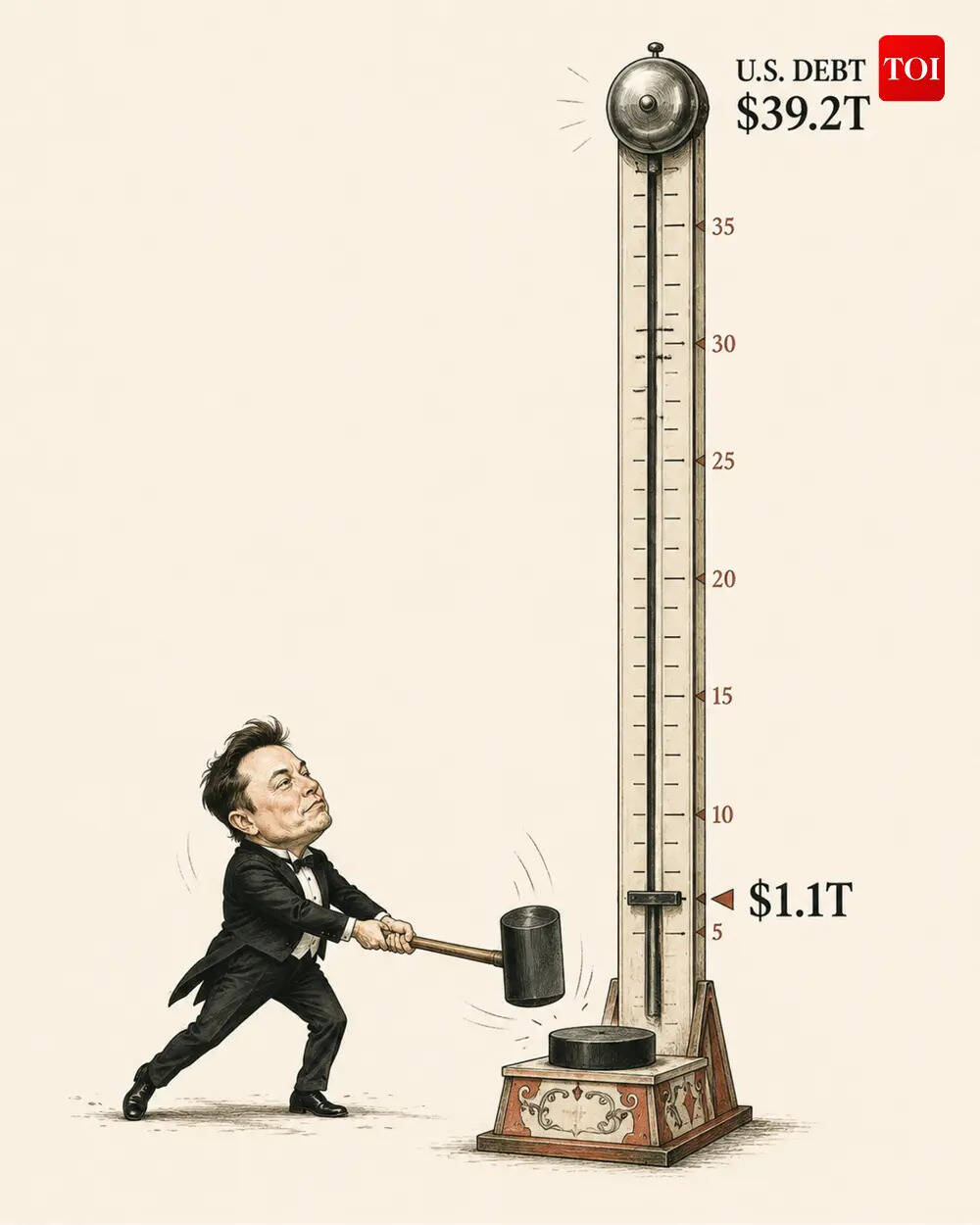
This year, for the first time in American history, the federal government will spend over a trillion dollars on interest alone. More than it spends on Medicare. More than it spends on defense.Musk’s trillion, the number that rewrote the record books on Friday, would not dent this. It would not slow it. It would be consumed and forgotten, a single year’s interest payment, after which the clock would continue exactly as before.There is something clarifying about this. The debt is not a problem that money solves. It is a problem that was created by the logic of money, by borrowing and spending and deferring and borrowing again across decades of political decisions made by hundreds of elected officials responding to millions of voters with competing interests. No individual fortune, however unprecedented, reaches the scale of what collective behavior, compounded over time, can produce. Musk’s trillion is the largest number any single person has ever accumulated. The country he lives in runs a deficit larger than his entire net worth every single year.The amount Musk holds is also paradoxical in its very being. Almost as though an item on the list of the things he cannot buy is his own trillion. Musk’s wealth exists as illiquid equity, so to actually possess that trillion he would have to flood the stock market with shares, which would cause it to tank and the trillion would no longer be a trillion.
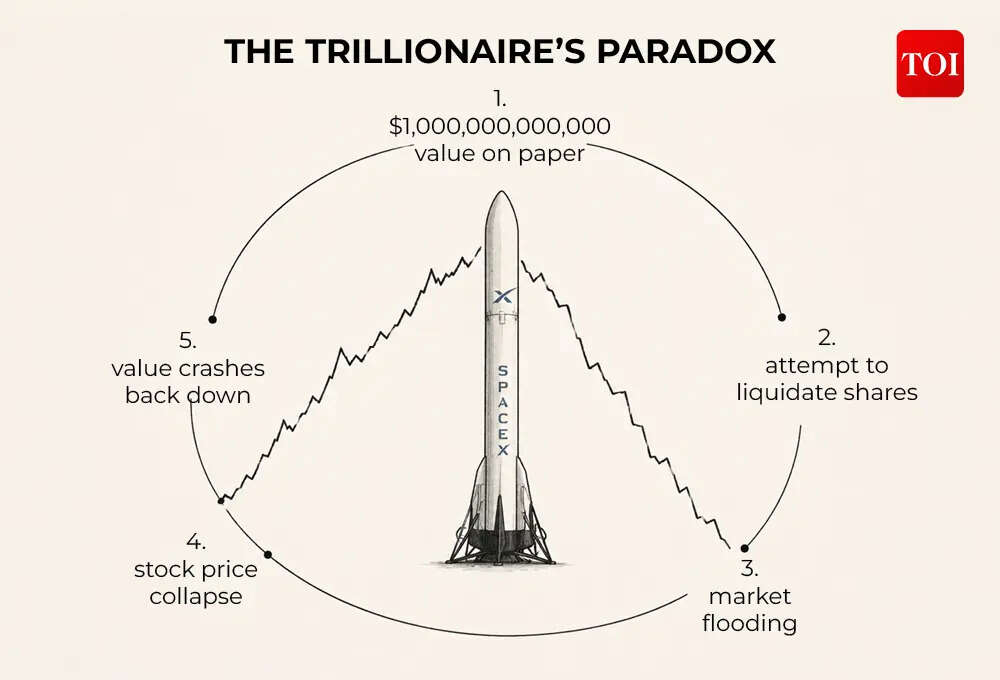
The dollar has value because we collectively decided it does. Musk’s trillion exists entirely as a social consensus — numbers in databases, equity stakes in companies whose valuations are beliefs held by enough people simultaneously. If enough people stopped believing, the number would change by morning. It has changed by tens of billions in a single day before, on a bad tweet.Which means the list of things a trillion cannot buy is not a list of things stronger than money, but a list of things we have decided, so far, not to sell.That decision is not permanent. The Outer Space Treaty could be amended, the Antarctic mining ban could be lifted in 2048 if every signatory agrees, and the debt ceiling gets raised whenever Congress decides to raise it. Ceasefires eventually hold or they don’t, but either way, what is unsellable today can become purchasable tomorrow — not because anyone got richer, but because enough people stopped agreeing to keep it protected.Musk’s trillion is unprecedented, but the things it cannot do are not a measure of his limits. They are a measure of ours.

Leave a Reply