
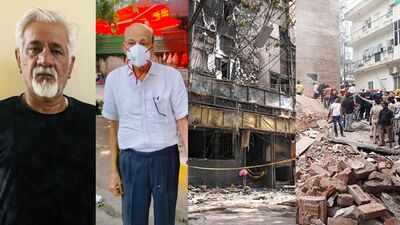
NEW DELHI: “Delhi mein sab chalta hai,” three months ago, those words surfaced in the aftermath of Delhi’s Malviya Nagar B&B fire — a tragedy that eventually claimed 23 lives.Now, after another deadly disaster in the capital, the words echo again.This time, it is not a fire but a five-storey building in Satya Niketan that came crashing down, killing seven people — five students and two labourers.Two tragedies. Two different locations. But behind both lies the same uncomfortable question: How much can be altered, ignored or allowed before a building becomes a death trap?The Malviya Nagar B&B tragedy had already exposed how far a property could drift from what it was legally meant to be.The building was more than two decades old when Lovkesh Bajaj bought it from another businessman three years earlier. Bajaj told police that the seller had suggested modifications, including increasing the size of rooms and making other alterations.
A challenge
The seller allegedly told him such changes were “common practice”. The consequences were deadly.The B&B had been licensed as a six-room property but had allegedly been expanded into a 25-room hotel. Investigators also found a single entry and exit point, a locked terrace and a lack of basic fire-safety systems.The chargesheet filed by Delhi Police said the accused had deliberately disregarded basic fire-safety norms and illegally expanded the property to maximise commercial returns.The June 3 blaze killed 23 people, including foreign nationals and members of an Indian family, and injured 20 others.The tragedy also exposed how quickly an illegal alteration can become a systemic failure.The building was allegedly operating across four floors, a basement and an improvised rooftop facility despite having a licence for only six rooms. It had no emergency fire exit, while the single entry and exit point meant that the same passage through which guests entered was also their only obvious route out.When the fire broke out at around 8:35 am, sleeping guests on the upper floors were caught off guard.Flames spread through combustible material, while dense black smoke travelled up the central staircase, the building’s primary passage.But the investigation that followed widened the question beyond the three people named as accused.A magisterial inquiry into the fire found regulatory failures involving multiple government agencies and said repeated opportunities to stop illegal construction and enforce safety norms had allegedly been ignored over several years.The inquiry report held the building owner and management responsible for unauthorised construction and operating without mandatory safety measures. But it also pointed to lapses by Delhi Police, the MCD, the tourism department and BSES Rajdhani Power Ltd.The report said the MCD had issued stop-work notices and sought police assistance, while also asking the power company to disconnect electricity to the building. Yet the unauthorised construction allegedly continued.The police were criticised for failing to act effectively on the MCD’s notices and for not escalating the matter despite being aware of the illegal construction. The report also raised the possibility of collusion involving a beat officer.The tourism department came under scrutiny too.The B&B licence was granted despite deficiencies that, according to the inquiry, should have been apparent during inspection. The report alleged that the inspection committee failed to properly record the building’s configuration, overlooked the absence of a fire NOC and did not flag inadequate ventilation in several rooms.BRPL, too, was criticised for not acting on the request to disconnect power. In other words, the question of responsibility in Hauz Rani did not end with the owner.It moved from the kitchen to the building plan, from the building plan to the licence, from the licence to inspections, and from inspections to the agencies that were expected to enforce the rules.Three months later, the setting changed from Hauz Rani to Satya Niketan. The building came down during ongoing construction work.And once again, questions about alterations, expansion, safety and enforcement have moved to the centre of the investigation.
An old building, more floors, more rooms
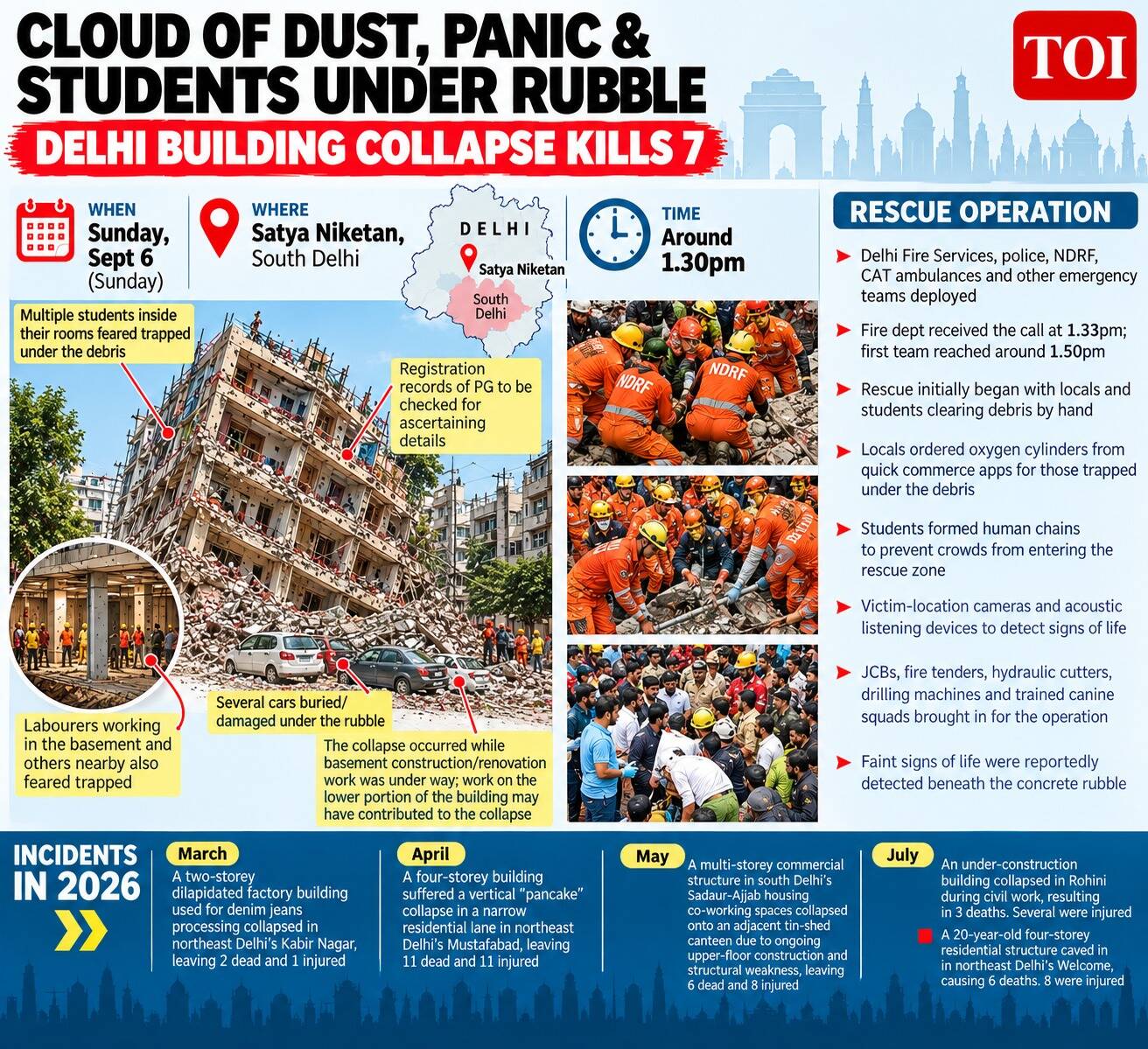
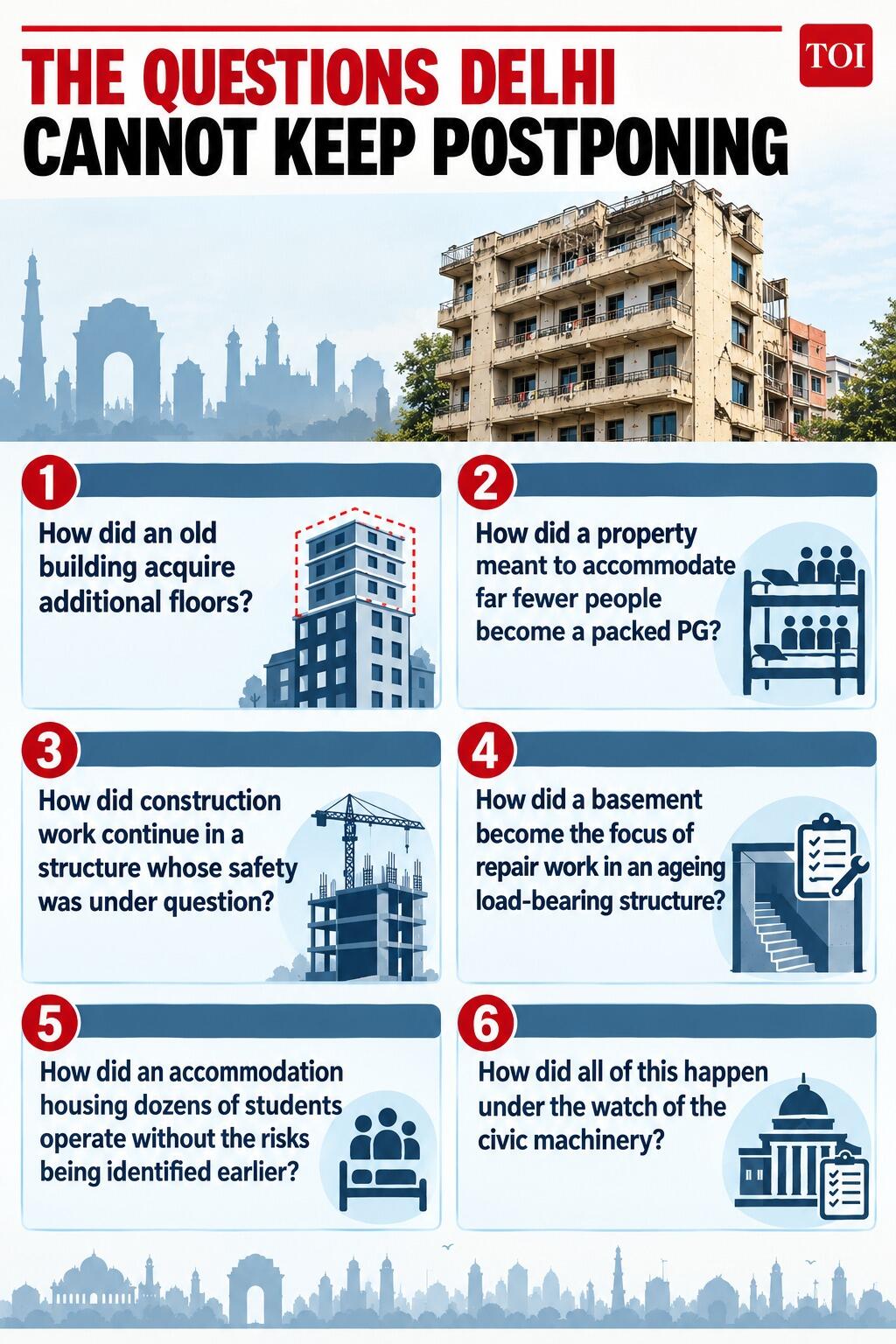
The Satya Niketan property was an ageing structure.According to the FIR, the owners allegedly added four floors despite knowing that the foundation could not bear the additional load. Further construction work was also allegedly underway when the building collapsed.During interrogation, Mahesh Gupta, who managed the accommodation on behalf of his parents, Hariram Gupta and Urmila Gupta, told police that the building had been leased to PG operator Hostel Daze in August 2025.
Students under rubble
Property owner Hariram Gupta, 81, is a retired Indian Air Force sergeant, while his wife, Urmila, is 75. Their son Mahesh, 52, was managing maintenance of the property, according to police.The property had been leased to business partners Shubham Tyagi and Sudhanshu, who were operating the PG facility from the premises.The labour contractor Sanoj was apprehended from Kasganj in Uttar Pradesh and brought in for questioning.The building had effectively been turned into tightly packed student accommodation.Around 15 rooms had been carved out in the 55-square-yard property, with about 45 students staying there — roughly three to a room — generating more than Rs 4 lakh a month in rent.Profit had a number attached to it. So did the risk.Repair and construction work was underway before the collapse.Mahesh reportedly told investigators that work had been underway in the basement for eight to 10 days because of the accumulation of waste and rainwater during the rainy season. The ground floor was also being repaired and expanded to increase commercial activity.Initial investigations have examined basement work, water accumulation and structural weakness as possible factors.The building, according to civic officials, dated back to the 1970s, with some repairs undertaken in 1990.An official said the property was located on a nine-metre right of way notified as a commercial street in 2007 and that the basement was constructed around that time. But the basement had no RCC pillar and was built using load-bearing walls.Investigators are now examining whether repair work on such a wall may have contributed to the collapse.That brings the investigation to another question: who approved, monitored or ignored the changes made to an ageing structure?
Whom to blame?
This is where the two tragedies begin to look increasingly similar. In both cases, the first instinct after the disaster was to look at the property owner and those directly operating the premises.But the blame did not stop there. In Hauz Rani, the police chargesheet focused on the owner, manager and cook. The magisterial inquiry, however, subsequently examined the role of multiple government agencies and officials.In Satya Niketan, the owners and those associated with the PG operation have been arrested. But the civic machinery is now under scrutiny as well.
Three officials, two tragedies
Five MCD South Zone officials were suspended a day after the collapse.They are Deputy Commissioner Rakesh Kumar, Superintending Engineer Ranvir Singh, Executive Engineer (Building) Lalit Kumar Goel, Assistant Engineer (Building) Sunil Chauhan and Junior Engineer (Building) Ashish Kumar.Three of these officials — Rakesh Kumar, Ranvir Singh and Ashish Kumar — were posted in the South Zone when the Hauz Rani fire took place, when 23 people died.No action was taken against them then. Now, after another fatal incident in the same broad civic enforcement landscape, they have been suspended.The question is not simply why action was taken. It is why it took another seven deaths.The MCD has said it has “zero tolerance” for unauthorised construction. Mayor Pravesh Wahi said the suspension of officials was aimed at setting an example and ensuring that lapses were not repeated.But the civic body itself has acknowledged that the exact cause of the collapse is still under investigation.Wahi said the building had not been classified as dangerous, although the owner was carrying out work in the basement.MCD commissioner Sanjeev Khirwar told TOI there was no confirmation of construction activity so far, but said officials had been suspended in view of local allegations and the ongoing inquiry.The distinction matters.Because if the building was not officially classified as dangerous, the question becomes whether the civic machinery had enough information to identify the risk before the structure came down.And that question becomes more uncomfortable when viewed against Delhi’s existing inspection system.
The inspection paradox
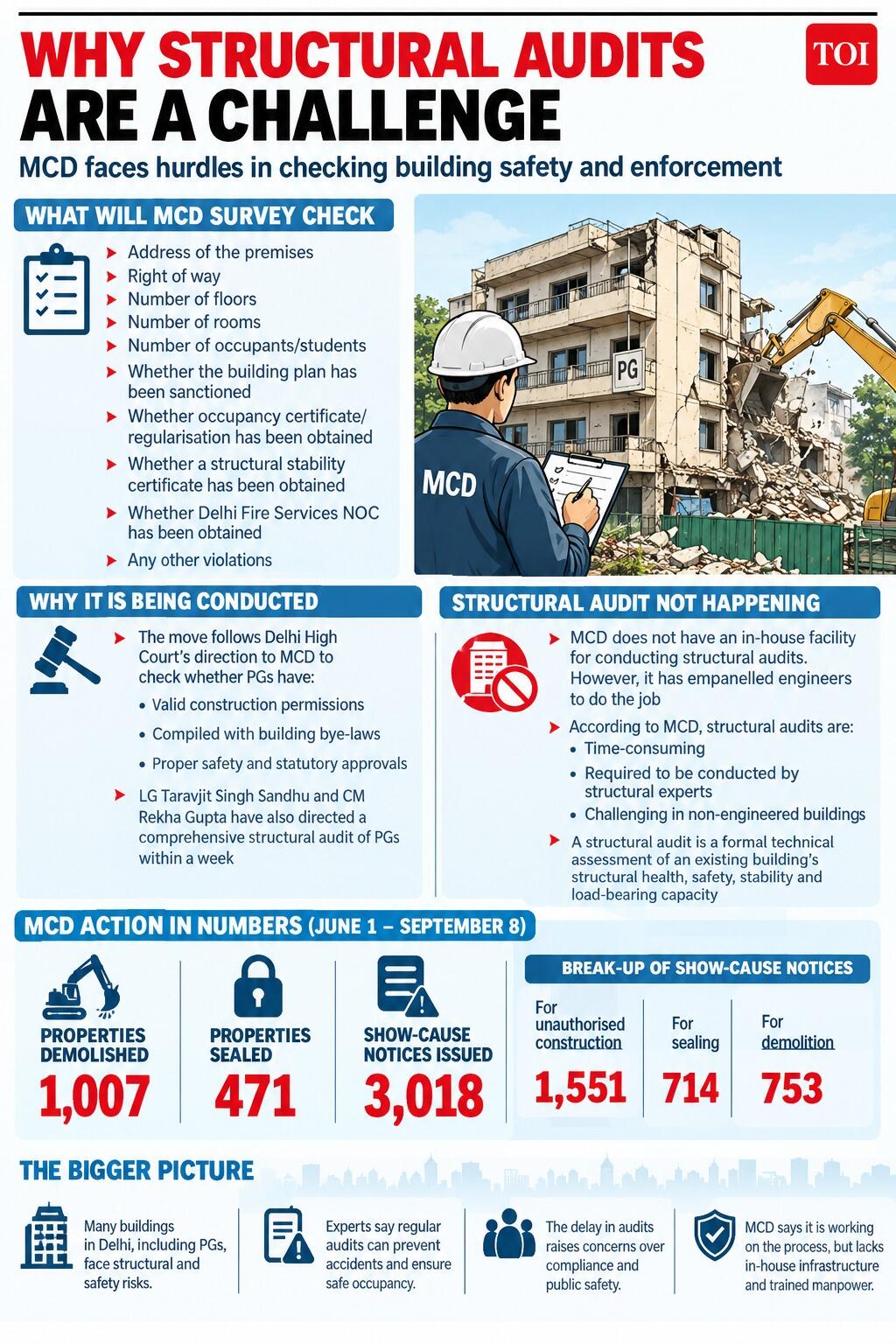
The MCD has now launched a fresh crackdown on unsafe structures.A day after the Satya Niketan tragedy, it issued show-cause notices to five buildings and a demolition notice to one in the South Zone. Several buildings around the collapsed structure were served vacation notices, while one was declared dangerous under Section 348 of the Delhi Municipal Corporation Act.The corporation also ordered a fresh survey of dangerous buildings in unauthorised colonies.Junior engineers in all 12 zones were asked to identify buildings that had outlived their structural life or were in a dilapidated condition and initiate action under the DMC Act.Officials were also told to ensure that owners and builders followed sanctioned building plans and complied with the applicable provisions of UBBL-2016 and MPD-2021 or MPD-2047.But the latest crackdown has also brought an earlier inspection exercise under scrutiny.The MCD building department had surveyed more than 30 lakh houses across Delhi till June-end as part of its pre-monsoon exercise.Only 51 structures were declared dangerous.Yet Satya Niketan, Hauz Rani and Said-ul-Ajaib — areas that have witnessed fatal fires and collapses — had not been declared dangerous during earlier surveys.The civic body says these surveys are based on visual inspections and complaints. Once a building is identified as dangerous, a vacation notice is served and demolition can follow.But a building does not necessarily become dangerous overnight.The more difficult question is whether years of additions, alterations, changing use and commercialisation can remain invisible until a wall cracks, a fire starts or an entire structure collapses.
After every tragedy, the crackdown
After the Satya Niketan collapse, the government has once again moved into enforcement mode.Chief minister Rekha Gupta ordered inspections of PG accommodations and action against illegal construction. She also ordered immediate sealing of buildings with unauthorised fifth floors.The government has also ordered inspections of nearby PGs and buildings.On September 8, the civic body surveyed 1,150 PG accommodations housing around 20,000 people, examining structural and fire-safety concerns.The LG and CM also discussed the safety and accommodation of students living in PGs. The chief secretary was directed to ensure that structural audits of buildings in major PG hubs were completed within a week.But LG T S Sandhu also cautioned against indiscriminate sealing drives, warning that such action could leave students homeless. A committee was asked to reach out to students living in PGs, hear their grievances and prepare a comprehensive database.The government is also examining alternative student accommodation through universities, the MCD and the DDA, including the possibility of using vacant and unutilised buildings owned by the two agencies.At the same time, the Delhi Disaster Management Authority control room and emergency contact numbers were ordered to be made operational.The measures are immediate. The problem is not.
Who owns the building — and who is responsible for what happens inside it?
Satya Niketan has also exposed a regulatory grey area around basements and structural alterations.Civic officials say permission for a basement is granted by the concerned urban local body, and the basement forms part of the sanctioned building plan. Construction has to comply with the applicable provisions of the Master Plan and building regulations.For plots up to 500 square metres, empanelled professionals have prescribed certification and inspection responsibilities, while the civic body retains a statutory role in monitoring compliance.Mandatory clearances and safety requirements, including fire and structural safety provisions, have to be complied with before and during construction, depending on the nature of the work.Any basement built without permission or modified in violation of the sanctioned plan can invite action.But the question in Satya Niketan is not simply whether rules exist.It is whether anyone was checking.
A citywide problem, not a single building
The Satya Niketan collapse is not an isolated building story. Delhi Fire Service data show that more than 330 building-related calls were received between January 1 and September 6 this year. Such incidents left 30 people dead and 120 injured.The corresponding period last year saw 446 such calls, with 46 deaths or fatal incidents and 155 injuries.The calls include not just major collapses but also complaints and precautionary calls involving cracks, falling bricks, roof collapses and other building-related concerns.Delhi has already witnessed the Said-ul-Ajaib collapse on May 30, which killed six people, as well as building collapses in Malka Ganj’s Sabzi Mandi area and Karawal Nagar in June.The Hauz Rani fire came in the middle of that pattern. Satya Niketan has now added another seven deaths.And the problem extends beyond Delhi. Between 2020 and 2024, nearly 33,000 people died across India in incidents involving building collapses, fires and falls into pits and manholes, according to government data.Experts say the numbers point to a wider problem of urban governance, maintenance and enforcement.Former urban development secretary M Ramachandran said accountability needed to exist at every level — from councillors and municipal officers to mayors.PSN Rao, dean of the School of Planning and Architecture, said municipal authorities already have laws and rules that need to be enforced. Regular inspections of potentially dangerous buildings, he said, are a basic municipal responsibility.A retired civil servant who worked in the urban development ministry and held senior positions in states also pointed to a lack of supervision and monitoring.The problem, experts said, is not necessarily the absence of rules or even manpower. It is whether the system acts before something goes wrong.And whether officials are willing to stop construction, seal a property or force an owner to undo an illegal alteration before the building becomes a headline.
The redevelopment excuse — and the counter-claim
After Satya Niketan, another layer was added to the blame game.MCD officials attributed unchecked vertical expansion in resettlement colonies, including Satya Niketan, to the absence of a clear redevelopment policy.They argued that such colonies did not receive the same redevelopment benefits available to other residential areas under MPD-2021, where buildings can have a permissible height of up to 17.5 metres.According to civic officials, this had created space for illegal vertical expansion over the years.They also pointed out that PGs and hostels can operate on residential plots under mixed-use regulations, subject to prescribed road-width and other conditions. But in some resettlement colonies, buildings stand on narrow roads and were originally designed as much smaller structures.The buildings, officials said, often have load-bearing walls rather than RCC columns.That makes unauthorised structural alterations particularly risky.One MCD official said standard building plans in resettlement colonies had permitted ground-floor construction with limited first-floor development. Such planned structures, officials said, are now difficult to find because buildings have expanded vertically without the required approvals.MCD also argued that the problem is not confined to one colony.Similar patterns can be seen in areas such as Madanpur Khadar, Mangolpuri and Trilokpuri, where plots can be as small as 25 square yards.DDA, however, pushed back against the suggestion that the absence of a redevelopment policy explains the problem.It pointed to Clause 4.5.4(i)(c) of MPD-2047, which provides for redevelopment of resettlement colonies under regeneration schemes.But DDA also acknowledged that every development or construction still requires a building plan to be sanctioned by the concerned local body.That leaves the central question unresolved.If the rules require sanction, who ensured that the construction remained within those rules?
The questions Delhi cannot keep ignoring
The Hauz Rani inquiry showed what happens when responsibility is divided across agencies: the owner can be blamed for illegal construction, the operator for running the premises, officials for failing to enforce rules, departments for overlooking deficiencies and utility agencies for failing to act on warnings.Satya Niketan is now raising the same question in a different form.
- The arrests have begun.
- The suspensions have begun.
- The inspections have begun.
- The demolition notices have begun.
- The policy announcements have begun.
But accountability cannot begin and end with the first action after a tragedy.Because by then, the people who needed protection have already paid the price. Delhi has heard the phrase before: “Delhi mein sab chalta hai.”It may explain how an extra floor, an extra room, an unauthorised alteration or a commercial use survives for years.But it cannot explain why the system waits for 23 deaths in a fire — and then seven more in a collapse — before asking who was watching.The real question is no longer whether “sab chalta hai”. It is who allowed it to.

Leave a Reply