
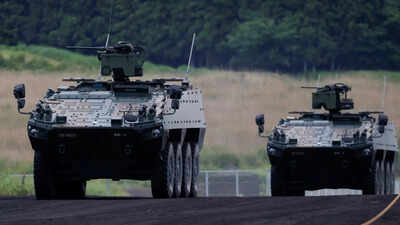
Amid escalating regional tensions between China and Japan, China’s military mouthpiece, PLA Daily, devoted an entire page to warning about Japan’s rapidly expanding drone capabilities.In four articles published in Monday’s edition, the People’s Liberation Army’s official newspaper argued that Japan was pursuing “remilitarisation” by developing unmanned systems capable of supporting long-range precision strikes, counterstrike operations and joint offensive missions with the United States.The warning comes as Beijing has intensified criticism of Japan’s defence policies under Prime Minister Sanae Takaichi, including Tokyo’s military modernisation, closer security ties with the United States and the Philippines, and debate over revising long-standing post-war security principles.
Links drones to Japan’s military expansion
According to PLA Daily, Japan’s 2022 National Security Strategy, National Defence Strategy and Defence Build-up Programme identified unmanned defence capabilities as a central pillar of the country’s future military planning.The newspaper said Tokyo planned to invest 1 trillion yen (around US$6.2 billion) in uncrewed systems over the five years beginning in 2023. It added that Japan had earmarked 277 billion yen for drone programmes this financial year, including 100 billion yen for its Synchronised, Hybrid, Integrated and Enhanced Littoral Defence (Shield) network.The publication compared the Shield programme with the US military’s proposed “hellscape” concept for a Taiwan contingency, under which large numbers of unmanned systems would be rapidly deployed to complicate an adversary’s operations.The articles said Japan was prioritising loitering munitions, armed reconnaissance drones and autonomous platforms across land, sea and air. They also highlighted Tokyo’s plans to acquire 23 US-made MQ-9B SeaGuardian drones, robotic dogs, unmanned surface vessels and autonomous underwater vehicles while expanding drone deployments across Kyushu, Okinawa, Ishigaki and Yonaguni islands, as well as strategic waterways including the Miyako and Osumi straits.PLA Daily claimed Japan was seeking to gain “asymmetric advantages” on future battlefields through unmanned combat systems and warned the country was moving beyond its long-standing “exclusive self-defence” policy.“By repeatedly crossing the red line of its ‘exclusive self-defence’ policy, Japan is transforming into a ‘state capable of waging war’ and emerging as a dangerous wild card that threatens regional peace and stability,” one of the articles said.
Wider criticism of Japan’s security posture
Monday’s publication follows a series of increasingly sharp statements from Chinese officials, military commentators and state media over Japan’s changing defence strategy.Earlier this month, Chinese maritime analyst Wu Shicun warned that Japan’s growing military role in the South China Sea carried “destructive potential” that could eventually exceed even that of the United States. He pointed to Tokyo’s unprecedented participation in this year’s Balikatan military exercises with the US and the Philippines, including Japan’s first overseas live firing of a Type-88 anti-ship missile.Beijing has also criticised Japan’s decision to revise its security policies, increase defence spending, ease restrictions on arms exports and deepen defence cooperation with Manila, including planned transfers of military equipment and negotiations on an intelligence-sharing agreement.On Monday, Chinese Foreign Ministry spokesperson Lin Jian said calls by local assemblies in Japan to uphold the country’s Three Non-Nuclear Principles reflected public support for peace. He warned that any move by Tokyo to revise those principles or allow the deployment of allied nuclear weapons would undermine Japan’s post-war commitments and the global nuclear non-proliferation regime.Separately, commentaries carried by China Military Online and China Daily accused Japan of accelerating “remilitarisation”, becoming increasingly dependent on the United States and expanding military cooperation with the Philippines as part of what they described as a more confrontational regional security strategy. Those articles represented the views of their respective authors and were not official government statements.Japan has defended its military build-up as a response to an increasingly challenging security environment, citing China’s expanding military capabilities, North Korea’s missile programme and Russia’s military activities. Tokyo’s 2022 security strategy marked its biggest defence policy shift since World War II, introducing plans to acquire counterstrike capabilities and substantially increase defence spending.

Leave a Reply