
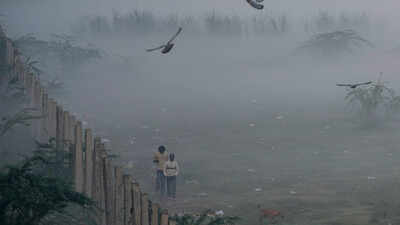
NEW DELHI: The Central Pollution Control Board on Tuesday defended its air quality monitoring methodology, explaining why official AQI readings are capped at 500 even as private monitoring apps reported levels as high as 1,800 in Delhi after Diwali.The clarification came amid questions over the wide disparity between government data and readings displayed by private air quality monitoring platforms.The CPCB said the 500-point ceiling was an intentional feature of the National Air Quality Index (NAQI), consistent with international practices. It explained that readings beyond 500 would not change the health advisory, as all such levels fall under the ‘Severe’ category.“The Air Quality Index (AQI) is a tool for effective communication of air quality status to the people in terms that are easy to understand. AQI is an indicative scale designed to convey the likely health implications of prevailing air quality conditions. The AQI category along with the associated health statement is more significant than the corresponding AQI value within that category,” the board said in a statement.The CPCB said the official index uses scientifically validated 24-hour rolling averages to assess sustained exposure to pollutants. Private apps, on the other hand, often capture hourly fluctuations through low-cost sensors, which may show sharp spikes in pollution levels.According to the board, the NAQI has six categories – ‘Good’, ‘Satisfactory’, ‘Moderately Polluted’, ‘Poor’, ‘Very Poor’ and ‘Severe’ – within a scale of 0 to 500. It said an AQI reading of 500 or above indicates broadly similar health risks and therefore does not warrant a separate category.“Beyond this level the AQI remains in the ‘Severe’ category and extrapolation of the index would not alter the assigned health impact category. The capping at 500 is thus a design feature of the index, as has been evolved in 2015 methodology of NAQI in line with the prevailing international practice including US EPA AQI scale,” it added.CPCB also said private apps could report higher readings during brief pollution spikes but show lower figures when pollution levels subsequently decline.“It is generally perceived that private apps show higher AQI. This may hold during short peaks, when hourly values rise sharply. However, when concentrations fall, such apps show lower AQI than the NAQI, since the NAQI continues to reflect the exposure of the preceding 24 hours,” it said.
Join conversation
Share your thoughts in the comments
Be respectful · TOI community guidelines
“This has also been evident in Delhi post Diwali firecrackers bursting event. The NAQI thus provides a consistent and reliable indication of the likely health impacts of sustained exposure to pollutants, which is the scientifically relevant measure for public health advisories,” it further said.The clarification came as social media posts showing screenshots of private air quality apps reporting AQI levels between 1,500 and 1,800 in Delhi on Diwali night, while CPCB’s official readings remained below 400.

Leave a Reply