
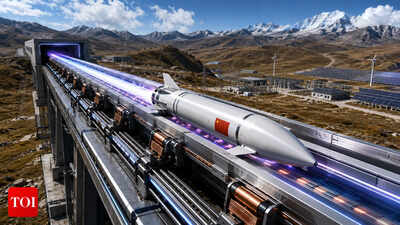
China is pushing an unconventional launch idea that could change the economics of reaching orbit: instead of igniting rockets at ground level and spending huge amounts of chemical propellant just to claw through the thickest part of the atmosphere, it wants to use electricity to catapult a rocket to supersonic speed before the engines fire.In contrast, SpaceX’s Falcon and Starship systems still depend on the classic chemical-rocket model, where the vehicle carries nearly all of its launch energy in liquid fuel and oxidizer from liftoff to orbit.
What China is building
The Chinese concept centers on electromagnetic launch, sometimes described as a “superconducting magnetic levitation plus electromagnetic propulsion” system.A report by South China Morning Post (SCMP), said the Ziyang Commercial Aerospace Launch Technology Research Institute has been developing this as a ground-based boost system that would accelerate a rocket along a track, using electricity rather than burning propellant for the first part of ascent.The idea is not simply a bigger launchpad.It is a different launch architecture altogether: energy would be fed from the ground through power systems, storage units, superconducting magnets and precision guidance hardware, then transferred to the rocket during the launch run.A successful test campaign in 2025 and follow-on work in 2026 were reported to have verified key subsystems such as electromagnetic propulsion control and high-temperature superconducting navigation, which suggests the project has moved beyond theory and into hardware development.
How it works
In the Chinese model, a rocket would be placed on or within an electromagnetic launch track and accelerated to several times the speed of sound before ignition.That means the vehicle would not need to burn as much propellant to overcome the densest part of Earth’s atmosphere, which is where rockets face the highest drag and heating loads.The engineering logic is straightforward: if the ground provides part of the velocity, the rocket can save fuel, lift less dead weight, and potentially carry more payload for the same launch mass.The same concept could also allow higher launch cadence, because the ground system can be reused without the wear and tear of repeated engine firings.
Why altitude matters
China’s reported interest in the Tibetan Plateau is not accidental.High-altitude sites have thinner air, which reduces aerodynamic drag and heating during the acceleration phase.That makes the “electric catapult” concept more practical, because the launch track would be trying to push the rocket through less atmosphere than a coastal launch site would face.The plateau location also fits the broader economic logic of the program.If the system is tied to China’s expanding low-carbon electricity supply, including hydro, nuclear, wind and solar power, the launch energy can be drawn from the grid and stored on site rather than loaded into every rocket as chemical propellant. That is the biggest philosophical break from conventional rocketry.
Why it matters
If the technology matures, it could challenge one of the most established assumptions in spaceflight: that chemical rockets must provide almost all of the energy needed to reach orbit.Chinese researchers linked to the patent work say their electric approach could solve three long-standing launch problems at once — cost, flexibility and high-frequency operations — while reducing launch expenses by an order of magnitude in theory.That said, the hurdles are enormous.A real system would need kilometres of perfectly aligned track, extreme bursts of electrical power, advanced control systems and a rocket built to survive brutal acceleration forces before ignition.The technology is still experimental, and the engineering challenges are severe.But if China can make it work, it could open a new lane in space access — one built not just on reusable rockets, but on reusable launch energy.

Leave a Reply