
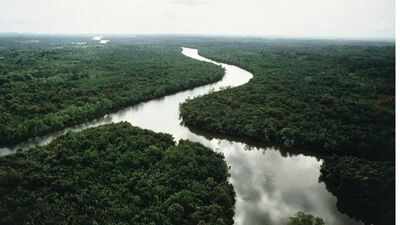
Planting trees across vast areas may not be the only way to restore damaged tropical forests, according to a new study. Instead, small patches of native trees can gradually help degraded forests recover.The study was carried out by Xishuangbanna Tropical Botanical Garden (XTBG) of the Chinese Academy of Sciences. It was published in the journal Restoration Ecology.The study of 20 years examined the long-term results of a restoration method called applied nucleation. The method involves planting small groups of native trees on a degraded tropical riparian corridor in southwest China.Riparian corridors are strips of land along rivers and streams. These areas are important because they support wildlife, protect water quality and connect different forest habitats. The researchers wanted to know whether small tree patches could help such damaged forests recover over many years.The approach worked in rebuilding forest cover and structure. However, restoring a tropical forest is a slow process. Even after two decades, the recovering forest was still in an early stage of development. It had not regained the diversity or biomass of a nearby natural forest.
Tropical forest restoration matters
Tropical forests cover more than half of the world’s tropical land area. They are home to a huge variety of plants and animals and play an important role in storing carbon and regulating climate.However, many tropical forests have been heavily degraded because of human activities. Restoring these forests has become a major environmental goal, but traditional large-scale tree planting projects can be expensive.The researchers wanted to test whether a simpler and lower-cost approach could support long-term forest recovery while reducing the need for intensive management.
Planting small tree clusters
The restoration project began in 2003 along a 12-kilometre degraded riparian corridor in southwest China. Instead of planting trees throughout the entire area, the researchers created small clusters, known as ‘nuclei’, of native tree species. Each cluster included three species of fig trees Ficus racemosa, Ficus benjamina and Ficus hispida, along with nine other native tree species.The planted sites received only two years of basic care, including weeding and watering. After that, the researchers allowed the forest to regenerate naturally without further active management.From 2003 to 2023, the team monitored how changes. They measured the effectiveness of the applied nucleation method at both the community and landscape levels.
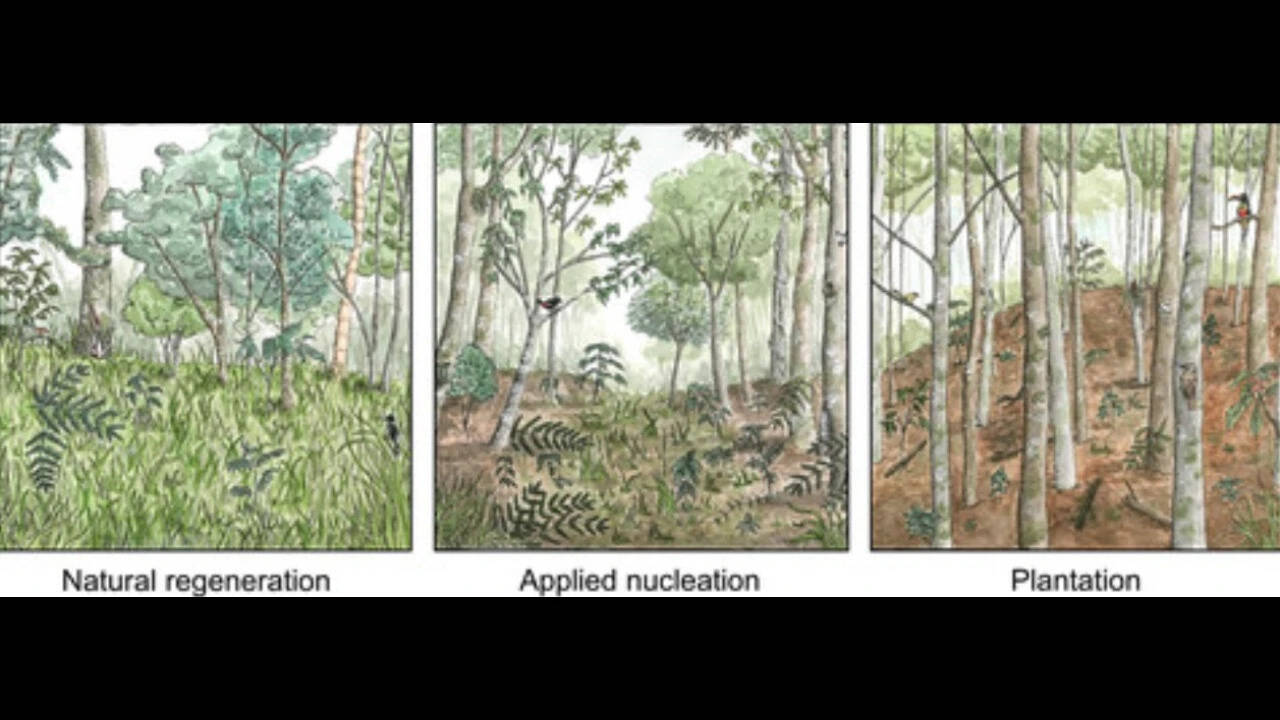
The restored areas reached only 19–30% of the tree diversity and biomass of a nearby natural forest. (Representational AI image)
Restored versus natural forests
To understand how successful the restoration had been, the researchers compared three different types of sites. The first were the planted nucleation areas, where the original tree clusters had been established. The second were natural expansion areas, where forest had spread naturally from those planted clusters over time. The third were reference plots located in a nearby seasonal rainforest, representing a more mature natural forest.Twenty years after planting began, the restored forest had made progress but, it still differed greatly from the natural rainforest. The planted and naturally expanded areas had only 19% to 30% of the tree diversity and biomass found in the nearby reference forest.
Forest in early stage
The researchers also looked at the types of trees growing in the restored forest and found a ‘pioneer bottleneck’. More than 75% of the trees in the restored areas were light-demanding pioneer species.Pioneer species are the first plants to grow in open or disturbed land. They grow quickly and help cover bare ground. However, they are usually replaced over time by slower-growing, shade-tolerant species as the forest matures.In comparison, about 80% of the trees in the nearby natural rainforest were shade-tolerant species.This difference showed that although the restored forest had grown successfully, it was still in an early successional stage.
Fig trees lead recovery
One of the most important findings involved the fig trees planted at the start of the project. The researchers found that fig trees made up 76.8% of the tree biomass in the planted nucleation areas.According to the study, these trees acted as foundation species. They helped create the basic structure of the recovering forest and supported the restoration process by providing the framework for further growth.Because of their strong contribution to forest structure, selecting high-biomass foundation species can improve future restoration projects.Although the study showed that applied nucleation is an effective restoration method, the researchers said that long-term recovery still requires patience and, in some cases, additional management.“Applied nucleation, which requires less intensive land management and lower input costs than traditional large-scale plantings, offers a feasible path forward. However, recovery is a multi-decade process, and restoring biodiversity will require sustained effort and possibly additional active management,” said SONG Liang of XTBG, as quoted by CAS.Based on the results, the researchers recommended using high-biomass foundation species as the centre of future planting efforts. They also suggested actively managing forests at different stages of succession to improve restoration outcomes.

Leave a Reply