
Former foreign secretary Vijay Gokhale argues that China waits for a strategic opening, acts pre-emptively and then builds a narrative of self-defence.His new book, “China’s Wars: The Politics and Diplomacy Behind its Military Coercion”, examines past conflicts and China’s recent grey-zone tactics.In an interview with Indrajeet Rai, Gokhale explains why the India-China relationship has entered an era of “armed coexistence”, why a full-scale war is not the most likely outcome but cannot be ruled out, and how political uncertainty after Xi Jinping could produce global economic shocks or military adventurism. Edited excerpts:You describe China as an opportunistic power. What does that mean, and when does Beijing decide to act pre-emptively?By opportunistic power, I did not intend to suggest that China is very different from other major powers. In the case studies in my book, China waited for the international situation to turn favourable, or for some advantage to accrue from its relations with other major powers, before carrying out conflict with a neighbour or another country. It used opportunity strategically to achieve its goals.The Chinese idea of preventive deterrence or preventive conflict differs from the Western concept. In the West, deterrence is a counteraction intended to stop the adversary from escalating. In the Chinese context, it is pre-emptive: China acts even before the adversary has had the chance to act first. The aim is to deliver a political and psychological shock so the adversary desists or fears retaliation.The 1962 conflict is one example. There was no indication that India intended to launch a military assault. But China used the words of then PM Jawaharlal Nehru and an international situation dominated by the Cuban missile crisis to act pre-emptively against India.China often depicts its own aggressive action as defensive and blames the other side. How central is this narrative warfare to its strategy?The Chinese Communist Party utilised China’s difficult circumstances after the collapse of the empire and projected itself as the only organisation capable of pulling the country out of its problems. It placed the blame for China’s declining economy and global influence on external circumstances. It played the victim’s card: China was perennially the victim, and the party was the instrument that would restore it as a major power.
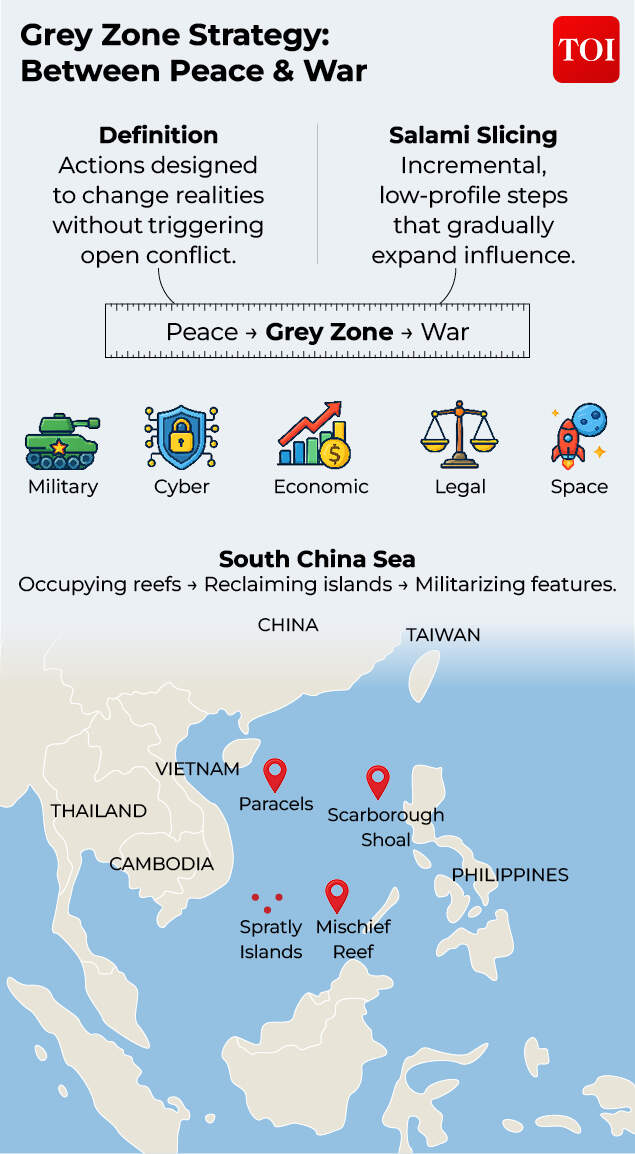
China’s grey-zone strategy seeks to steadily pressure and exhaust rivals while avoiding the escalation of tensions into full-scale war.
The blame, therefore, was always placed on somebody else: The colonial powers, the United States in the Korean War, India in the 1962 war and the Soviet Union in the 1969 conflict. There was never an acknowledgement that some responsibility also fell on China.This is not limited to foreign policy. The party does not take responsibility for major domestic failures either: The Great Leap Forward, the Cultural Revolution or the 1989 Tiananmen incident. Blame falls on an external force or a few bad elements, never the party itself.You argue that China is pursuing sustained grey-zone coercion. How does this work against India?Since 1979, China has not fought a real conflict. The leadership made economic development the priority, and successive leaders after Mao Zedong focused on reform and opening up.But China was not willing to give up the use of force; it changed the manner in which force was used. Instead of hot wars or major conflict, it engaged and continues to engage in very low-intensity military conflict, popularly known as grey-zone warfare.Grey-zone warfare uses threats or actual force while staying below the threshold that might tempt the rival to launch a counteroffensive. It punishes or deters, but stops short of making the rival feel compelled to push back with force. We see it along the Line of Actual Control, in the South China Sea and in the East China Sea.I have characterised the situation on the LAC after 2020 as the end of peaceful coexistence and the beginning of armed coexistence. Armed coexistence does not mean conflict. It means China will continue to take grey-zone military action around the LAC to keep us tied down and to exhaust us not only financially – because keeping forces and equipment at those heights costs a lot – but also in terms of men and material.This fulfils a key Chinese objective: Keeping India confined to South Asia.
Apart from the United States, there are few potential rivals in this century, and India is one. If you look at India, it’s geographical location, its population size, its territorial size, its talent, it’s economic potential. All of it lends a credence to the belief that India can become a major power in this century. And clearly, China would like to delay that possibility.Does that mean a large-scale India-China war is unlikely in the foreseeable future?Nobody can predict this definitively. China and its decision-making processes are opaque, and there are no alternative channels of information such as free media or civil society.China is a mature state focused on becoming the strongest economy and power in the world. On a rational cost-benefit analysis, the price of a major war with India could exceed the benefits. Logically, China would be reluctant to engage in such a conflict.At the end of the day, however, it is impossible to predict. We have to be prepared for the worst, while logically understanding that a hot conflict with India may not be in China’s interest in the foreseeable future.China’s capabilities against Taiwan have grown, while the US is distracted by several conflicts. Could Xi Jinping move on Taiwan to secure his legacy?An American commander of the Indo-Pacific Command, Admiral Philip Davidson, suggested that by 2027 China would have the military capability to launch an assault on Taiwan. Some interpreted that to mean China would attack by 2027, but he did not actually say this.China’s capabilities for an assault on an island have substantially increased: Landing craft, area-denial capabilities, communication systems and anti-ship missiles.It is one thing for a major power to bomb another country and destroy its infrastructure, and quite another to occupy or conquer it. That requires a very large commitment of forces and material, with no assured guarantee of victory.China’s demographic decline is already causing anxiety. An assault would mean mass casualties because boots on the ground would be required. After Galwan, India acknowledged within days that 20 soldiers had been martyred; China took much longer to admit fatalities. With Taiwan potentially producing casualties in the hundreds or thousands, Beijing will worry about the domestic impact.This is where democracy, for all its weaknesses, becomes a strength. A democratic government has electoral and constitutional legitimacy to act, including in war. In China, the party claims it has popular support but has never tested that proposition. The reaction to large-scale war casualties is unpredictable.Xi has removed the age and term limits that helped institutionalise succession. What happens after him and why should India worry?Deng Xiaoping introduced two reforms that stabilised succession: Those above 68 could not continue in top party positions, and the president was limited to two five-year terms. This helped ensure smooth transitions from Jiang Zemin to Hu Jintao and then to Xi Jinping.Xi has abolished the age and term limits. In an authoritarian system, no leader will voluntarily give up power because enemies may find it easier to target him, and he cannot be certain a successor will not misuse authority against him.China could enter a period of political uncertainty and potentially turmoil as Xi ages and factions emerge in a contest for power. It is unclear whether this happens before or after his death, or whether he intends to stand for a fourth term.Because China is the world’s second-largest economy, domestic turmoil would affect its economy, military and diplomacy and create huge ripple effects abroad. Beleaguered regimes also sometimes use an external threat to divert attention. India must consider whether turmoil could produce military adventurism and how to preserve its national interests, sovereignty and territorial integrity.China has few formal allies and did little visibly to support Iran. Does it lack the partnerships needed to become a global leader?China lacks the United States’ large network of treaty allies. But we should not underestimate the goodwill it enjoys. The Belt and Road Initiative has been welcomed as an alternative route to development. Western assistance often came with harsh conditions; China offers fewer and less onerous strings. Nobody gives aid for free, but China has built substantial diplomatic influence.There was little need for China to do more in the Iran war. It could neither persuade the United States to stop nor force peace. It protected its oil interests and relations with Iran and the Gulf countries without entering the mediation game.
When the conflict ends, Iran will rebuild using its oil and gas wealth. It is unlikely to trust the West, while China can build infrastructure at a scale few others can match. China needs energy; Iran needs infrastructure and money. That creates an enormous downstream economic opportunity and a win-win situation. Why would China get significantly involved now when there seems to be no clear way out of the conflict?As US-China rivalry intensifies, which side of the emerging world order should India prefer?India should not look at the world order through an either-or lens. The United States and China will both remain major powers. The question is how, in a triangular or quadrangular relationship, including the European Union if it acts as a union, we create an international framework relevant to this century.
Join conversation
Share your thoughts in the comments
Be respectful · TOI community guidelines
India has objective advantages: Its location, demographics and consumer base; tested political stability; an independent military capability and growing defence industry; and talent.I do not see how India can fail to become a major power in this century. The international order is disintegrating and all states are hedging their bets; India is doing so too. The task is not to choose a US-led or China-led order. It is to help build an order in which India is one of the leaders.

Leave a Reply