
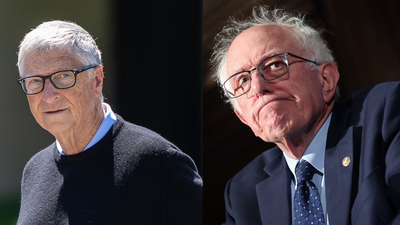
US Senator Bernie Sanders has thrown his weight behind Bill Gates once more, endorsing the Microsoft co-founder’s warning that artificial intelligence poses a serious danger to jobs and to human life. Writing on X late Sunday night, the Vermont senator said Gates was right that AI “poses a grave threat to jobs and the future of humanity” and that dealing with the risks should be, in Gates’s phrase, the world’s top priority. He closed with a line in capitals: “WE MUST ACT BEFORE IT’S TOO LATE.”The post landed days after Gates published a roughly 6,000-word essay on his personal site laying out three risks he believes the world is unprepared for: permanent job losses, AI-enabled bioterrorism and cyberattacks, and the effect of AI companions on children. Sanders added his own political framing to it, calling on Congress to stand up to what he described as the wealth and power of Big Tech oligarchs. The alignment is not new. Sanders first sided with Gates on taxing automation in his 2023 book, and returned to the theme in December, asking how displaced workers would pay rent or buy healthcare once the machines were doing the work.
Bernie Sanders has been circling this argument since before ChatGPT went mainstream
Sanders has never been shy about automation. His 2020 campaign promised to strip tax breaks from companies that swapped employees for robots. Earlier this month he went further, writing to the chief executives of Meta, OpenAI and Anthropic and asking them to pause frontier development outright. That letter cited reports of models being used to help design new viruses and of AI systems breaching other companies’ servers, which Sanders read as evidence that the industry’s own risk thresholds had already been crossed.
Bill Gates wants a token tax and a list of jobs machines are not allowed to take
Gates is not asking anyone to stop building. He has said he would support a credible global slowdown but does not believe one is coming, given the geopolitical and commercial pressure to keep going. His proposals are structural instead. He wants a tax on AI tokens and robots, on the logic that employers currently pay payroll tax on a human hire but can write off a machine immediately, and he wants the revenue funnelled into retraining and a wider safety net.He has also floated something he calls Human Reserved: categories of work set aside for people by decision rather than by economics. Caregiving is his example, drawn from watching paid carers look after his father in the final stages of Alzheimer’s. In a recent interview he was blunter than his essay, saying tech executives privately understand how capable these systems are but avoid saying so publicly because of the trillions still to be raised. On the industry’s preferred approach he was dismissive: self-regulation on the most dangerous tool ever invented, no thanks.
The jobs data does not show a collapse yet, only a door closing on young workers
Not everyone is convinced. Nvidia chief executive Jensen Huang pushed back last week, saying he loves Gates but does not see what Gates sees, and predicting AI will create work at unprecedented scale. The numbers so far sit awkwardly between them. AI was named in 112,713 announced US job cuts through July, about 24 percent of the total and the leading stated reason for five straight months, yet overall announced cuts are down 41 percent year on year.The sharper signal is generational. Stanford researchers tracking payroll data found employment among 22 to 25 year olds in heavily AI-exposed roles running 19 percent below where it should be. Sanders wants Congress moving before that becomes the whole labour market rather than its youngest edge.

Leave a Reply