
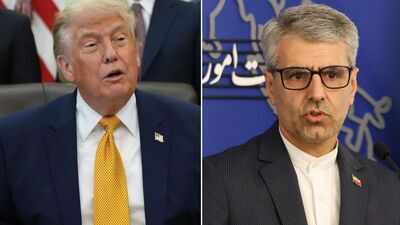
TOI correspondent from Washington: One side believes that it has come away with a deal. The other side is still dealing with the idea of a deal. It turns out that the US-Iran peace agreement purportedly pounded out during talks in the Alps has more holes than Swiss cheese.On Tuesday, US President Donald Trump took to Truth Social to announce what sounded suspiciously like the diplomatic equivalent of a completed real-estate closing. Iran, he declared, had agreed to nuclear inspections “long into the future (Infinity!!!),” accepted major concessions, and was effectively on a path toward what he called “Nuclear Honesty.” In return, Trump said he had agreed to keep the Strait of Hormuz open, suspend any naval blockade, and permit limited sanctions relief through US-controlled escrow accounts that would purchase American corn, wheat, soybeans, food, and medicine. “Talks are going well!” the president proclaimed.There was only one problem. Almost simultaneously, Iranian officials appeared to be describing an entirely different deal… that was still in the works. Iranian foreign ministry spokesman Esmaeil Baqaei flatly rejected suggestions that Tehran had agreed to allow inspectors into nuclear facilities damaged by recent US and Israeli strikes. There was “no established procedure” for such inspections and no meeting had even taken place with the IAEA. Iran’s envoy in Geneva similarly suggested the issue would be addressed only in future negotiations. The chasm between the two narratives is not merely cosmetic. On the American side, Trump’s Truth Social post reads like a victory lap written before the race has been run. For Iran, the Trump and Vance prescription reframes sanctions relief as a subscription to the US farm bureau. The result is a diplomatic landscape in which Washington says the house has been sold, while Tehran insists the parties are still arguing over whether to schedule a home inspection.In fact, the gap extends well beyond inspections. Vice President JD Vance had said Iran agreed to admit inspectors from the IAEA, calling it a critical first step toward preventing a nuclear weapon. Yet Tehran maintains that inspections of bomb-damaged sites are not currently on the table. Then there is the money question. Trump says any sanctions relief will be tightly controlled through US.-managed escrow accounts and spent only on humanitarian goods purchased from American suppliers. Iran says any funds released belong to Iran and can be spent however Tehran chooses. And missiles? Iran says its ballistic missile program is not up for discussion at all; Washington says it is. Such contradictions have become a recurring feature of this negotiating process. Since the preliminary MoU was announced earlier this month, Trump has repeatedly described the agreement as substantially complete, while Iranian officials have portrayed it as little more than a framework for future talks. Trump has a well-established habit of announcing diplomatic breakthroughs before negotiators have finished arguing over the fine print. His references to inspections lasting “Infinity!!!” may excite supporters but do little to clarify what Tehran has actually signed. At the same time, Iranian officials have their own reasons to downplay concessions before a domestic audience. Publicly acknowledging inspections, limits on spending, or restrictions on missile programs would be politically sensitive in Tehran. The most plausible explanation is that both sides are describing different stages of the same negotiation, with Washington presenting desired end-state outcomes as settled facts and Tehran emphasizing that those outcomes remain subject to further bargaining. In other words, Trump appears to be reading from the final chapter of the book while Iranian officials are still haggling over Chapter Three.The peace process, then, remains less a signed contract than a work in progress, a diplomatic bridge under construction, with Washington already celebrating the ribbon-cutting and Tehran still debating the engineering plans.

Leave a Reply