
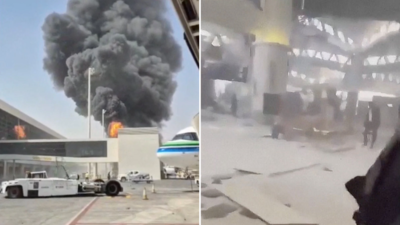
A missile does not need to destroy a skyline to threaten the future built around it. For Saudi Arabia, repeated Houthi attacks on airports and oil infrastructure have become more than a security threat. The recent strikes on Riyadh’s airport have killed at least 13 people and injured more than 300, disrupted flights and affected major international events. They have also raised a larger question: Can one of the Middle East’s wealthiest countries convince the world that it remains safe for business?That question is at the centre of Crown Prince Mohammed bin Salman’s Vision 2030. The ambitious plan seeks to reduce the kingdom’s dependence on oil by attracting foreign investment, expanding tourism and turning Riyadh into a global business hub. Its success rests not only on grand projects and deep pockets, but also on the promise of stability. Investors, expatriates and tourists must believe that the risks are manageable.
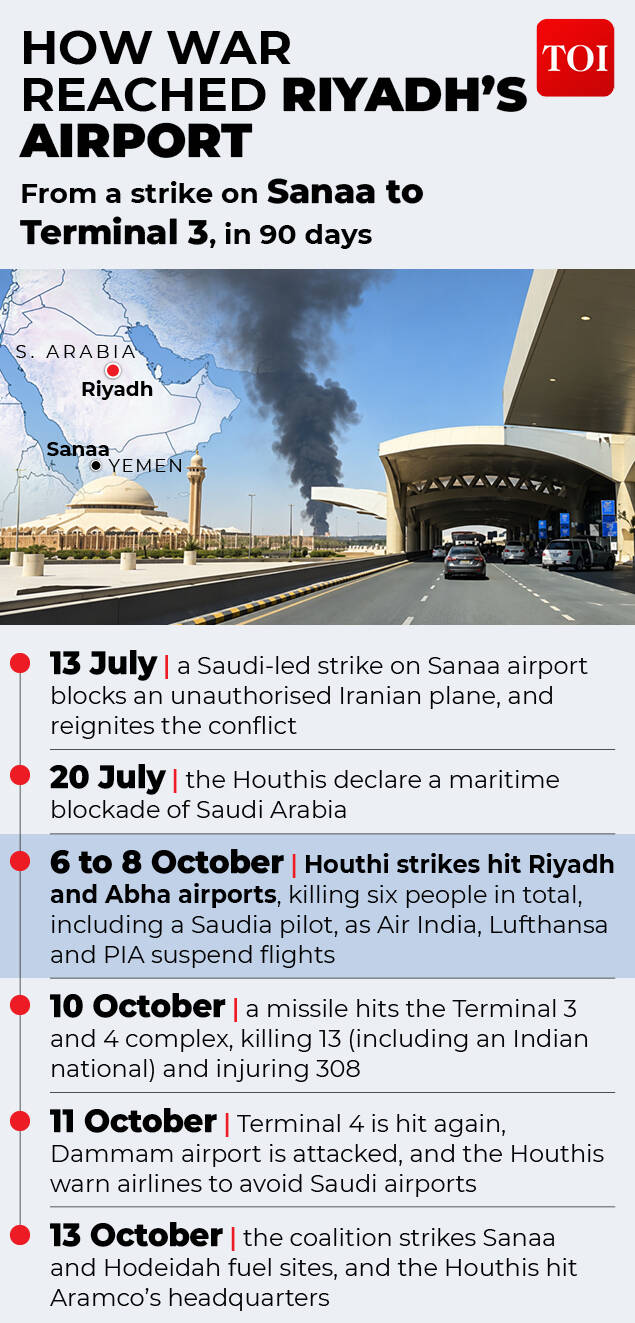
In just three months, the conflict escalated from a strike on Sanaa to attacks threatening Saudi Arabia’s airports, oil infrastructure and regional connectivity
Yet the movement challenging that promise rules parts of a country where millions struggle to afford food. The Houthis have maintained a sophisticated missile and drone arsenal despite Yemen’s economic collapse.How does a rebel group keep fighting, and can Saudi Arabia stop it without putting its own ambitions at risk?
A hungry country with a long reach
The United Nations estimates that more than 22 million people in Yemen will need humanitarian assistance and protection in 2026. Some 18.3 million face acute food insecurity, while more than 2.2 million children under five are acutely malnourished.The Houthis control large parts of the country, including the capital, Sanaa, and have built a military capability that extends well beyond Yemen’s borders. Their arsenal includes ballistic missiles, cruise missiles and drones. Their forces have also threatened commercial shipping through the Red Sea, giving the movement influence over a vital trade route.
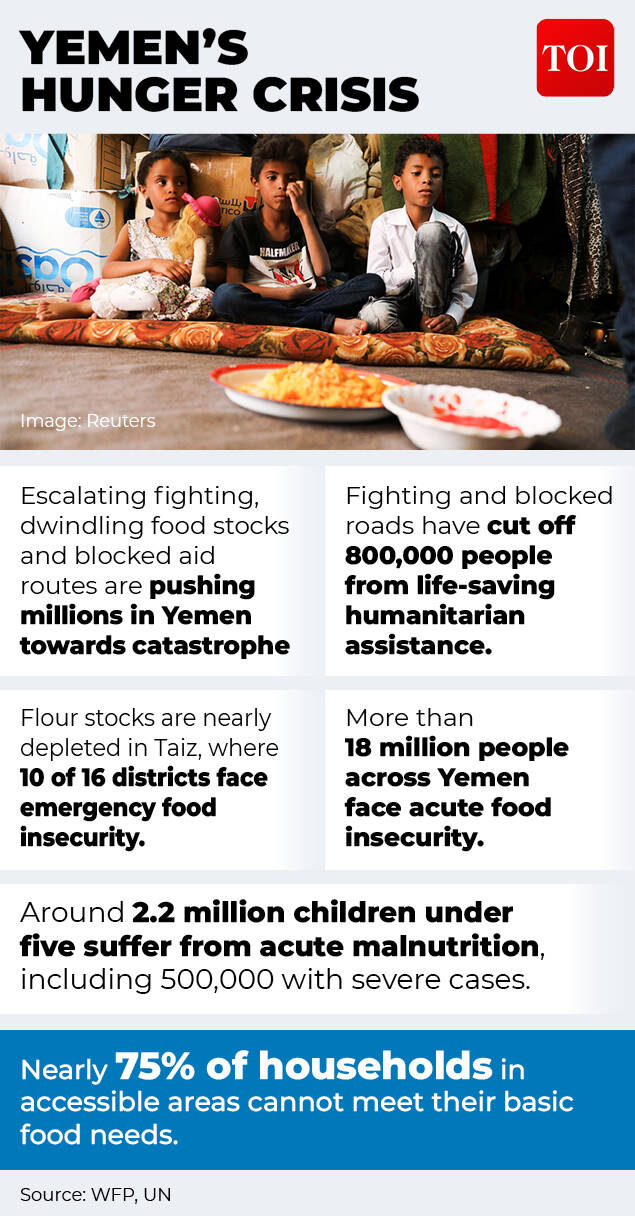
Millions face hunger while the Houthi movement continues to fund and sustain a war that reaches far beyond Yemen’s borders
The latest escalation has raised the stakes. After the Houthis seized strategic areas near the Bab el-Mandeb Strait in September, Saudi Arabia resumed its military campaign in support of Yemen’s internationally recognised government. Saudi-backed forces have sought to recover territory, while the Houthis have retaliated with attacks on Saudi infrastructure.The movement’s military reach rests on two foundations. It generates substantial revenue from territory under its control and uses overseas procurement networks to obtain the components needed for weapons production. Iranian assistance adds technology, training and expertise.
The supply chain
For years, the image of Houthi weapons procurement was relatively straightforward: Iran supplied arms, smugglers moved them into Yemen, and the movement deployed them against its enemies. That remains part of the picture, but the network has become more complicated.The Wall Street Journal has reported that Iran’s Islamic Revolutionary Guard Corps began supplying missile and drone components, alongside trainers, around 2015. Maritime interceptions subsequently made some established supply routes riskier. The Houthis responded by expanding their ability to assemble weapons locally, with help from Iranian specialists.
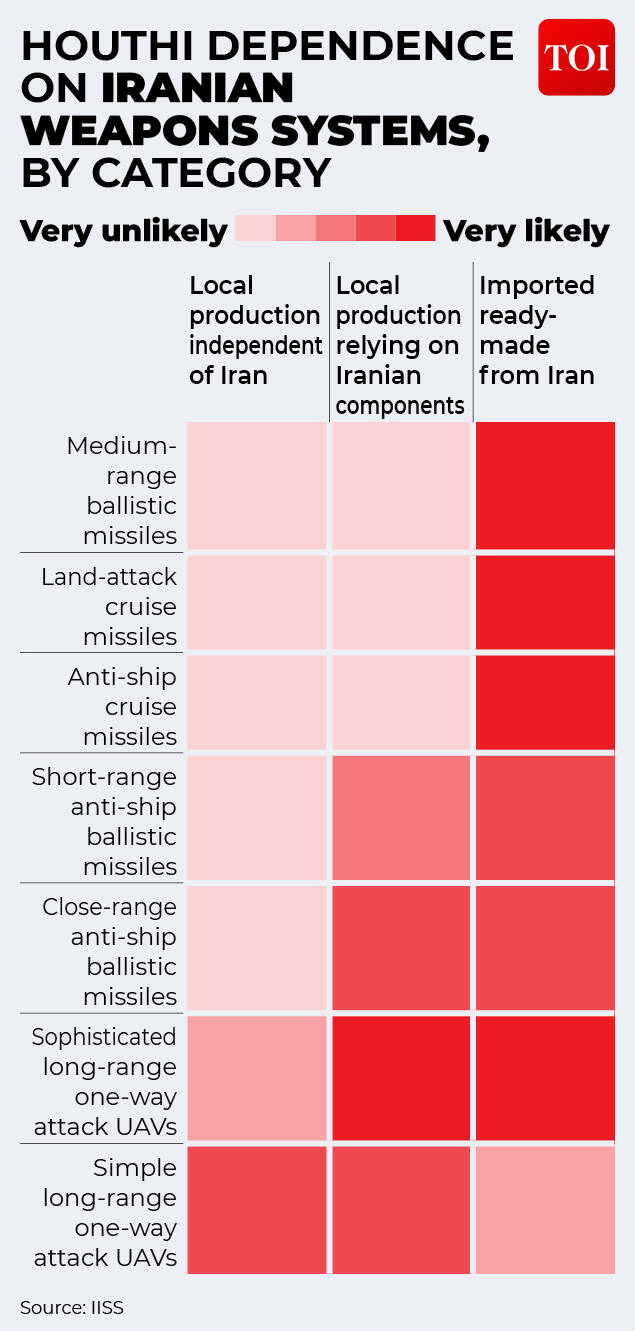
The extent of Iranian involvement varies by weapon, with some systems appearing heavily reliant on imported designs while others can be assembled locally using foreign components.
This shift has made the movement less dependent on receiving complete weapons shipments. Instead, it can source individual components through commercial networks and combine them with locally assembled systems.Chinese-manufactured goods have become an important part of this picture. A study by Century International, cited by Alhurra, found that Chinese-origin materials accounted for around 35% of documented items identified in seized Houthi-bound shipments between 2021 and 2025, compared with 21% from Iran. It also found that dual-use items made up more than 80% of documented items in seized shipments in 2024 and 2025.Dual-use goods have legitimate civilian applications but can also be incorporated into military equipment. Electronics, industrial machinery, engines and specialist materials can therefore move through ordinary commercial channels before reaching a weapons workshop.A September report by Bloomberg described a July inspection that uncovered phenolic resin, a heat-resistant material used in missile construction, alongside tail fins resembling ballistic missile components. Other containers inspected in Aden contained items resembling missile bodies and guidance systems, as well as computer-controlled machine tools and drone-suitable engines.Conflict Armament Research has also documented components from Chinese suppliers in a Houthi missile related to Iran’s Kheibar Shekan design.
Why sanctions keep missing their target
The growing use of commercial components presents a difficult problem for governments seeking to stop the flow of weapons. Sanctions can blacklist companies and individuals, while maritime interdictions can seize suspect cargo. Neither measure automatically dismantles a procurement network that can change suppliers, routes and intermediaries.Professor Harsh V Pant, vice-president at the Observer Research Foundation, said the central difficulty is that enforcement targets individual shipments and transactions, while Houthi procurement operates through a flexible network.
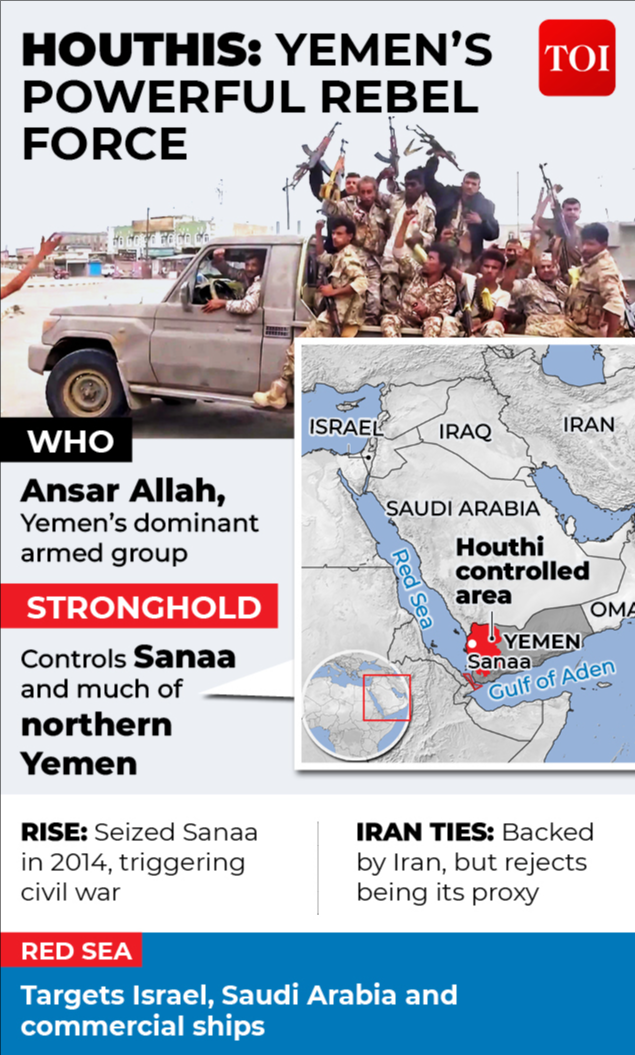
Control over Sanaa and large parts of northern Yemen gives the Houthis territory, revenue and strategic leverage despite the country’s deepening humanitarian crisis
Pant told TOI that “the supply chain has changed from weapons smuggling to distributed manufacturing”.He said dual-use goods are difficult to distinguish from legitimate trade, while interdictions can simply push shipments towards alternative routes. Sanctions may increase costs without removing the ability to procure essential components.China’s role creates a potential point of pressure. Its manufacturing base and export infrastructure provide access to a broad range of commercially available components, industrial equipment and logistics services. Pant argued that pressure on Chinese suppliers could constrain the Houthi weapons programme if it targets sensitive components, repeat procurement intermediaries and logistics firms.The objective, he said, should be to make replenishment slower, more expensive and less reliable over time, rather than assume sanctions can seal Yemen’s borders.Sharma said domestic revenues from taxation, customs duties, fuel imports and control of commercial activity sustain the Houthi war effort, while Iranian assistance strengthens its missile and drone capabilities.“Targeted pressure on Chinese suppliers, combined with stronger export controls, financial monitoring and cooperation with Beijing, could restrict access to critical components. However, many of these goods have legitimate civilian uses, making enforcement difficult. Intelligence-sharing and coordinated international action are more likely to deliver lasting results than unilateral pressure or maritime interdictions alone.”
Where does the money come from?
Iranian assistance is important, but the Houthis do not depend entirely on Tehran to pay for their war effort. Much of their routine funding is raised in the territory they govern.Professor B L Shukla of Indira Gandhi National Tribal University said the movement draws revenue from taxes, customs duties, fuel imports and control over commercial activity. Iranian support provides military technology, components, training and expertise, strengthening the capabilities that domestic income helps sustain.The exact division between local funding and Iranian assistance is unclear. But Shukla said the distinction is important: domestic revenue keeps the system running, while external support enhances its military reach.A UN Panel of Experts on Yemen has documented the Houthis’ control over customs, taxes, zakat and other sources of state income, alongside additional levies on economic activity. The Arab Gulf States Institute in Washington has estimated that around 70% of Yemen’s tax revenue is collected in Houthi-controlled territory.Fuel is particularly valuable. The Houthis control the Red Sea ports of Hudaydah, Ras Isa and Al-Salif, through which a large share of Yemen’s imports enter. Customs duties and the commercial fuel trade give the movement access to significant resources.The UN panel estimated that customs revenue from fuel imports generated around $4 billion between 2022 and 2024. Its findings also described the use of Houthi-linked companies and false country-of-origin certificates to circumvent sanctions.These revenues give the movement room to finance its administration, security apparatus and military activities. They also help explain why restricting Iranian weapons shipments alone may not be enough.Dr Ashok Sharma, Visiting Fellow at the University of New South Wales Canberra at the Australian Defence Force Academy, said the Houthis have built a relatively self-sustaining war economy, with domestic revenues keeping their operations running while Iranian assistance strengthens their weapons capabilities.“The Houthis generate substantial revenue through taxation, customs duties, fuel imports, smuggling and control of strategic ports. Iran remains crucial for advanced weapons technology, specialised components and training. Even a significant reduction in Iranian support may not dismantle the war machine, but it could weaken its technological sophistication and long-range strike capabilities.”
A machine that feeds itself
The different parts of the Houthi system reinforce one another. Control of territory provides income. Income helps fund procurement and weapons production. Missiles, drones and the threat of force strengthen the movement’s military position, helping it maintain control over territory and revenue sources.The Houthis also use their military reach to pressure Riyadh politically. Threats to Saudi infrastructure raise the cost of backing the Yemeni government and increase the risks of a renewed war.
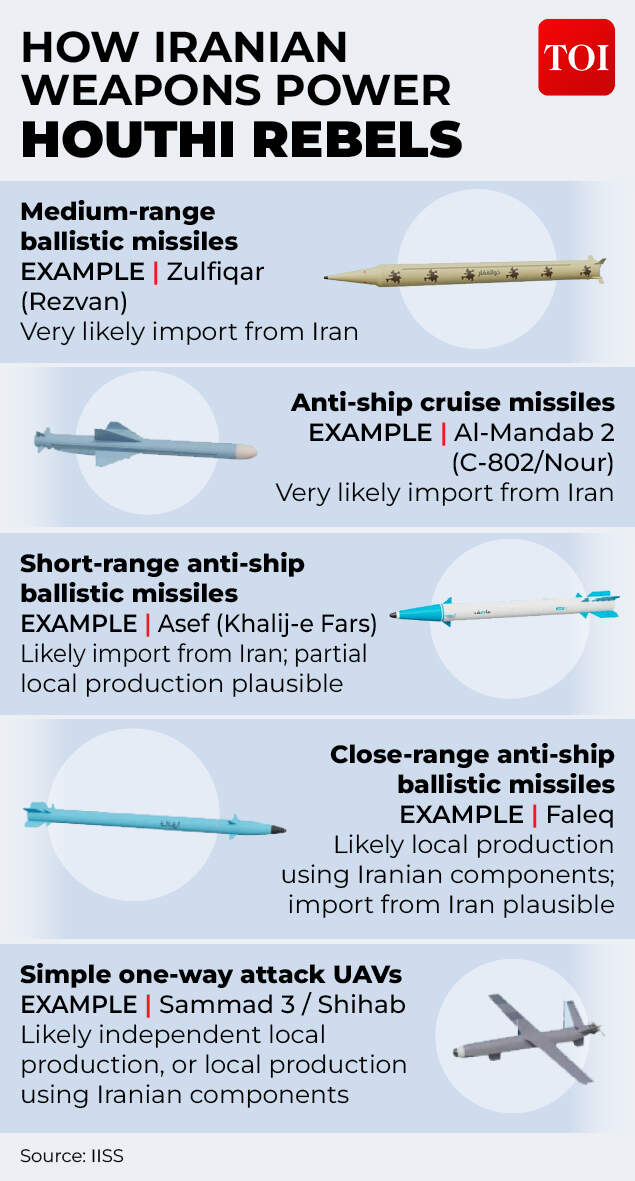
Iranian technology and components have helped the Houthis build a weapons arsenal capable of threatening commercial shipping and targets deep inside Saudi territory
The movement’s influence over maritime traffic adds another lever. Its position near the Bab el-Mandeb Strait gives it the ability to threaten one of the key routes connecting the Red Sea with the Gulf of Aden. That matters particularly now because Saudi Arabia has relied on its East-West pipeline to move oil towards Red Sea export terminals when disruption in the Strait of Hormuz has constrained other routes.This does not mean the Houthis can defeat Saudi Arabia in a conventional war. The kingdom has far greater financial resources and a much stronger air force. But the movement does not need to win a conventional battle to impose costs. It needs only to keep the threat credible and make the conflict expensive enough to test Riyadh’s willingness to continue.The strategy carries serious consequences for Yemen itself. The renewed fighting has overwhelmed hospitals and cut off humanitarian assistance to hundreds of thousands of people, according to relief agencies. On October 14, Reuters reported that more than 200,000 people had been displaced in recent weeks as fighting intensified.
A blurry vision
For years, Saudi Arabia has sought to replace its image as an oil-dependent state with that of an international business, tourism and investment hub. Vision 2030 is central to this effort.The attacks on Riyadh’s airport have exposed the vulnerability of that promise. The subsequent strike on Aramco’s headquarters has brought the threat closer to the infrastructure underpinning the kingdom’s economy. Saudi authorities have said the company continued operating after the attack, but the episode has reinforced concerns about the security of critical facilities.
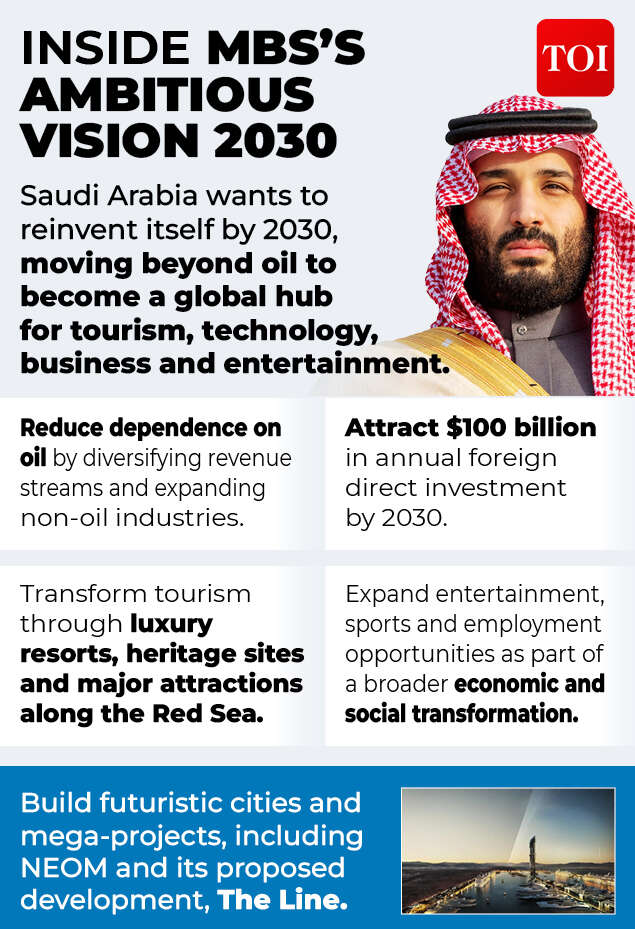
From tourism to foreign investment, Vision 2030 depends on Saudi Arabia convincing the world that it is a secure destination for business and leisure
The disruption is already visible in the events calendar. Reuters reported that several senior oil executives were removed from the schedule of the WPC Energy Congress in Riyadh after the airport attacks. Saudi Arabia’s flagship Future Investment Initiative, due later in October, faces the challenge of persuading international investors that the kingdom remains open for business.On October 15, the Gulf Cooperation Council announced that the EU-GCC summit, scheduled for October 24 in Riyadh, had been postponed. The GCC cited continued Houthi attacks and the suspension of flights at King Khalid International Airport as reasons for rescheduling the meeting.Saudi Arabia has maintained that it can withstand the disruption. Its energy minister, Prince Abdulaziz bin Salman, has stressed the kingdom’s resilience, while organisers of major international conferences have sought to keep events on schedule with enhanced security arrangements.Pant said Saudi Arabia has significant financial and institutional buffers, including large foreign assets and strong capital reserves. These give the government the capacity to withstand shocks. But prolonged insecurity could undermine investment confidence and slow medium-term economic diversification.The IMF’s July 2026 assessment reached a similar conclusion about the risks from the wider regional conflict. It said Saudi Arabia had shown resilience, but warned that a prolonged escalation could disrupt shipping, damage energy infrastructure and weaken investor confidence and diversification prospects.Pant cautioned that Saudi Arabia’s reputation could become a larger long-term cost than the initial physical damage, although the two should not automatically be treated as competing priorities. The crucial issue is whether the state is seen as capable of protecting people and restoring normality quickly.Sharma said the reputational damage from repeated attacks could eventually outweigh the immediate physical destruction, as investors, tourists and skilled expatriates reassess the risks of operating in Saudi Arabia.“Missile attacks on Riyadh and critical infrastructure challenge the kingdom’s carefully cultivated image as a secure global business hub. Investors and expatriates can react within days through postponed visits, cancelled travel and tighter security measures. The real danger is sustained insecurity, which can gradually erode investor confidence and increase the cost of doing business.”
MBS faces a difficult choice
For Mohammed bin Salman, the stakes extend beyond international reputation. A substantial part of his domestic legitimacy rests on delivering economic diversification, employment opportunities and a higher standard of living. Vision 2030 is central to his promise that the kingdom can offer younger Saudis opportunities beyond the traditional oil economy.Persistent security threats could complicate that promise. A prolonged conflict may force the government to divert money and attention towards defence, while uncertainty could delay private investment and major projects.Shukla said investors may postpone decisions when risks rise, while expatriates could reconsider relocation if attacks become frequent. Sustained insecurity can also increase insurance costs and weaken confidence in Riyadh as a regional business hub.That leaves the crown prince facing three broad choices: intensify military action, pursue negotiations with the Houthis, or combine stronger defences with diplomatic engagement.A large-scale ground offensive could be costly and difficult to sustain. Yemen’s mountainous terrain and divisions among anti-Houthi forces would make a decisive victory uncertain. The experience of Saudi Arabia’s earlier intervention, which began in 2015 and was followed by a fragile UN-brokered truce in 2022, offers a warning against assuming military pressure will quickly resolve the conflict.Negotiations, meanwhile, would involve difficult compromises. The Houthis have previously sought concessions over revenue, salaries and their place in Yemen’s political future. Riyadh would have to weigh the cost of compromise against the risks of an open-ended war.Shukla argued that the most sustainable approach would combine stronger air and missile defences, protection for critical infrastructure, efforts to disrupt illicit supply networks and diplomacy. Such a strategy would seek to reduce immediate threats without committing Saudi Arabia to another prolonged campaign.Sharma said Riyadh faces a choice between escalating its military campaign and pursuing negotiations, but argued that a combination of stronger defences, targeted pressure and diplomacy would better protect Vision 2030.“A large-scale military campaign could demonstrate resolve but risk drawing Saudi Arabia into another prolonged and expensive conflict. Negotiations without credible deterrence could encourage further Houthi attacks. A calibrated strategy combining stronger air and missile defences, disruption of weapons supply chains, diplomatic engagement with Iran and internationally supported negotiations offers a more sustainable path.”
The real test
Saudi Arabia has the resources to defend itself and cushion its economy against a period of instability. But resilience is not the same as immunity. Every new attack tests the kingdom’s ability to protect its people, keep business moving and persuade investors that today’s disruption will not become tomorrow’s normality.The Houthis pose a difficult challenge because their strength does not depend on a single weapons shipment or an unlimited supply of Iranian cash. More airstrikes may damage facilities and raise the cost of fighting, but they cannot easily dismantle a system that adapts when individual routes are blocked.For Mohammed bin Salman, the choices carry risks on every side. Escalation could deepen the conflict, while negotiations may require painful compromises. The harder task is to contain the threat without allowing security spending and prolonged uncertainty to derail Vision 2030. The Houthis may never defeat Saudi Arabia on the battlefield. But by making the kingdom look unsafe, they can strike at the one target Mohammed bin Salman cannot afford to lose: confidence in the future he has promised.

Leave a Reply