
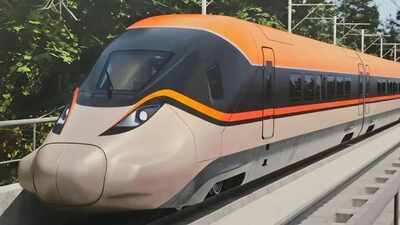
India’s first bullet train project is likely to see the launch of its first high-speed train in 2027. India and Japan have jointly decided to operate indigenous bullet trains equipped with globally interoperable signalling systems on the Mumbai-Ahmedabad high-speed rail corridor, according to a senior official.India is planning to begin trials of its domestically developed bullet trains by the middle of 2027. Civil construction on the 97-km Surat-Vapi high-speed rail stretch is scheduled to be completed this year, while the railway ministry aims to launch commercial services on the country’s first bullet train route from August 2027.
India’s own bullet trains
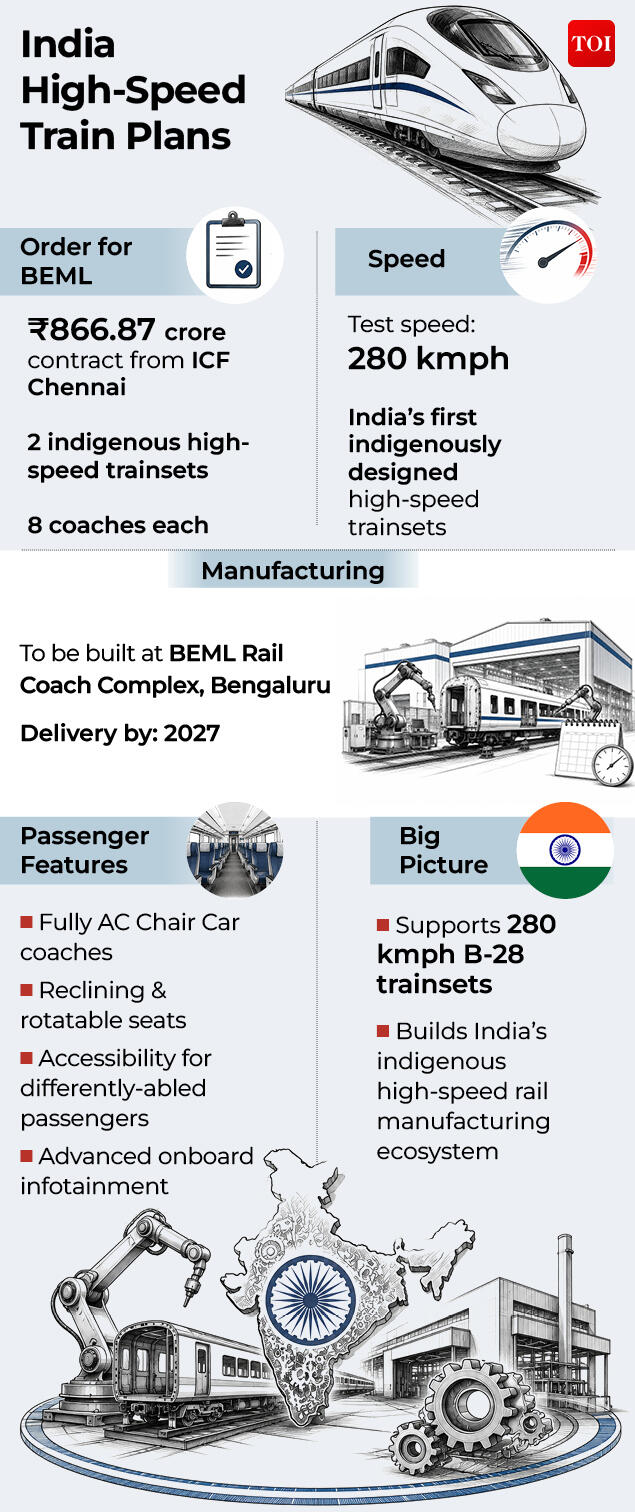
The trainsets for India’s first high-speed rail corridor will be manufactured within the country, marking a significant milestone for India’s engineering and manufacturing capabilities. The development programme is being planned in two phases. The initial trainsets will be designed for a top speed of 280 kmph, while subsequent versions are expected to be developed with capabilities to operate at speeds of up to 350 kmph.Also Read | Why India making its own bullet trains is a big deal – explainedIntegral Coach Factory (ICF), Chennai, has awarded a contract worth Rs 866.87 crore to BEML Limited for the design, manufacture and commissioning of two prototype high-speed trainsets.These prototype bullet trains will be capable of operating at speeds exceeding 250 kmph and will have a design speed of 280 kmph.Under the contract, BEML will manufacture two eight-coach high-speed trainsets. Their rollout is scheduled for 2027, and sources told TOI that the design work is currently in its final stages.The trainsets will feature fully air-conditioned chair car coaches equipped with world-class passenger amenities, advanced onboard infotainment systems, reclining and rotatable seats, as well as dedicated facilities for divyangjans.To support the project, BEML has established a dedicated ‘Aditya’ High-Speed Rail Complex in Bengaluru for the manufacture of these bullet trains.The trainsets, codenamed B-28, will be built using advanced precision-driven technologies. While bullet trains operating in countries such as Japan and across Europe are primarily designed to withstand cold weather conditions, the Indian versions will be specifically engineered to perform reliably in the country’s hot and dusty environment.
Bullet train plans
Japan trains for later stages
The project came into focus last week after former Japanese law minister Hideki Makihara alleged that India had been a difficult negotiating partner and blamed delays in the bullet train project. Subsequently, the Ministry of External Affairs clarified that discussions with Japan on the high-speed rail project were progressing smoothly.Officials associated with the Mumbai-Ahmedabad high-speed rail project said Makihara had not participated in meetings related to the bullet train corridor. They added that coordination on the project has instead been carried out by representatives of Japan’s Ministry of Land, Infrastructure, Transport and Tourism.The decision to make its own bullet trains followed the failure of Japanese suppliers to submit proposals that matched the timeline for commencing operations on the Surat-Vapi section of the corridor from 2027, according to an ET report.“This is a flagship project for India and Japan. Both countries are working on a common goal of commercial operations in 2027,” a senior official told ET, adding that Japanese experts have been overseeing the project since construction began in 2021.“All approvals of drawings, designs, construction schemes, and quality control are done by Japanese experts,” the official said, adding that both countries take decisions jointly to ensure the corridor is operationalised as quickly as possible.Makihara questioned Japanese Prime Minister Sanae Takaichi’s visit to India and alleged that the country was moving away from Japanese technology for its bullet train project. He specifically criticised the decision to adopt open-source signalling protocols instead of Japan’s proprietary DS-ATC (Digital Automatic Train Control) system for the corridor.Officials said that trainsets, signalling systems and the Operations Control Centre (OCC) are long-lead components that require suppliers to begin production well in advance of deployment. “We started pursuing the Japanese side to give offers for these items. For two years, this exercise was conducted,” the official said, adding that the Japanese side “could not share offers for these items.”According to Indian officials, they were subsequently informed that Japan was phasing out the E5 series bullet trains. “The new train series E10 was decided as the alternative train that will be offered to India,” the official said. The official added that the E10 train is still under development and is expected to enter service in Japan only by 2032 and in India by 2034.“The Japanese vendors did not give any offers for supplying signalling systems in the bullet train project. A decision to go ahead with open-source signalling protocols was taken after techno-commercial evaluation and in agreement with concerned representatives from both nations,” officials said, adding that Makihara’s remarks were aimed at Japan’s domestic political audience.The project is being supported through an Official Development Assistance (ODA) loan extended by the Japan International Cooperation Agency (JICA). The financing is provided on commercial terms and carries conditions requiring procurement from suppliers approved by the Japanese side.

Leave a Reply