
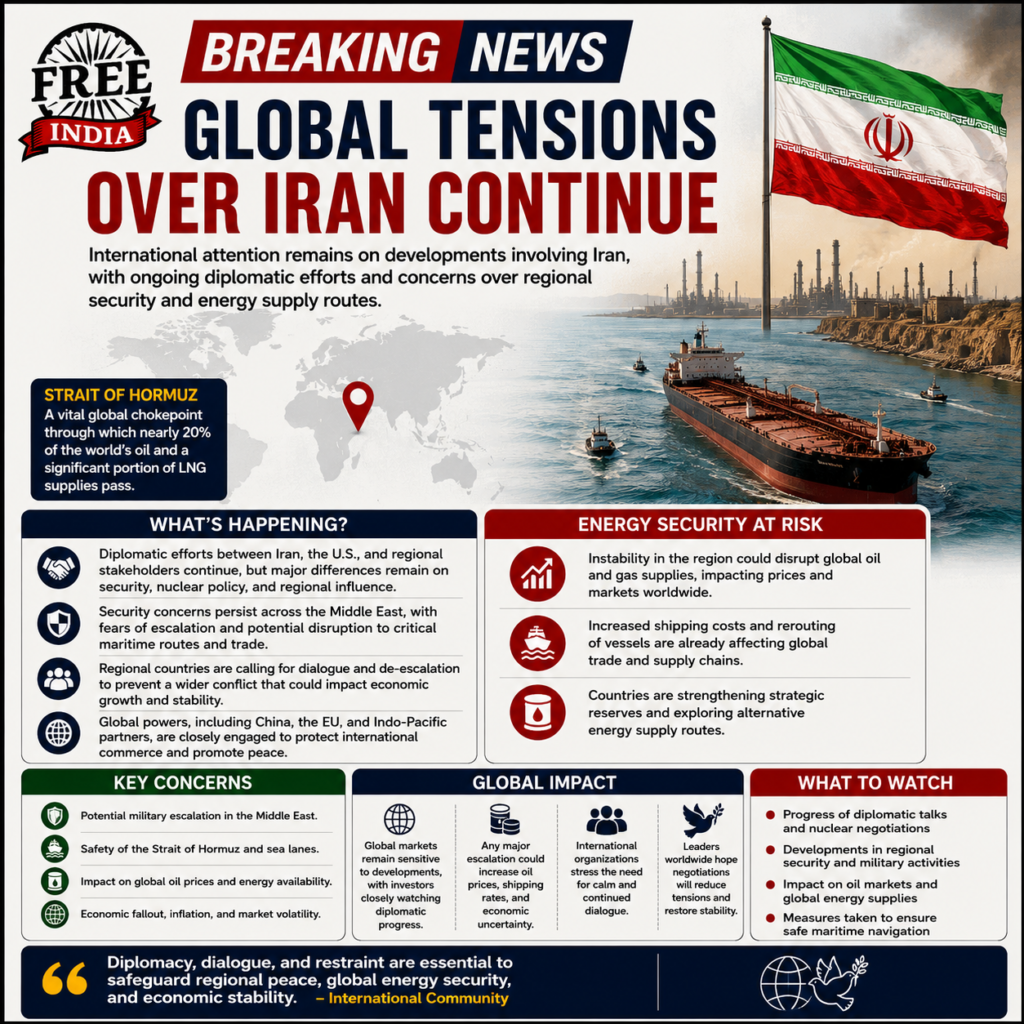
International attention remains focused on developments involving Iran as diplomatic negotiations continue alongside growing concerns over regional stability, maritime security, and global energy supply routes. The situation has become one of the most closely watched geopolitical issues, with governments, energy markets, and international organizations monitoring events across the Middle East.
Recent discussions between Iran, the United States, and regional stakeholders have centered on reducing tensions, preventing further military escalation, and restoring stability in key strategic areas. While diplomatic channels remain active, major differences continue to exist on security, nuclear policy, and regional influence, making a comprehensive agreement difficult to achieve.
A major concern for the international community is the security of the Strait of Hormuz, one of the world’s most important maritime trade routes. A significant portion of global oil and liquefied natural gas (LNG) shipments passes through the narrow waterway, making any disruption a major risk to global energy markets. Continued instability in the region has already increased shipping costs, affected trade flows, and created uncertainty across international energy sectors.
Energy analysts warn that prolonged tensions could place additional pressure on fuel prices and supply chains worldwide. Several countries have begun strengthening energy security measures, expanding strategic reserves, and exploring alternative supply routes to reduce dependence on vulnerable maritime corridors. International agencies have also highlighted the importance of maintaining uninterrupted energy transportation to avoid broader economic disruptions.
Regional governments across the Middle East have increasingly called for diplomatic solutions, emphasizing the need to prevent a wider conflict that could impact economic growth, trade, and security cooperation. Multiple countries have supported ongoing peace efforts and encouraged dialogue aimed at reducing military tensions and restoring confidence among regional powers.
The situation has also drawn attention from major global powers, including China, European nations, and Indo-Pacific partners, all of whom have strategic interests in maintaining regional stability and protecting international commerce. Several international forums continue to discuss mechanisms for ensuring safe maritime navigation and preventing further disruptions to global supply chains.
Financial markets remain sensitive to developments involving Iran, with investors closely tracking diplomatic progress and security developments. Any major escalation could influence crude oil prices, shipping rates, inflation trends, and broader economic conditions in both developed and emerging economies.
Despite ongoing uncertainty, diplomatic efforts remain active, and many world leaders continue to express hope that negotiations will help reduce tensions and support long-term regional stability. The coming weeks are expected to be crucial in determining whether diplomacy can ease concerns surrounding security, energy supplies, and international trade routes.
Key Highlights
- Global focus remains on developments involving Iran.
- Diplomatic talks continue amid unresolved regional tensions.
- Security concerns remain centered on the Strait of Hormuz.
- Energy markets are closely monitoring potential supply disruptions.
- Shipping costs and trade routes have been affected by instability.
- Several countries are strengthening energy security measures.
- Regional powers are pushing for diplomatic solutions and de-escalation.
- Global markets remain sensitive to developments in the Middle East.

Leave a Reply