
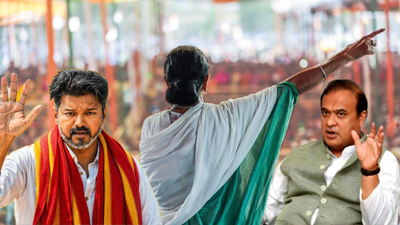
The dust has finally settled on the EVMs across five distinct corners of India. From the rain-washed palm groves of Kerala to the tea-stained hills of Assam, the 2026 Assembly Elections have been a marathon of high-decibel rhetoric, shifting loyalties, and a digital-age makeover of the classic Indian padyatra.While the results remain locked in the strongrooms until counting day on May 4, the campaign itself has already written a story of an India in transition—where regional pride, welfare economics, and the “star power” of new entrants collided in a spectacular display of democratic fervor.
Tamil Nadu’s biggest entry
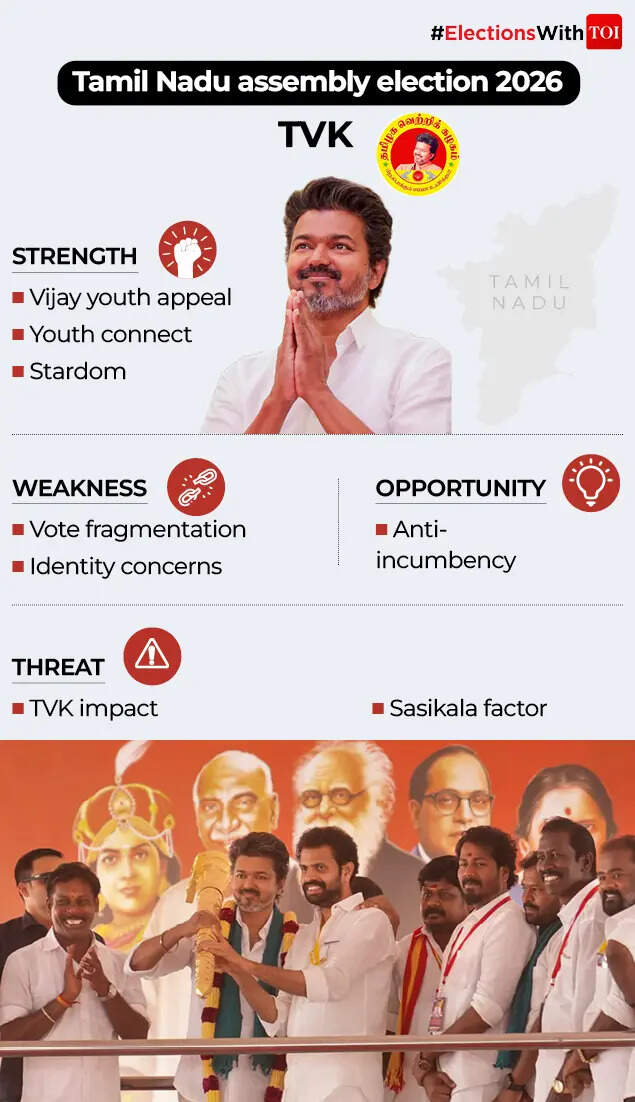
Before a single vote was cast, Tamil Nadu’s 2026 election was already marked by tragedy and it cast a shadow over everything that followed.On 27 September 2025, Vijay, Tamil cinema’s reigning megastar and founder of the two-year-old Tamilaga Vettri Kazhagam (TVK), held a rally in Karur. He was supposed to arrive around noon. He arrived more than six hours late. By then, tens of thousands of people had packed a venue permitted for 10,000. When his convoy finally appeared, the crowd surged. Then again. Then again. Forty-one people were killed. The dead included children. Tamil Nadu had not seen a death toll like that at a political rally in living memory.cTVK leaders were booked for culpable homicide. The CBI was called in. The campaign that was supposed to announce Vijay as Tamil Nadu’s great political disruptor had instead produced its darkest pre-election moment.And yet, because this is Tamil Nadu, and because Vijay is Vijay, the crowds kept coming.Sources inside the party said Vijay had become highly cautious about attending large public gatherings following the Karur tragedy. Several scheduled events were cancelled despite election permissions being granted. In Tiruverumbur, a TVK candidate campaigned with a Vijay cut-out. In Kolathur, another used a lookalike to attract crowds. The DMK, sensing weakness, pounced. Deputy Chief minister Udhayanidhi Stalin mocked the limited schedule openly, describing the approach as a “work-from-home” campaign.The permission battles became their own subplot. With less than a month to go for polling, TVK applied for a rally at Perambur’s Mullai Nagar junction. On the eve of the event, Chennai Corporation officials allegedly dug pits at the venue and erected iron barriers, rendering the site unusable. A police inspection concluded the location couldn’t accommodate 3,000 people. Vijay condemned the turn of events furiously, calling it a “fascist attack on democracy” and accusing certain officials of colluding to disrupt the rally. The DMK called it routine administration. Nobody believed either side entirely.Vijay chose to personally contest from Perambur — the constituency where he grew up — and from Tiruchirappalli East, both seats currently held by the DMK with comfortable margins. TVK leaders framed this as a marker of confidence rather than caution. The sitting MLA in Tiruchirappalli East dismissed Vijay as a non-factor. The voters, it seemed, had not got the memo.
Assam: ‘Point-blank shot’
In Assam, the defining campaign moment wasn’t a rally or a speech. It was an 18-second clip that the ruling party posted, deleted, and then, in an act of extraordinary brazenness, partially brought back.On February 7, the BJP‘s Assam unit shared a video on X that showed chief minister Himanta Biswa Sarma symbolically shooting Muslims. The clip contained what looked like real footage of Sarma wielding an air rifle, interspersed with AI-generated images of two individuals in skullcaps and beards being shot at. The post was captioned “Point blank shot.” Before it disappeared from the platform, the video had amassed over a million views.Congress called it a call to mass violence. The CPI and CPM went to the Supreme Court. When asked in the state assembly about his discriminatory policies, Sarma was characteristically unrepentant- “I will take sides. Won’t let ‘Miya’ Muslims take over Assam.”“In a rickshaw, if the fare is Rs 5, give them Rs 4. Only if they face troubles will they leave Assam.” Defending the remarks subsequently, Sarma insisted he was referring to illegal immigrants from Bangladesh.His government simultaneously announced a policy of arms licences for natives in remote areas. When asked if this risked turning Assam explosive, his answer was direct, “I want the situation in Assam to be explosive.”The particular irony at the heart of this story is that Sarma is an unlikely extremist. When he was sworn in as Assam’s chief minister in 2021, nobody could have pointed to an ideological biography that predicted what followed. He had served three consecutive terms on a Congress ticket and been a minister in the Tarun Gogoi government, holding portfolios ranging from health to finance to agriculture. He had no deep roots in the RSS. By the measure of the movement he eventually joined, he was a latecomer. And yet, since joining the BJP in 2015, his rhetoric has regularly outpaced that of many politicians with lifelong Sangh Parivar roots.
Zubeen question
Woven into the Assam campaign was also the name of Zubeen Garg.Garg, 52, was the state’s most beloved singer, a voice that had travelled well beyond language, into the daily life of the Northeast. On September 19, 2025, he died while swimming off an island in Singapore. A coroner’s court there called it accidental drowning. Sarma did not accept that. He claimed Garg was “murdered as part of a conspiracy.”Congress saw the opening and took it. It promised voters justice in Garg’s death within 100 days of coming to power. Sarma pushed back- the judiciary, he said, was not a campaign promise, and no party could guarantee a court outcome on an election timeline. But in Assam, where Garg’s songs were less entertainment than memory, that kind of correctness had limited reach.
The 90 lakh question
In West Bengal, the most extraordinary number of the campaign season wasn’t a seat projection or a vote-share figure. It was 90 lakh — the number of voters erased from the electoral rolls before a single vote was cast.The Special Intensive Revision of electoral rolls resulted in close to 90 lakh names being removed from West Bengal’s voter lists, many of them concentrated in border areas and non-elite rural, caste, and minority-heavy districts. Of those who filed appeals, roughly 27 lakh individuals sought restoration of their voting rights. Just about 1,400 voters were actually able to secure relief through the tribunals set up to review cases — leaving almost all applicants without restoration.1,400 out of 27 lakh. The TMC said the exercise risked disenfranchising genuine voters. The BJP said it was a necessary correction of bogus entries and names of illegal migrants. The matter went to court.Against this backdrop, West Bengal recorded its highest-ever voter turnout. The first phase saw a 92.8% turnout, a record, arriving after the 90-lakh reduction in the voter roll earlier in the year. Mamata Banerjee, seeking a fourth consecutive term, delivered one of the most-quoted lines of the entire election season. At a rally in Kolkata’s Chowringhee, she said: “Remember this, you cannot defeat us. We fight against injustice; we fight for our rights. I was born in Bengal, and I shall breathe my last in this very Bengal. I will take over Delhi once I have secured victory in Bengal. I will do so by rallying all the political parties together. I won’t want the seat of power; I want the complete dismantling of the BJP in Delhi.” Amit Shah, campaigning in Kolkata at the same time, responded with a laugh, saying she had nothing left in Bengal, so how would she go to Delhi. The exchange dominated headlines for days.
Fish, identity and political theatre
But if one image captured the texture of West Bengal’s 2026 campaign more vividly than any speech or slogan, it was a fish.Koustav Bagchi, a lawyer-turned-politician and the BJP’s candidate from Barrackpore, moved from door to door in crisp white and red traditional attire, a fish in hand. Drums thudded behind him as supporters chanted his name. A few kilometres away in Kolkata’s port area, another BJP candidate, Rakesh Singh, staged a similar spectacle, dressed for effect and flanked by party workers, hoisting a fish repeatedly as he moved through early-morning crowds, taking on city mayor Firhad Hakim in one of the state’s high-profile contests.In Bengal, fish is more than food. It is the bloodstream of the cuisine. In 2026, that resonance was being staged as political theatre, with candidates brandishing it to quell a very specific anxiety.
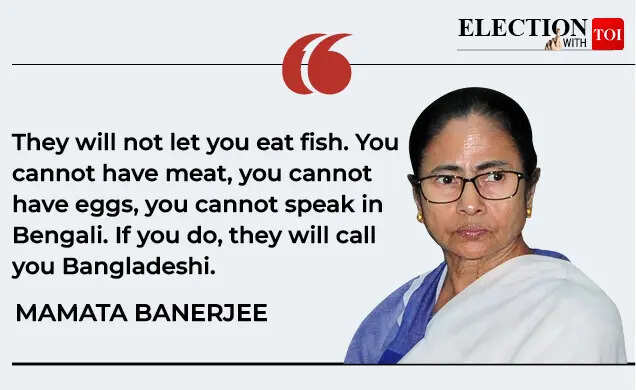
The anxiety had been created by Mamata Banerjee herself. At a rally in Basirhat’s Swarupnagar, she tore into what she called the BJP’s fish “lies”, saying Bengal “eats up what it produces,” and questioned the saffron party’s silence on the “targeting of meat and fish shops” if it was such a big fan of the aquatic vertebrate. “In their states, they will not allow you to eat fish, meat and eggs. Who are they to decide what people will eat?” she thundered. She also reminded the audience of how “people are tortured and lynched in BJP-governed states for speaking in Bengali.”The BJP scrambled to answer on its own terms. BJP MP Anurag Thakur participated in a public show of eating fish during a poll campaign. Seen eating fish and meat with party workers at a local hotel in Kolkata, he said: “The BJP has Chief Ministers in 16 states. There, people can eat whatever they want and they can practice whichever religion they want. We do not want to impose restrictions on food or religion.” He then accused Banerjee of spreading misinformation to malign his party’s image.From PM Modi to Amit Shah, the fish debate reached the campaign speeches of even the top brass of the BJP as they tried to shed their “outsider” and “vegetarian” image in Bengal. The campaign had reduced, at one level, to a contest over who could more convincingly claim the right to a plate of hilsa.
Triangular tussle in God’s own country
Kerala has had a simple political rule since 1982: Left wins, Left loses. Congress wins, Congress loses. Swap. Repeat. Pinarayi Vijayan broke it in 2021 by winning two terms in a row. In 2026, he was going for three — something no Kerala government has ever done.That was one story. The bigger story on the campaign trail was the BJP. For the first time in the state’s political history, a strong three-way contest was visible in nearly every constituency. Unlike previous elections, where the LDF and UDF often benefited from tacit cross-voting to keep the BJP at bay, both fronts this time found themselves under genuine pressure from the NDA. The closing days of the campaign were marked by controversy on all sides. In Palakkad, BJP workers were allegedly caught distributing cash, with videos circulating widely. The Congress, meanwhile, faced allegations over the misuse of funds collected for housing landslide victims in Wayanad. Both stories spread fast. Both were loudly denied. What also stood out was the spectacle of two national INDIA bloc partners spending much of the campaign attacking each other rather than the BJP. Each alliance accused the other of colluding with the BJP and compromising Kerala’s secular tradition. The campaign period was also unusually short- just three weeks. Despite that, Prime Minister Modi, home minister Amit Shah, and Rahul Gandhi all visited the state multiple times. Everyone wanted Kerala. Everyone treated it like it could actually change hands.
Hotel lobby, lottery king’s son and Puducherry’s magnificent chaos
And then there is Puducherry — proof that you don’t need millions of voters to generate industrial quantities of political drama.The standout moment of the Puducherry campaign happened not at a rally or in a manifesto but in a hotel lobby where a Union minister sat, waited for nearly two hours and was stood up.Chief Minister Rangasamy’s AINRC had placed two firm conditions for staying in the NDA: opposition to the inclusion of the newly formed Latchiya Jananayaga Katchi of Jose Charles Martin — son of lottery king Santiago Martin — in the alliance, and a renewed demand for statehood for Puducherry. The BJP agreed to neither. Union Minister Mansukh Mandaviya arrived at a hotel in the UT for alliance talks. Rangasamy did not attend the meeting. Until that Thursday evening, there was genuine speculation that Rangasamy might exit the NDA entirely to form an alliance with Vijay’s TVK. The BJP immediately dispatched Mandaviya to Puducherry on a special flight to persuade him. The alliance eventually held. Jose Charles Martin remained one of the most-watched figures of the Puducherry contest. His father Santiago Martin built one of India’s largest lottery businesses. The son launched a party from scratch ahead of these elections and negotiated his way into the ruling alliance. In a union territory with 30 constituencies and fewer than a million voters, where individual constituencies have between 30,000 and 50,000 electors, the dynamics of money, access, and influence operate differently from larger states. Despite everything, Puducherry recorded 89.87% voter turnout- the highest since 1964, the year of the first election after the territory’s merger with India. When political stakes feel personal, people show up. In Puducherry, they always do.
What it all adds up to
Across five states, India’s 2026 election season was less a referendum on any single policy than a vivid exhibition of what this democracy looks and feels like when it runs at full throttle.A megastar’s mania turned lethal before his campaign officially began — and he kept campaigning anyway, more cautiously, in the shadow of 41 deaths. A chief minister posted an AI-generated video of himself shooting at a religious minority, watched it go viral, watched it get deleted and then defended it. Ninety lakh voters were struck from a list, those who remained on it showed up in record numbers, as if to answer the deletion with defiance. And in Puducherry, a Union minister sat alone in a hotel lobby, stood up by an ally in India’s smallest electoral theatre, over a dispute involving a lottery baron’s son.

Leave a Reply