
Middle East conflict impact: What happens when the world’s argest liquefied natural gas (LNG) hub suffers extensive damage? Qatar’s key gas hub, Ras Laffan, has sustained extensive damage after multiple strikes from Iran as part of the ongoing conflict in the Middle East that started after US-Israeli strikes on Iran.The strikes by Iran have caused such damage to the facility that Qatar says may take years to repair. Attacks on Ras Laffan and other energy installations on Thursday briefly pushed Brent crude up more than 10 per cent to above $119 per barrel before prices eased. Worryingly, QatarEnergy CEO Saad al-Kaabi has said that Iran’s attack has wiped out 17% of Qatar’s LNG capacity for up to 5 years!This has raised fresh concerns over global energy supplies as the Middle East conflict continues.
Israel Iran War
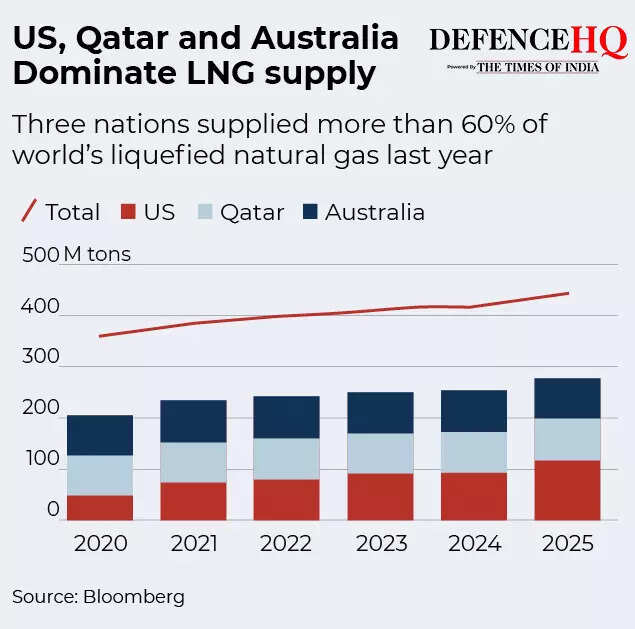
According to a Financial Times report, under usual conditions, Ras Laffan supplies around a fifth of the world’s LNG supplies. In Europe gas prices have shot up by 35% and Asia too is vulnerable to long-lasting supply shocks.India gets around 40% of its LNG requirements from Qatar. Reacting to the damage to key energy infrastructure in the Middle East, External Affairs Ministry spokesperson Randhir Jaiswal said, “India had previously called for the avoidance of targeting civilian infrastructure, including energy infrastructure, across the region.”
“The recent attacks against energy installations in different locations across this region are therefore deeply disturbing and only serve to further destabilise an already uncertain energy scenario for the whole world,” he added.
Which Middle East oil & gas facilities have been hit?
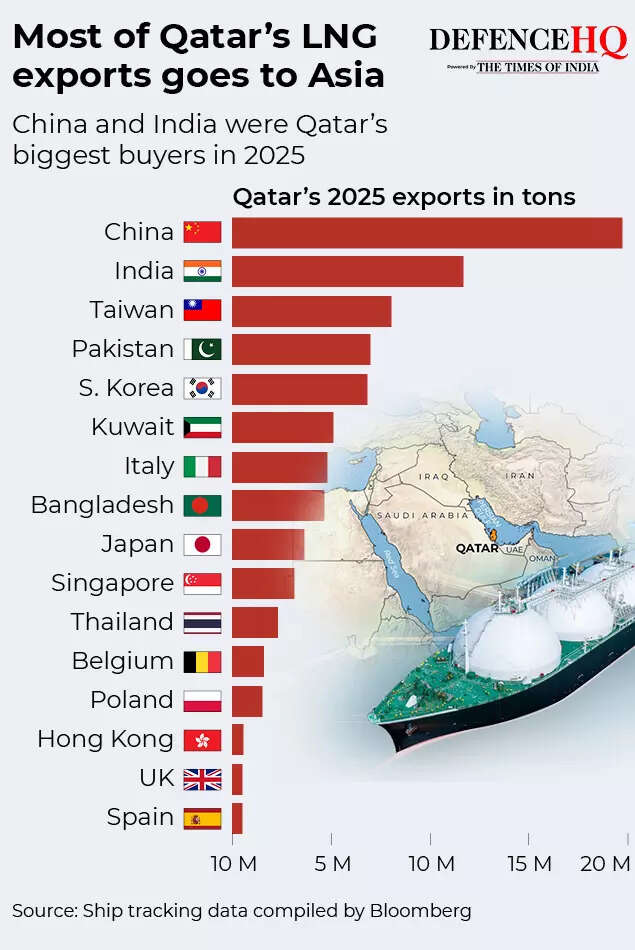
QatarEnergy, which operates Ras Laffan, told Reuters that the damage can take 3 to 5 years to repair. It would possibly cost the company around $20 billion annual revenue loss and may even force it to cancel long term contracts with countries like China, Italy, Korea, and Belgium.Iran’s South Pars field, which is part of the world’s biggest gas reserve shared with Qatar has also been hit.Several other critical facilities across the region have also been targeted. Iran’s Kharg Island, a major crude export hub, was struck, while the UAE’s Ruwais refinery halted operations as a precaution after a drone incident.
Saudi Arabia’s Ras Tanura refinery and Yanbu port facilities, key to oil processing and exports, have faced disruptions, alongside drone strikes on Kuwait’s Mina Abdullah and Mina Al-Ahmadi refineries, both of which later contained fires. The continued attacks have significantly reduced Gulf oil output and heightened fears of severe disruption to global energy markets.
What do attacks on Middle East oil & gas fields mean for India?
The most important point to note is that the top five major import sources of crude petroleum for India are Russia, Iraq, Saudi Arabia, UAE, and USA. The total share of these five countries in the quantity of imported crude oil was around 83% in fiscal 2025. India is a big importer of LPG and LNG and relies heavily on supplies from Middle Eastern countries such as Qatar, Saudi Arabia and the UAE. Hence, any supply disruption, whether it is due to passage threats in the Strait of Hormuz or closure of gas facilities in this region, has important ramifications for India. So, India is heavily exposed to the recent attacks on Middle Eastern oil and gas infrastructure, with key facilities in Qatar, the UAE, Iran, Saudi Arabia and Iraq – all major suppliers or transit points – coming under fire, says Sourav Mitra, Partner – Oil & Gas, Grant Thornton Bharat. He lists some startling facts:
- More than 60% of India’s crude oil imports originate from the Persian Gulf, particularly from Iraq, Saudi Arabia, and the UAE, meaning a majority of India’s oil supply is linked to regions now directly affected by strikes.
- Additionally, 40% to 50% of India’s crude imports normally transit the Strait of Hormuz, which has been rendered nearly impassable due to Iranian attacks and heightened maritime risk, further tightening India’s supply chain exposure.
- On the LNG side too, India relies heavily on the Gulf with Qatar – whose Ras Laffan LNG hub suffered extensive missile damage – alone being responsible for around 40% of India’s LNG.
- Meanwhile, about 90% of India’s LPG imports travel through the Hormuz chokepoint, placing most of its household cooking‑fuel supply at risk as shipping disruptions intensify.
Simply put, these disruptions translate into heightened supply uncertainty, rising import costs with a weakening rupee, and increased pressure on domestic energy markets.“LNG production outages in Qatar and hits on UAE gas facilities have already forced Indian distributors to curtail supply and raise industrial gas prices. Crude prices have surged sharply following the attacks, with Brent fluctuating between $90-120 per barrel in the past few days, aggravating India’s import bill and risking further depreciation of the rupee in an economy that imports 85% to 90% of its oil,” notes Sourav Mitra. So what is India doing to tackle the unprecedented situation?India has been actively looking to ensure safe passage of its ships through Strait of Hormuz for oil and gas supplies and some tankers have managed to make their way through the passageway and dock in India. Diversification has also been a key strategy.On the issue of LNG supply, MEA spokesperson Randhir Jaiswal said, “With the latest attacks, the LNG supply is going to be impacted. It has been impacted because of the closure of the Strait of Hormuz. But we are in discussion with several countries. We are in touch with all the stakeholders there to see how best we can secure our energy needs.”He added, “We’re trying to buy LPG from everywhere, wherever it’s available. So if Russia is available, we’ll go there too. Because the current situation is such that we have to ensure that our people’s fuel needs are met… I can say that we want to have a wide range of options…”Sujata Sharma, Joint Secretary, Ministry of Petroleum and Natural Gas said on Thursday, “We are affected by the supplies of the Middle East… Anything which impacts the supplies from the Middle East impacts us… We are trying to pick up the cargoes from other sources. In crude oil, we have already diversified. Around 70% of our crude is coming from the area outside the Strait of Hormuz. Some of our LPG is also coming from the US. Qatar is definitely a very big supplier of LNG. But there are other suppliers also. For example, the US and Australia. There are other big suppliers as far as LNG is concerned…”Grant Thornton Bharat’s Mitra explains how India is responding by accelerating diversification, i.e., raising non‑Hormuz imports to around 70%, increasing crude purchases from Russia and securing additional cargoes from the US, West Africa and Latin America to offset Gulf disruptions. “Over the medium term, India is also turning to alternative LNG sources such as the US and Australia while expanding domestic buffers like strategic reserves and speeding up renewable adoption to reduce long-term dependence on conflict-prone regions. For LPG India has secured 1 MMT of LPG mainly from the US and is also actively working with Iran to secure passage from the Strait of Hormuz,” he says.“Meanwhile, replacement LNG volumes could come from the US, West Africa, Australia or Russia, but longer shipping distances mean higher freight costs and slower delivery times. In the near term, India’s priority will likely be ensuring supply security for critical sectors, particularly fertilizers with the sowing season approaching, as well as cooking gas and power generation,” says Sumit Ritolia, Lead Research Analyst, Refining and Modelling at Kpler.As per Ritolia, India sits among the most exposed buyers in the region. As per Kpler tracking, more than half of its LNG imports come via Hormuz (Qatar and the UAE), making the country particularly vulnerable to both physical supply disruptions and price shocks.“This dependence matters because many of India’s long-term LNG contracts are linked to oil prices, while any additional volumes typically need to be sourced from the spot market — often at significantly higher prices during supply disruptions,” says Ritolia.“If the disruption through Hormuz persists, Indian buyers may need to procure higher-priced spot cargoes or reduce consumption. Price-sensitive sectors, particularly industrial users and smaller gas distributors, could shift toward alternative fuels such as oil products, naphtha or petroleum coke,” he says.The shutdown of the Strait of Hormuz has already blocked India’s access to almost 60 per cent of its LPG. This has led to panic buying across the country. If shipments through the Middle East continue to be affected, India will need to source LPG cargoes from alternative suppliers such as the US or West Africa, though these supplies involve longer voyages and higher freight costs, says Ritolia.“In the short term, this means that the replacement costs may rise and create tighter regional balances, especially if multiple Asian buyers compete for limited alternative cargoes,” Ritolia tells TOI.Yet another measure is to get domestic refineries to maximise LPG yields. In fact, as per the government’s latest data, domestic LPG production from refineries has increased by about 36 per cent.

Leave a Reply