
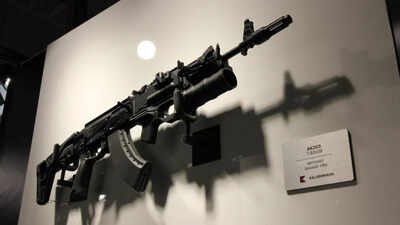
NEW DELHI: Every working day, 23-year-old Neha Mishra shoulders an AK-203 ‘Sher’, takes aim and pulls the trigger. But the shots she fires at the Indo-Russian Rifles Pvt Ltd (IRRPL) facility in Korwa are not part of military training. They help determine whether a newly manufactured rifle is ready for a soldier.Mishra is the only woman among IRRPL’s nine test firers. Her firing range is just a few kilometres from her home in Munshiganj, Amethi, and her job is to test the rifles manufactured at the facility.She is also among those to fire the first AK-203 made entirely from components and input materials manufactured in India, marking a major milestone in the country’s small-arms manufacturing programme.For Mishra, the difference between the earlier rifles containing Russian-origin components and the fully Indian version is difficult to detect.“It is the same. There is no major difference,” she said.Asked whether she would choose the fully Indian rifle if she were a soldier, her response was immediate.“Without doubt. We can take this with our eyes closed.”For India, however, the rifle represents the culmination of a decade-long effort to turn a Russian design into an indigenous weapon, from technology transfer and material development to building a domestic network of suppliers.
Why the AK-203 matters
Major General Sudhir Kumar Sharma, CEO and managing director of IRRPL, said the importance of the programme ultimately comes down to the soldier carrying the weapon.“You may have jets, missiles and every modern weapon system imaginable. But for a soldier standing on the border or conducting a counter-insurgency operation, the most important weapon is still the rifle,” he said.The push for the AK-203 was shaped in part by the Army’s experience during the insurgency in Jammu and Kashmir in the 1990s, when militants frequently used Kalashnikov-pattern rifles known for their reliability and simplicity.After evaluating weapons from several countries, the Army selected the AK-203. The next challenge was to manufacture the Russian-designed rifle in India.Korwa in Amethi was selected as the production site, with an existing ordnance factory, land and infrastructure, along with access to engineering and manufacturing ecosystems in nearby Lucknow and Kanpur.
From Russian design to Indian rifle
The project involved extensive technology transfer from Russia, with around 90,000 pages of technical documentation covering the rifle’s design and manufacturing processes.The programme was slowed by the Covid-19 pandemic and the Russia-Ukraine war, with the final technology package arriving only in 2024.The first rifle assembled at Korwa in August 2023 contained about 5% Indian content. That figure rose to 15% by December 2024.By August 2026, all 50 major components and nearly 180 child parts were being manufactured in India.The transition required Indian manufacturers to reproduce specialised materials and components that had previously relied on Russian specifications. These included specialised steel alloys, springs, engineering plastics, composites, coatings and metals with precise chemical compositions.
Building the Indian supply chain
Advanced Weapons and Equipment India Ltd (AWEIL) and Adani Defence Systems and Technologies helped develop the domestic vendor base.IRRPL teams, including Indian Army officers and Russian specialists, visited around 76 sub-vendors across the country to assess manufacturing processes, input materials and technology and help address production challenges. Roughly half of these vendors are in Uttar Pradesh, particularly around Kanpur and Lucknow.Testing capabilities also had to be developed in India. Components were initially sent to Russia and later to laboratories in Delhi-NCR, Lucknow, Kanpur, Bengaluru and Pune.IRRPL subsequently established its own laboratory at Korwa, capable of conducting about 76 types of tests, including X-ray and magnetic particle inspection.Russian specialists, including a chief technologist and a quality-control expert, continue to work at the facility alongside the Indian team.“Components pass through hydraulic and electrical machinery in a production process involving 122 separate actions. At full production, individual workstations are designed to complete their task in about 90 seconds, allowing a finished rifle to emerge roughly every 100 seconds,” Sharma said.
The rifle’s ultimate test
Every AK-203 undergoes firing tests before acceptance. About 70 rounds are fired from each rifle, including two high-pressure rounds that generate around 50% more pressure than standard ammunition.The Korwa facility has around two dozen firing ranges for the testing process.The first fully Indian AK-203 also underwent a continuous 3,000-round firing test, which it successfully completed, Sharma said.IRRPL is now preparing 10 rifles with 100% indigenous content for Army trials while continuing production under its existing programme.The company has already delivered around 70,000 rifles, progressively increasing their Indian content.
A young workforce in Amethi
The manufacturing ecosystem has also created a new pool of young defence workers in Amethi and neighbouring districts.Many employees are in their mid-20s and come from Amethi, Sultanpur, Pratapgarh, Rae Bareli and surrounding areas. They include ITI graduates, diploma holders and engineering students, many of whom had no previous experience in defence manufacturing.Among them is 25-year-old Abhishek Pathak, an ITI diploma holder and former NCC cadet who once hoped to join the armed forces.Another test firer, Sachin Dev, also comes from Amethi and entered the facility through an NCC background.The Indo-Russian character of the venture remains visible at the management level as well. IRRPL’s eight-member board is equally divided between Indian and Russian representatives. Four of the eight general managers reporting to the CMD are Russian officers based in India.
From 70,000 rifles to expansion
IRRPL currently employs around 247 people, with that number expected to rise to about 460 when production reaches full scale.Sharma said the target from April 2027 is to produce one rifle every 100 seconds, provided suppliers can maintain the required flow of components.The company has also received indications of demand for more than 1.5 lakh rifles and is looking beyond domestic production towards exports and potentially other weapons in the Kalashnikov family.For now, however, the focus remains on meeting the Army’s requirements and completing the transition from a Russian-origin design to an AK-203 built entirely in India.

Leave a Reply