
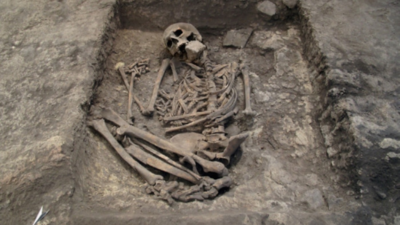
A man buried beneath a hearth in southeastern Spain nearly 3,700 years ago may have been subjected to a ritual intended to suppress supernatural forces rather than simply punish or humiliate him, according to a new archaeological study. The man’s face was positioned just one centimetre below the floor of a large hall, while a stone had been forced into his mouth and the lower part of his body lay beneath a hearth. Researchers believe the unusual arrangement may have been designed to symbolically overpower an enemy and prevent the return of forces associated with chaos.The interpretation was proposed by Marco Mazón Gomariz of the Complutense University of Madrid in a study titled ‘Trampling the Enemy: A Possible Magical Ritual of Annihilation in El Argar’, published in the journal ‘Ilu. Revista de Ciencias de las Religiones’ on October 5, 2026. The research examines the remains of an individual identified as AY5, discovered at the Bronze Age archaeological site of La Almoloya in Murcia, Spain. The author stresses that the magical-ritual explanation remains a hypothesis because the people who buried the man left no written account explaining their actions.
A body hidden beneath a room’s floor
The burial dates to Phase 3 of the El Argar culture, between approximately 1750 and 1550 BCE. La Almoloya was an important settlement associated with the Bronze Age society that occupied southeastern Iberia for centuries. According to the study and accompanying archaeological reports, AY5 was a man approximately 40 years old and around 1.63 metres tall. His remains were discovered in Room H9, within the settlement’s first residential complex, where the body had been placed between two floor levels.The lower floor had been modified to accommodate the corpse. His lower body lay beneath a hearth, while his face was positioned at ground level, approximately one centimetre below the surface people would have walked on. A large stone had also been placed inside his mouth.The arrangement meant that people crossing the room could repeatedly step over the area covering his face. The burial contained no grave goods, unlike some other interments associated with the El Argar culture. Earlier interpretations viewed the unusual placement as a deliberate act of punishment or humiliation. The man was effectively positioned beneath the feet of people using the hall, while the stone in his mouth suggested an attempt to silence him.However, Mazón Gomariz argues that the burial may have had a more complex religious purpose.
Why researchers suspect a magical ritual
The study compares AY5’s burial with ancient practices in Egypt and the Near East, where the act of trampling an enemy could symbolise domination over a defeated rival. In some religious and political traditions, enemies were associated with disorder and chaos, making their symbolic destruction a way of reinforcing the power of rulers and the forces they represented. Ancient Egyptian imagery, for instance, depicted rulers trampling enemies as a demonstration of victory and the restoration of order. Similar representations appeared in the ancient Near East, where kings were shown standing over defeated opponents.The researcher also draws on evidence of magical practices intended to neutralise perceived threats. In parts of the ancient Near East, rituals against witchcraft involved figurines representing enemies or harmful forces. These objects could be damaged, buried or trampled as symbolic acts intended to defeat the threat they represented.The stone inside AY5’s mouth may be significant in this context. Mazón Gomariz suggests that it could have symbolised the silencing of the individual, potentially preventing him from speaking or exerting influence even after death. The combination of the stone, the body’s position beneath a hearth and the location of the face beneath a frequently used floor could therefore represent a coordinated ritual intended to keep a perceived threat under control.
Was the hall more than a political space?
The location of the burial also informs the new interpretation. Room H9 was a large, semi-basement hall measuring approximately 70 square metres, with benches capable of accommodating around 50 people and an elevated platform. The room also contained a sunken hearth that researchers describe as unusual for the site during this period. Its layout and access route have led scholars to examine whether the space served functions beyond ordinary domestic activities.Mazón Gomariz argues that the hall may have combined political and religious purposes. If it was used for gatherings or ceremonies, the burial’s prominent position could have given the treatment of AY5 a symbolic significance for those entering or crossing the room.The man’s identity, however, remains unknown. A genetic analysis has reportedly established that he was a third-degree relative of two other individuals buried at La Almoloya, suggesting that he had biological connections to the community rather than necessarily being an outsider.The researcher raises the possibility that AY5 may have held a political or religious role before losing favour, but there is no conclusive evidence identifying him as a priest, official or enemy of the settlement.
An interpretation that remains unproven
The skeleton does not show clear injuries that establish how the man died. The manner of his burial cannot, by itself, reveal whether he was killed, executed or died under other circumstances. The position of the body, the absence of grave goods and the stone in his mouth provide clues about how the living treated the dead, but they cannot definitively establish the purpose behind those actions.The study’s central argument is that the burial may have been intended to suppress forces of chaos symbolically, rather than simply to humiliate a person after death. Yet, without written records from the El Argar society, the exact meaning of the ritual remains uncertain.The discovery nevertheless offers a glimpse into how Bronze Age communities may have understood death, enemies and the relationship between the physical world and supernatural threats. For now, AY5 remains an individual whose identity and fate are lost to history, while the unusual way he was buried continues to raise questions about the beliefs of the people who lived at La Almoloya.

Leave a Reply