
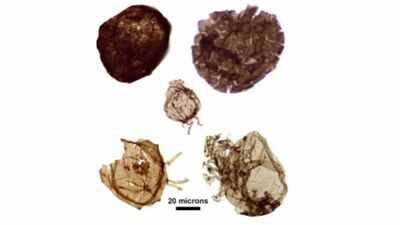
More than 12,000 microscopic fossils recovered from 1.7-billion-year-old rocks in northern Australia are offering scientists a rare glimpse into the early history of complex life. The fossils belonged to ancient eukaryotes, the broad group that includes animals, plants, fungi and algae. They lived long before animals appeared, yet their cells already had a complexity far beyond that of bacteria and archaea. According to ScienceDaily, researchers studied mudstone cores stored by the Northern Territory Geological Survey and found that the fossil organisms lived in environments containing oxygen, from coastal mudflats to the open sea. Oxygen-free samples contained only simpler microbial forms. The findings, published in Nature, support the idea that oxygen was important in the evolution of early eukaryotes and may have helped create the biological conditions that eventually allowed complex life to flourish.
Fossils hidden in old drill cores
The fossils were found inside cylindrical rock cores stored in an open-air warehouse in Darwin, Australia.The cores had been collected decades ago by mineral exploration companies drilling hundreds of metres below the surface. The companies were searching for geological resources, not ancient life, and were largely unaware that the mudstone contained microscopic fossils.The rocks formed from hardened seafloor mud more than 1.4 billion years ago. At that time, much of northern Australia was covered by an ancient inland sea.The fossil-bearing mudstones remained stored until researchers revisited them with questions about the origins of complex cells. The material offered a rare opportunity because the rocks preserved both the organisms and clues about the environments in which they lived.Scientists crushed samples of the mudstone and dissolved them. This process left behind organic residues that could be examined under a microscope.The researchers identified more than 12,000 fossils. The number gave them enough material to compare organisms from different layers and environmental settings rather than relying on one or two unusual specimens.
What makes a eukaryote complex
All modern life is broadly divided into two cellular types.Prokaryotes, which include bacteria and archaea, generally have simpler cells. Their genetic material is not enclosed within a nucleus, and they lack many of the specialised internal structures found in more complex cells.Eukaryotes have a more elaborate cellular organisation. Their DNA is enclosed inside a nucleus, and their cells contain organelles that perform specialised tasks.Animals, plants, fungi and algae are all eukaryotes. Although these organisms look extremely different from one another, they share a basic cellular architecture that can be traced back to an ancient common ancestor.The first eukaryotes were not animals or plants. They were single-celled organisms, but their cells already contained features that marked a major evolutionary transition.That transition eventually made multicellular organisms possible. Cells could specialise, communicate and cooperate, creating bodies with tissues and organs.The Australian fossils therefore do not show the first animals. They document an earlier stage in the story, when complex cellular life was already established but animals had not yet evolved.
The evolutionary leap
The rise of eukaryotes was one of the most important events in Earth’s biological history.Scientists believe that the ancestor of modern eukaryotes emerged through a symbiotic relationship between at least two prokaryotic organisms. An archaeon and a bacterium may have combined in a way that allowed one cell to live inside another.Over time, the partnership produced a more complex cell. The internal bacterium eventually became the mitochondrion, an organelle that generates energy for the cell.Mitochondria allowed eukaryotic cells to produce energy efficiently through aerobic respiration. That energy supply helped support larger cells, more complex structures and eventually multicellular life.The exact circumstances of this transformation remain uncertain. Scientists do not know precisely when the first eukaryotic cells appeared, what environments they occupied or how they survived in Earth’s changing oceans.Fossils can provide information that genetic studies alone cannot. DNA from living organisms reveals relationships among modern species, but it cannot directly show how extinct organisms lived billions of years ago.Ancient rocks provide a record of both the organisms and their surroundings.
The oxygen question
One of the central questions in the study was whether early eukaryotes depended on oxygen.Most living eukaryotes use oxygen to release energy from food. Aerobic respiration produces the substantial energy needed to power complex cellular activity.However, some modern eukaryotes can survive in oxygen-free environments. Genetic evidence also suggests that oxygen may have been scarce when the earliest eukaryotes evolved.Those observations have challenged the assumption that oxygen was essential from the beginning. If the first eukaryotes could live without oxygen, then perhaps the transition to complex life happened in low-oxygen environments.The Australian fossils offered a way to test that question. Researchers examined the chemistry of the mudstones around the fossils to determine whether oxygen had been present in the ancient seawater.They found eukaryote fossils in samples deposited in oxygenated settings. The organisms lived in environments ranging from coastal mudflats to the open sea, but they were found only where oxygen was available.Samples formed under oxygen-free conditions contained simpler prokaryotic forms instead.
Evidence from 1.7 billion years ago
The oldest fossils in the Northern Territory collection date to about 1.75 billion years ago. The fossils studied in the new research span approximately 1.7 to 1.4 billion years ago.They are among the oldest known eukaryote fossils on Earth.Their age places them far earlier than the appearance of animals. The first animal fossils are generally associated with much later periods in Earth’s history, while these organisms lived during the Proterozoic Eon.At the time, the planet’s oceans and atmosphere were very different from those of today. Oxygen levels had risen compared with earlier geological periods, but oxygen was not evenly distributed across marine environments.Some areas may have been oxygen-rich, while others remained chemically hostile to organisms that depended on oxygen.The fossils show that eukaryotic organisms occupied oxygenated areas within that uneven world. They were not necessarily widespread across every environment, but they had already diversified enough to live in different oxygen-rich habitats.
What the mudstone reveals
The rock surrounding a fossil can tell scientists where and how the organism lived.Mudstone forms from fine sediment deposited in quiet water. Chemical traces within the rock can preserve evidence of oxygen, sulphur, iron and other conditions present at the time.By analysing the mudstone’s chemistry, researchers reconstructed the environmental conditions of the ancient seafloor.The fossils appeared in settings ranging from coastal mudflats to open marine environments. That range suggests that early eukaryotes were not restricted to one narrow habitat.At the same time, their absence from oxygen-free samples was significant. The pattern was consistent across the analysed material, strengthening the connection between oxygen and the presence of early eukaryotes.The evidence does not prove that every early eukaryote required oxygen under all circumstances. It shows that the ancient fossil lineages in this study were associated with oxygenated environments.That distinction is important because life often contains exceptions. Some modern eukaryotes have adapted to oxygen-free conditions, but those adaptations may have evolved later or may represent specialised departures from an oxygen-dependent ancestry.
A world before animals
The fossils belonged to single-celled organisms, but they carried features associated with greater complexity.Their remains show surface structures such as extensions and plates. These features may have helped the organisms interact with their surroundings, move, feed or protect themselves.The organisms were not animals, but they represented the kind of cellular complexity from which multicellular lineages could eventually develop.For billions of years, Earth was inhabited almost entirely by microbial life. The emergence of eukaryotes changed the possibilities available to evolution.Once cells could produce more energy and organise their internal functions, they could become larger and more structurally complex. Later, groups of cells could remain together and specialise.The Australian fossils capture an early stage in that long process. They show that complex cells existed well before the rise of large organisms visible to the naked eye.The world was not yet populated by forests, animals or reefs, but the cellular foundations of those later developments were already present.
Oxygen as an evolutionary opportunity
The study supports the idea that oxygen helped drive the evolution of complex life.Oxygen would have provided early eukaryotes with a more efficient way to obtain energy. That energy could support cellular processes that would be too demanding for simpler organisms relying on less efficient forms of metabolism.The availability of oxygen may also have created ecological opportunities. Eukaryotes could occupy habitats where oxygen-dependent metabolism was possible, while other microbes remained limited to oxygen-poor environments.Over time, those differences could influence competition, predation and the distribution of organisms.The researchers’ findings suggest that oxygen was not merely a later advantage for eukaryotes. It may have been part of the environmental setting that allowed early complex cells to survive and diversify.The evidence does not mean oxygen alone caused the rise of eukaryotes. Evolution depends on genetics, symbiosis, nutrients, climate, ecological interactions and chance.But oxygen appears to have been an important condition in the environments where these ancient complex cells lived.
Why fossils matter more than DNA alone
Scientists often use genes from living organisms to study ancient evolutionary relationships.Genetic comparisons can reveal which modern organisms share common ancestors and identify groups that branched off early. They can also provide clues about the genes involved in energy production, cellular organisation and oxygen use.But living organisms are not perfect records of the past. They have evolved for millions or billions of years since their ancestors existed.Fossils provide a different kind of evidence. They show the physical remains of organisms that are no longer alive and preserve information about the conditions in which they lived.The Australian mudstones offer both biological and geological evidence. The fossils show that eukaryotic organisms were present, while the surrounding chemistry indicates whether their habitat contained oxygen.Together, those records help scientists connect evolutionary history with environmental context.This combination is especially valuable for periods when no animals, plants or familiar organisms existed to provide easy comparisons.
The challenge of preservation
Microorganisms are difficult to preserve as fossils.They are tiny, soft-bodied and easily destroyed by decay, burial, erosion and chemical alteration. Fossils may survive only when sediment and chemistry protect their organic remains.The Australian mudstones preserved enough detail for researchers to identify eukaryotic characteristics. Features such as surface extensions and plates helped distinguish the organisms from simpler prokaryotic forms.The discovery also shows why old geological collections remain valuable. Drill cores stored for decades may contain fossils that were overlooked because nobody expected them to be there.Modern microscopy and geochemical techniques can reveal information that was not accessible when the rocks were first collected.Other fossil-bearing cores around the world may hold similar clues. Researchers can re-examine old samples with new questions and improved analytical tools.Storing these cores made it possible to study a vanished ecosystem without extracting new material from a remote site.
What remains unknown
The fossils answer some questions but raise others.Scientists still do not know precisely what the organisms ate, how they moved or whether they formed colonies. They also do not know how closely the fossil lineages were related to the ancestors of modern eukaryotes.The surface structures may have served multiple functions. Extensions could have helped with feeding or movement, while plates may have contributed to protection or cell shape.More fossils from different locations will be needed to determine how widely these organisms lived and whether the oxygen association applies to other early eukaryotic lineages.Researchers also want to understand how oxygen levels changed across ancient oceans. Oxygen may have existed in localised zones long before it became widespread throughout the atmosphere and deep sea.The fossils provide a snapshot of life in certain environments. They do not represent every habitat on Earth at the time.Continued geological and palaeontological work could reveal whether oxygen-dependent eukaryotes were common or whether they were one branch of a more diverse early community.
A glimpse of our deep origins
The discovery connects modern life to an almost unimaginable past.Animals, plants and fungi share a cellular heritage with organisms that lived more than a billion years before any of them appeared. The eukaryotic cell inside every human body is part of a story that began in ancient oceans.The Australian fossils do not resemble people, trees or animals. They were microscopic cells preserved in mudstone. Yet their cellular organisation represents an early step toward the complexity that eventually made those forms possible.The study also highlights how closely life is tied to Earth’s physical conditions. The availability of oxygen influenced which organisms could survive, where they could live and what evolutionary paths were open to them.By studying ancient rocks, scientists can ask not only when complex life appeared but also why it appeared in the first place.
The continuing search
The researchers plan to continue studying the Australian microfossils and the rocks that preserve them.Each new specimen can improve understanding of the early eukaryotic world. Scientists can compare shapes, surface features, chemical environments and geological ages.Additional fieldwork may uncover fossil-rich layers in other parts of Australia or reveal related organisms in rocks from different continents.The search is difficult because the most important clues may be microscopic and hidden inside rocks that were collected for entirely different reasons.The discovery demonstrates the value of combining techniques. Satellite and geological mapping can identify promising formations, laboratory dissolution can isolate organic residues, microscopy can reveal cell structures and geochemistry can reconstruct ancient environments.No single method provides the complete answer. Together, they offer a more detailed picture of life before animals existed.
A major clue from ancient Australia
More than 12,000 fossils from Australian mudstone have strengthened the link between oxygen and the early evolution of complex cells.The organisms lived between roughly 1.7 and 1.4 billion years ago, long before animals appeared. They were early eukaryotes, with cellular features more complex than those of bacteria and archaea.Researchers found them in oxygenated settings ranging from coastal mudflats to the open sea, while oxygen-free samples contained only simpler microbial forms.The results support the idea that oxygen helped create the conditions in which eukaryotes could emerge and diversify.The discovery does not reveal every step in the journey from simple cells to animals, but it provides an important piece of the puzzle. In ancient Australian rocks, scientists have found evidence that the rise of complex life was shaped not only by biological innovation but also by the chemistry of Earth’s oceans.The fossils show that long before animals walked, swam or flew, complex life was already learning how to survive in an oxygen-rich world.

Leave a Reply