
Global Science News: Researchers have successfully sequenced the largest animal genome ever documented, belonging to the South American lungfish (Lepidosiren paradoxa) — a freshwater fish known as a “living fossil.” At approximately 91 billion DNA base pairs, this genome is about 30 times larger than the human genome, which contains roughly 3 billion base pairs, setting a new record in animal genomics research.
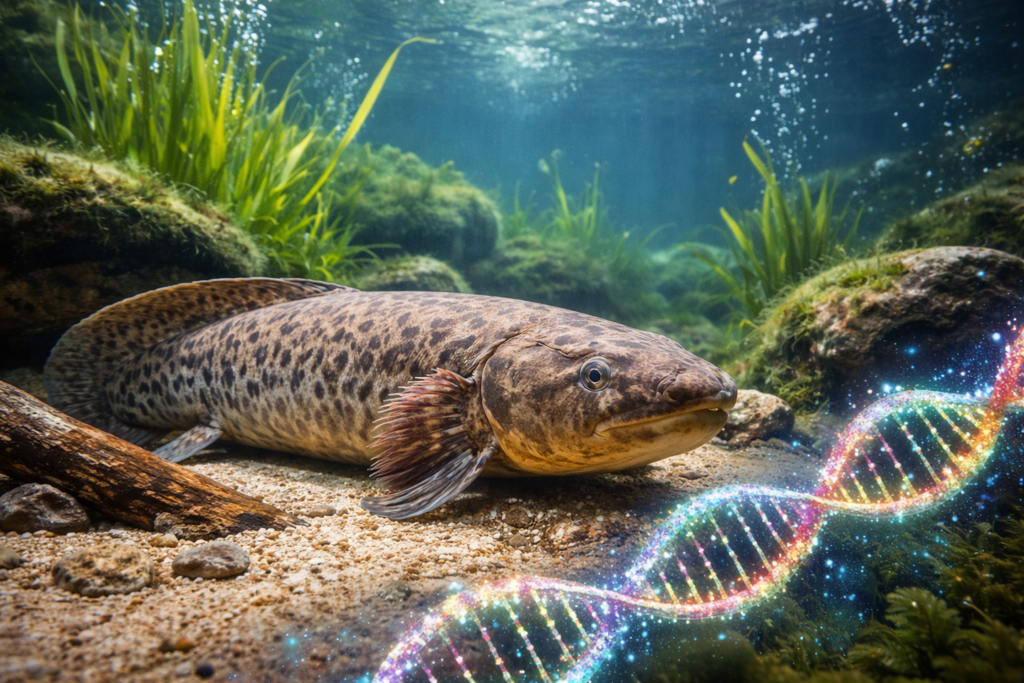
Unprecedented Size: The magnitude of the lungfish’s genetic code far surpasses previous records. In fact, 18 of its 19 chromosomes are individually larger than the entire human genome, underscoring its extraordinary complexity.
Why It Matters: Lungfish are considered close relatives of the earliest vertebrates that transitioned from water to land. Decoding their genome provides scientists with critical clues about vertebrate evolution, especially the adaptations that may have enabled ancient fish to develop limb-like structures and breathe air.
Scientific Hurdles Overcome: Sequencing such a massive genome was no small feat. The project involved advanced genomic technologies and sophisticated computational analysis to piece together the enormous amount of DNA. Experts highlight that lungfish genomes are especially rich in repetitive DNA elements, which expand over time and contribute to their record-breaking size.
Evolutionary Insights: Beyond size, the genome offers a window into evolution. Lungfish have existed for over 400 million years and exhibit features that mirror ancient vertebrates. By comparing lungfish DNA with other species, researchers can gain new understanding about the genetic changes that occurred as life moved from oceans onto land.
Future Research: The complete sequence of this enormous genome opens up numerous research avenues, from studying genome expansion mechanisms to uncovering how so-called “living fossils” have survived for millions of years with relatively unchanged body plans. Scientists believe this work will deepen our understanding of genetic diversity and evolutionary biology.

Leave a Reply