
Mukesh Ambani-led Reliance Industries (RIL) has partnered with America First Refining (AFR) to develop the first large oil refinery project in the United States in nearly fifty years, with President Donald Trump describing it as a ‘historic $300 billion deal’. This marks one of RIL’s largest overseas investments and signalling its re-entry into the American energy sector after a four-year gap.Data from the US Energy Information Administration shows that the US had 132 operational petroleum refineries as of January 2024.“This is a historic $300 billion deal—the biggest in US history—a massive win for American workers, energy and the great people of South Texas,” Trump said, expressing gratitude to Reliance for what he called a “tremendous investment.” The facility is expected to boost domestic energy production in the US while generating thousands of jobs, Trump said.
Israel Iran War
Reliance Refinery in US: Top 10 Things We Know
America First Refining (AFR), the company developing the refinery at the Port of Brownsville in Texas, said in February that it had secured a “nine-figure investment from a global supermajor at a 10-figure valuation,” though it did not disclose the identity of the investor at the time. “For the first time in half a century, the US will build a new refinery designed specifically for American shale oil,” said AFR chairman & founder John Calce according to a TOI report.The development comes within years of RIL’s exit from the US upstream oil and shale gas sector in 2021. 1) Refinery OutputThe upcoming refinery will have the capacity to process 168,000 barrels of shale oil per day.
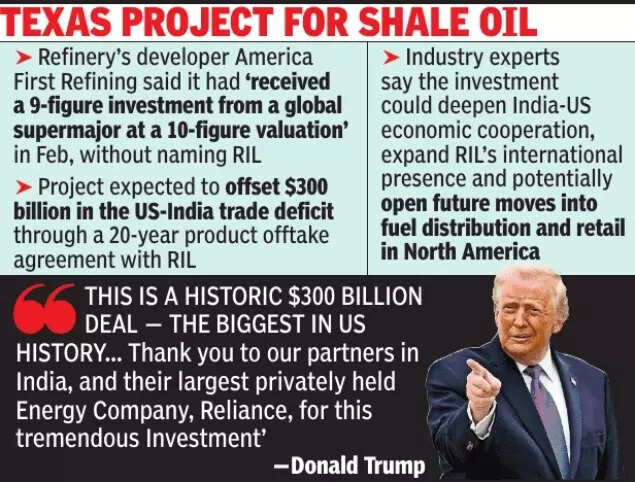
2) Refinery locationAFR said the proposed refinery will primarily process light shale crude sourced from the Permian Basin in west Texas.The firm added that the refinery will be located at a deepwater port, allowing refined fuels to be supplied to both domestic and international markets.3) ConstructionThe construction of the refinery is expected to begin in the second quarter of this year.4) Purchase agreementAFR also said that the same global supermajor had entered into a 20-year agreement to purchase the refinery’s output.According to AFR, the estimate is based on a long-term offtake agreement under which the global supermajor will purchase 1.2 billion barrels of shale oil valued at around $125 billion. The arrangement also covers the sale of nearly 50 billion gallons of refined petroleum products, including gasoline, diesel and jet fuel, estimated to be worth about $175 billion. 5) Trade SurplusThe project could also help reduce India’s trade surplus with the United States, an issue that has previously drawn criticism from Trump. Taken together, these deals are expected to improve the United States’ trade balance by roughly $300 billion, AFR said.6) InvestmentAnalysts pointed out that the equity investment in the refinery has been described as a “nine-figure” amount, indicating a commitment of several hundred million dollars. At the same time, the overall project valuation is said to be in the “ten-figure” range, suggesting the capital investment is likely to stay below $1 billion.7) RIL’s second greenfield investment outside IndiaThe proposed facility in Texas will be Reliance Industries’ second greenfield investment outside India. In 2021, the company had announced a partnership with Abu Dhabi National Oil Company (ADNOC) to develop a $2 billion petrochemicals plant in the UAE.8) RIL has world’s largest integrated refinery complexReliance Industries, which has a market capitalisation of ₹18.82 lakh crore ($204 billion), runs the world’s largest integrated refinery complex at a single site in Jamnagar, Gujarat. The facility has the highest crude processing capacity globally at 1.4 million barrels per day (mmbpd) and also holds the world’s highest complexity index of 21:1.This capability enables the company to convert even the heaviest grades of crude oil into high-quality petroleum products. 9) What it means for US & RILAlthough the US shale boom that began in the mid-2000s significantly increased the country’s oil output, limited refining capacity capable of processing the lighter crude produced has meant that a substantial portion has been exported abroad.Between 2014 and 2024, the United States exported close to 10 billion barrels of crude oil while continuing to import around 28 billion barrels, a trend that has cost American consumers and workers more than $1.8 trillion, according to AFR.“The US has a surplus of light shale oil but a shortage of refining capacity designed to process it,” said Trey Griggs, president of AFR. “Building this refinery will unlock a major expansion of American energy production.”“Once operational, the AFR refinery will redirect up to 60 million barrels of US crude annually back into domestic refining—strengthening American industry, energy security and economic growth,” AFR said,People familiar with the matter told ET that Reliance Industries may hold a 50.39% stake in the refinery project.“Capex could be higher if associated petrochemical facilities are planned for a project of this magnitude,” JP Morgan said in a report on the development. “Given the size, it is likely that Reliance would engage with local partners and, assuming a stake of 50% with a 30-70% equity-debt funding mix, we estimate RIL’s implied equity investment could be $10 billion.”One analyst said the investment could serve as a way for the company to diversify its exposure beyond the Gulf region through US shale assets. 10) Strengthening economic tiesIndustry experts said the project could strengthen economic ties between India and the United States. M S Banani, joint managing director of Axiom Gas Engineering, a fuel station developer, noted that Texas is among the most significant energy hubs in the world, hosting major companies such as ExxonMobil, Chevron, Shell and BP.“Establishing a refinery there provides direct access to crude supply and one of the largest fuel markets globally,” Banani said. “RIL has extensive experience in processing heavy and sour crude at its Jamnagar refinery complex, which gives it a strong technical advantage in refining diverse crude grades, including those available from regions such as Venezuela.”From a business standpoint, Banani added, the investment could give an Indian company an entry point into the US refining ecosystem and potentially open opportunities to expand into fuel distribution and retail operations in the future.“It reflects both the growing global presence of Indian industry and the strengthening strategic partnership between India and the US,” he told TOI.

Leave a Reply